This Swiss history timeline covers 50 moments, from Julius Caesar turning back the Helvetii in 58 BC to the neutrality vote of September 2026. You can filter every entry by era, or by one of five patterns that keep coming back. Each moment comes with a short explanation and, where we’ve covered it in depth, a link to the full story.
Why patterns? Because read as a list of dates, Swiss history looks like chaos: battles, splits, treaties, votes. Read by pattern, it suddenly makes sense. The same five moves repeat for more than 700 years. Once you see them, you’ll recognise them in the news.
Sources: Historical Dictionary of Switzerland, Swiss National Museum.
The five patterns behind every Swiss history timeline
I built this timeline around one idea. Switzerland's past is less a story of heroes than a story of habits. Here are the five that matter most.
1. Alliances and bridges
Switzerland began as a defence pact, not a nation. In 1291, three valleys promised to help each other, and other cantons joined one by one. The same instinct later built the Red Cross, the Gotthard tunnels and the Schengen deal with Europe. The Swiss connect things. That's how a small country stays useful to big ones.
2. Shocks from outside
Scan the Swiss history timeline for turning points, and many were not Swiss choices at all. Caesar, the Habsburgs, Napoleon and Hitler all forced change from outside. Even Swiss neutrality grew out of a crushing defeat in 1515 and a deal among great powers in 1815.
3. Splits, then compromise
The Swiss fight among themselves more often than visitors assume. Catholics and Protestants went to war four times. Basel split in two, and so did Appenzell. Even so, almost every split ended in a compromise that let both sides keep their pride. The short Sonderbund War of 1847 is the classic case.
4. The people decide
From 1874 onwards, Swiss citizens gained the right to veto laws and propose new ones. Since then, many of the biggest turns, from the UN to women's suffrage, came through the ballot box. Our guide to Swiss direct democracy explains how the system works.
5. Dark chapters
Finally, a pattern most timelines leave out. Swiss history includes crushed peasant revolts, an antisemitic first initiative, Nazi gold and a CIA front company. I've included these moments on purpose. A Swiss history timeline without them would be a brochure, not history.
The interactive Swiss history timeline: 50 moments
Use the buttons to filter this Swiss history timeline by pattern or era, or search for a name or year. Every entry stays on the page, so you can also simply scroll.
Before 1291
- 58 BCShocks from outside
Caesar turns back the Helvetii
The Celtic Helvetii try to migrate west. Julius Caesar defeats them at Bibracte and sends them home. Their name lives on in “Helvetia”.
- 1191Alliances and bridges
Bern is founded
Duke Berthold V of Zähringen founds Bern. Legend says he named it after the first animal he killed on a hunt: a bear. How Bern became the federal city →
1291–1513: the old Confederacy
- 1291Alliances and bridges
The Federal Charter
In early August, Uri, Schwyz and Unterwalden seal an alliance for mutual help. Much later, it becomes Switzerland's founding myth. Was William Tell real? →
- 1315Shocks from outside
Battle of Morgarten
Men from Schwyz ambush a Habsburg army by a lake and a steep slope. The small alliance survives its first big test.
- 1353Alliances and bridges
Eight places
Lucerne, Zurich, Glarus, Zug and Bern have all joined. The “Eight Old Places” form the core of the Confederacy. The 26 Swiss cantons →
- 1386Shocks from outside
Battle of Sempach
The Confederates defeat Austria again. Duke Leopold III dies on the battlefield.
- 1476Shocks from outside
Grandson and Murten
The Swiss crush Charles the Bold of Burgundy twice in one year. He dies at Nancy in 1477, and Swiss infantry becomes Europe's most feared.
- 1481Splits, then compromise
The Stans Agreement
Town and country cantons nearly go to war over power and loot. A compromise, reportedly helped by the hermit Niklaus von Flüe, lets Fribourg and Solothurn join.
- 1499Shocks from outside
The Swabian War
After victory over the Holy Roman Empire, the Confederacy is independent in all but name.
- 1513Alliances and bridges
Thirteen cantons
Appenzell joins, completing the old Confederacy of 13 cantons. It stays that size until 1798.
1515–1797: faith and mercenaries
- 1515Shocks from outside
Defeat at Marignano
France breaks the Swiss army near Milan. The Swiss give up conquest, though their men keep fighting as mercenaries. The history of Swiss mercenaries →
- 1523Splits, then compromise
Zwingli's Reformation
Zurich breaks with Rome under Ulrich Zwingli. The Confederacy splits into Catholic and Protestant camps.
- 1531Splits, then compromise
Second War of Kappel
Zwingli dies in battle. The peace lets each canton choose its own faith, a template for Swiss coexistence.
- 1541Alliances and bridges
Calvin returns to Geneva
John Calvin turns Geneva into the “Protestant Rome”. The city is only an ally, not yet a canton.
- 1597Splits, then compromise
Appenzell splits in two
Catholic Innerrhoden and Protestant Ausserrhoden go separate ways. The two half-cantons still exist today. Why half-cantons exist →
- 1648Alliances and bridges
Peace of Westphalia
Basel's mayor Wettstein wins formal exemption from the Holy Roman Empire. Switzerland is legally independent.
- 1653Dark chapters
The Peasants' War
Farmers rise against the ruling cities over taxes and debt. The revolt is crushed, and its leaders are executed.
- 1712Splits, then compromise
Second Villmergen War
The last religious war tips the balance to the Protestant cities of Zurich and Bern.
- 1792Dark chapters
Massacre at the Tuileries
Swiss Guards die defending Louis XVI in Paris. The Lion of Lucerne later honours them. The Swiss mercenaries →
1798–1848: revolution to federal state
- 1798Shocks from outside
French invasion
France invades, loots Bern's treasury and creates the Helvetic Republic. Its first capital is little Aarau. Switzerland's forgotten capitals →
- 1803Shocks from outside
Napoleon's Act of Mediation
Napoleon restores the cantons and adds six new ones, including Vaud, Ticino and Graubünden.
- 1815Alliances and bridges
Neutrality recognised
After Napoleon's fall, the great powers recognise Swiss “perpetual neutrality”. Valais, Neuchâtel and Geneva join. Why is Switzerland neutral? →
- 1833Splits, then compromise
Basel splits
After armed clashes, the countryside breaks away from the city. Basel becomes two half-cantons.
- 1847Splits, then compromise
The Sonderbund War
A 26-day civil war between liberal and Catholic conservative cantons. Fewer than 100 people die. The Sonderbund War →
- 1848Splits, then compromise
The federal state
A new constitution creates modern Switzerland. Bern becomes the federal city, not a capital. Why Bern is not officially the capital →
Halfway through the Swiss history timeline, the federal state is born. From here on, the people start to vote.
1849–1913: the modern state
- 1863Alliances and bridges
The Red Cross
Henry Dunant and General Dufour help found the International Committee of the Red Cross in Geneva.
- 1874The people decide
The optional referendum
A revised constitution lets 30,000 citizens challenge new federal laws. Direct democracy gets its veto. How Swiss direct democracy works →
- 1882Alliances and bridges
The Gotthard rail tunnel
The 15-kilometre tunnel opens after a decade of work that cost the lives of about 200 workers. Europe's north and south are linked.
- 1891The people decide
The popular initiative
Citizens gain the right to propose changes to the constitution. The same year, 1 August is celebrated nationally for the first time.
- 1893Dark chapters
A dark first
The first initiative ever accepted bans kosher slaughter. It targets Switzerland's small Jewish community.
1914–1945: the world wars
- 1917Shocks from outside
The Hoffmann affair
A Swiss minister is caught working on a separate peace between Germany and Russia. He resigns. Swiss neutrality under pressure →
- 1918Splits, then compromise
The general strike
About 250,000 workers strike and the army is sent in. The 48-hour week follows within a year. Women's suffrage, another demand, takes 53 more years.
- 1920Alliances and bridges
League of Nations
Voters approve membership with 56.3%, and Geneva becomes the League's home.
- 1934Dark chapters
Bank secrecy becomes law
The Banking Act makes it a crime for bankers to reveal client information. Switzerland and Nazi gold →
- 1938Dark chapters
The J-stamp
At Swiss request, Germany marks the passports of Jewish citizens with a “J”. It makes turning refugees away easier. The uncomfortable truth →
- 1940Shocks from outside
The Réduit
Swiss pilots shoot down German aircraft, then pull back. General Guisan announces the Alpine Réduit strategy. Were Swiss bridges rigged to blow? →
1946–1989: the Cold War
- 1947The people decide
The state pension
Voters approve the AHV old-age pension with about 80% yes. It remains the backbone of Swiss social security.
- 1959Splits, then compromise
The magic formula
The four main parties begin sharing the seven seats of the Federal Council. The deal holds for decades. Does Switzerland have a president? →
- 1963Shocks from outside
Bunkers for everyone
A new law makes nuclear shelters standard in Swiss homes. The Swiss bunker law →
- 1970Dark chapters
The Crypto AG secret
The CIA and West German intelligence secretly buy a Swiss encryption firm and spy on its customers for decades. Crypto AG and the CIA →
- 1971The people decide
Women get the vote
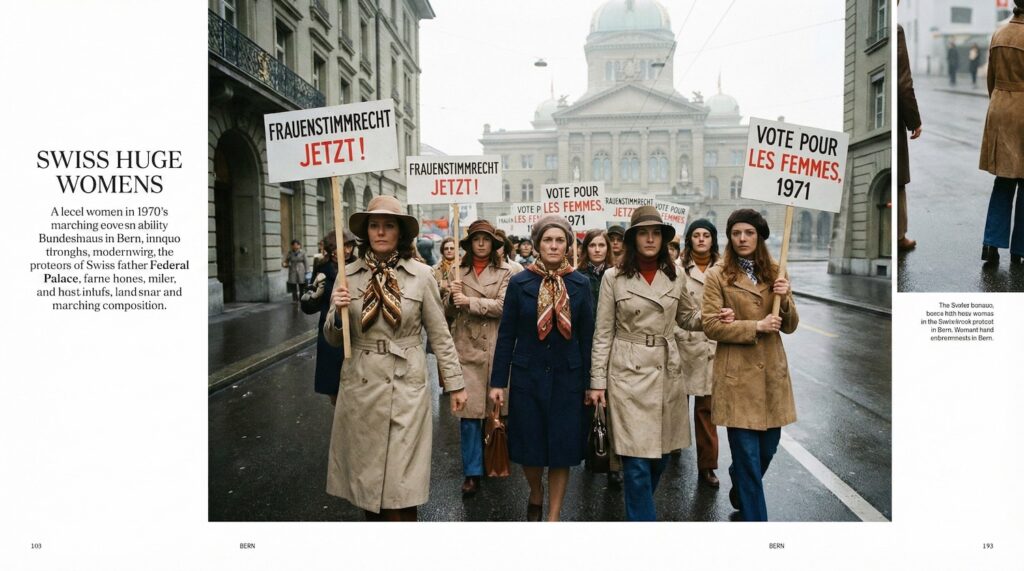
Swiss men finally approve women's suffrage with 65.7%. It comes 53 years after Germany. Swiss women's suffrage →
- 1979Splits, then compromise
Jura becomes a canton
After decades of conflict with Bern, the French-speaking north Jura becomes Switzerland's newest canton. The 26 Swiss cantons →
- 1986The people decide
No to the UN
Voters reject UN membership by 75.7%, fearing for neutrality.
1990–today
- 1992The people decide
No to the EEA
The European Economic Area fails by about 24,000 votes, and the language regions split sharply. Is Switzerland in the EU? →
- 1996Dark chapters
The Bergier Commission
Pressure over dormant Holocaust-era accounts leads to an expert inquiry. Swiss banks settle for $1.25 billion in 1998. Switzerland and Nazi gold →
- 2002The people decide
Yes to the UN
Switzerland joins the United Nations by popular vote, the only country ever to do so.
- 2008Alliances and bridges
Schengen
Routine passport checks at land borders end as Switzerland joins the Schengen area. Switzerland and Europe →
- 2016Alliances and bridges
The Gotthard Base Tunnel
The world's longest rail tunnel, at 57 kilometres, opens under the Alps.
- 2022Shocks from outside
Sanctions on Russia
After the invasion of Ukraine, Switzerland adopts EU sanctions. Moscow calls it no longer neutral. Is Switzerland still neutral? →
- 2026The people decide
Moutier and the neutrality vote
Moutier moves from Bern to Jura on 1 January. On 27 September, about 70% of voters reject a strict neutrality initiative. What the 2026 vote decided →
That is the end of this Swiss history timeline, for now. The next vote will add another moment.
No moments match. Try another filter.
Which pattern dominates Swiss history?
Count the entries in the Swiss history timeline, and an interesting picture appears. Shocks from outside and alliances tie for first place. Splits followed by compromise come a close third. The people decide in eight moments, nearly all of them since 1874. Dark chapters appear seven times.
How often each pattern appears in our 50 moments
So what does that tell us? In my view, the Swiss history timeline shows that the Swiss rarely chose their turning points. Outsiders usually forced them. What made Switzerland different was the response. Instead of a strong ruler, it reached for an alliance, a compromise or, later, a vote.
Of course, the selection is mine, and another historian would build a different Swiss history timeline. Still, I'd bet the shape would stay roughly the same.
Swiss history in eight eras
If you prefer a story to a list, here is the same Swiss history timeline told in eight short chapters. Each chapter matches one of the era filters above.
Before 1291: Helvetii, Romans and a bear town
Celtic Helvetii lived on the Swiss plateau before Rome arrived. After Caesar defeated them in 58 BC, the region became part of the Roman world for centuries. Later, the land passed to Burgundians and Alemanni, then to the Holy Roman Empire. Towns like Bern, founded in 1191, grew under noble families such as the Zähringen.
1291 to 1513: the old Confederacy
On any Swiss history timeline, this is the heroic age. The early alliance of Uri, Schwyz and Unterwalden survived the battles of Morgarten in 1315 and Sempach in 1386. Cities such as Zurich and Bern joined, and Swiss infantry became the terror of Europe. By 1513, the Confederacy counted 13 cantons.

The charter above is the document that later became the symbol of the whole story. Here's the twist, though: it only became the official founding document in 1891, six centuries after it was written.
1515 to 1797: faith, mercenaries and the patricians
After the defeat at Marignano, the Swiss stopped conquering but kept selling soldiers abroad. Then the Reformation split the country into Catholic and Protestant camps. Meanwhile, a few powerful families ran the cities, while rural subjects had little say. That tension exploded in the Peasants' War of 1653.
1798 to 1848: revolution to federal state
French armies ended the old order in 1798. Napoleon then redrew the map, and the Congress of Vienna fixed the borders and recognised neutrality in 1815. Three decades of conflict followed, ending in the brief civil war of 1847. The constitution of 1848 created the modern federal state.
1849 to 1913: railways, Red Cross and referendums
This is when modern Switzerland took shape, and when the Swiss history timeline speeds up. The Red Cross was founded in Geneva in 1863. The Gotthard rail tunnel opened in 1882. Above all, citizens gained the referendum in 1874 and the popular initiative in 1891.
1914 to 1945: the world wars
Switzerland stayed out of both world wars, but not out of trouble. The language regions split in sympathy during the First World War, and a general strike shook the country in 1918. During the Second, Switzerland built the Alpine Réduit, shot down German aircraft in 1940 and traded with Nazi Germany. See our deep dive on Switzerland and Nazi gold for the uncomfortable side.
1946 to 1989: the Cold War
The post-war years brought prosperity, the state pension and the "magic formula" for sharing government. They also brought bunkers in every home and a secret that only surfaced in 2020: Crypto AG. Women finally won the national vote in 1971, and Jura became a canton in 1979.

1990 to today: Europe, money and memory
The last chapter of the Swiss history timeline is about Europe and the past. Voters rejected the EEA in 1992, yet approved close ties with the EU later. The dormant-accounts scandal forced a hard look at the war years. In 2026, Moutier changed canton by vote, and voters rejected a strict neutrality initiative.
Three myths this Swiss history timeline corrects
Laying everything out in order exposes a few stories that don't survive contact with the dates. Here, the Swiss history timeline works like a lie detector.
Myth 1: "Switzerland was founded in 1291"
The 1291 alliance was real. However, it created no state, and it was one of many local pacts. Switzerland as a federal state dates from 1848. Moreover, 1 August only became a national celebration in 1891, and a federal public holiday in 1994. Any honest Swiss history timeline has to say so. The legend of William Tell grew around the same story.
Myth 2: "Switzerland has always been neutral"
Not even close, as the Swiss history timeline above shows. Until 1515, the Confederacy was an aggressive military power. For three more centuries, Swiss mercenaries fought in other people's wars. Neutrality only became international law in 1815.
Myth 3: "Switzerland is the world's oldest democracy"
The Swiss do have one of the oldest systems of direct democracy. But for most of history, only men voted. Women won the national vote in 1971, and the last canton gave in only in 1991. So the claim depends heavily on who counts as "the people". On this Swiss history timeline, full democracy arrives surprisingly late.
Test yourself: which came first?
Think you've got the Swiss history timeline straight now? Try these six pairs. Even history buffs usually miss one.
Which came first? Six pairs from Swiss history
Score: 0 / 6Which came first: the Federal Charter or the Battle of Morgarten?
The Federal Charter, in 1291. Morgarten followed in 1315.
Which came first: the Red Cross or the federal constitution?
The federal constitution, in 1848. The Red Cross followed in 1863.
Which came first: women's suffrage or Swiss UN membership?
Women's suffrage, in 1971. UN membership only came in 2002.
Which came first: the Gotthard rail tunnel or the popular initiative?
The Gotthard tunnel, in 1882. The popular initiative arrived in 1891.
Which came first: Jura's new canton or the EEA vote?
Jura, in 1979. The EEA vote followed in 1992.
Which came first: Bank secrecy law or the League of Nations?
The League of Nations, in 1920. The Banking Act followed in 1934.
Where to see Swiss history in person
If this Swiss history timeline makes you want to travel, a few places bring the dates to life:
- Schwyz: the Museum of the Swiss Charters displays the 1291 Federal Charter.
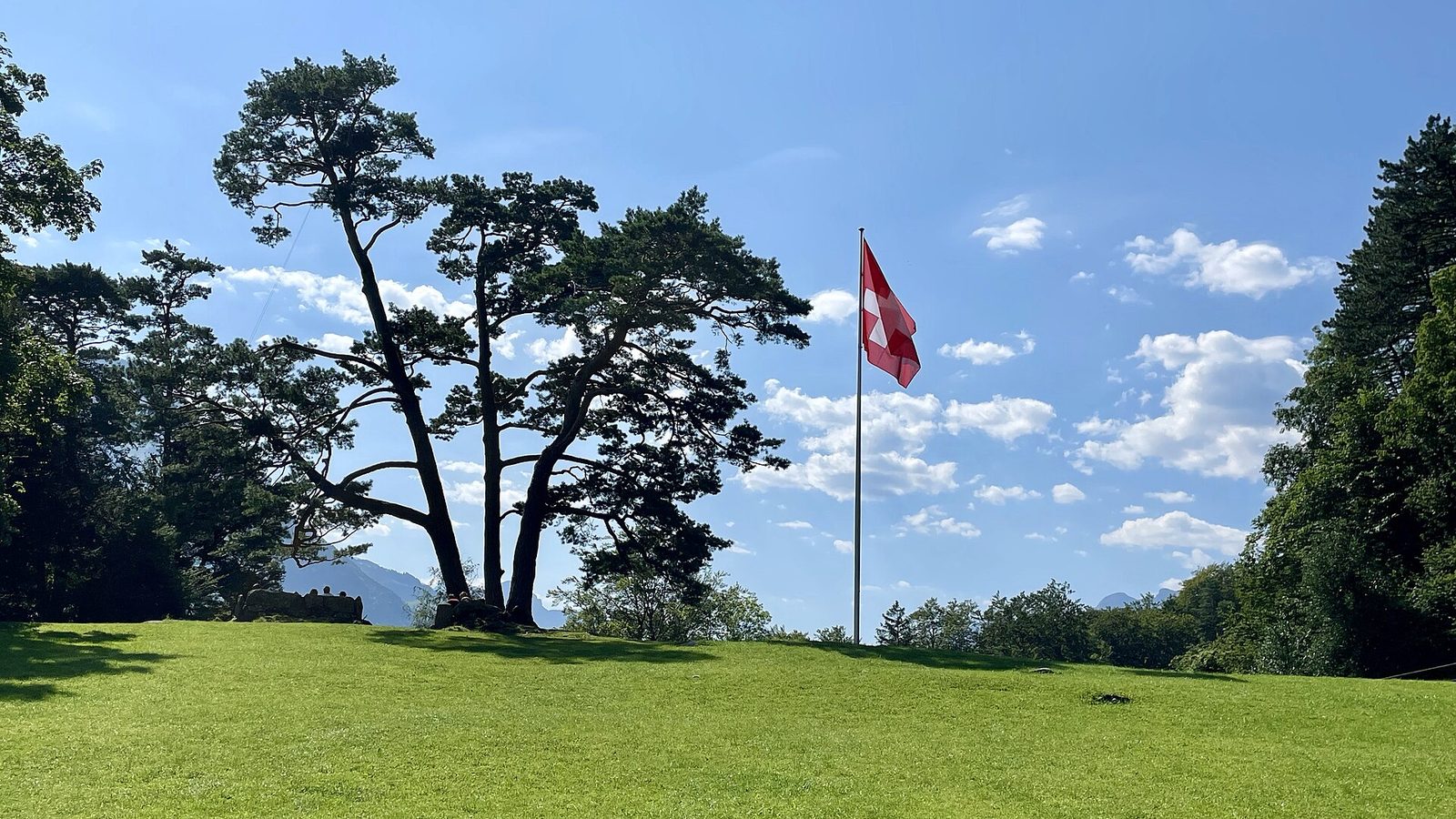
- Rütli meadow: this field above Lake Lucerne links the founding legend to General Guisan's speech of 1940.
- Lucerne: the Lion Monument honours the Swiss Guards killed in Paris in 1792.
- Zurich: the Swiss National Museum covers the widest sweep of Swiss history under one roof.
- Bern: the Federal Palace is the seat of power in a country with no official capital of Switzerland.
For more ideas, see our guides to the cultural treasures of Switzerland and the 26 Swiss cantons.
FAQ: Swiss history timeline
When was Switzerland founded?
It depends on what you mean. The traditional date is 1291, when Uri, Schwyz and Unterwalden sealed their alliance. However, modern Switzerland as a federal state was founded in 1848, with its first federal constitution.
How old is Switzerland?
Measured from the 1291 alliance, the Swiss Confederacy is more than 730 years old. Measured from the federal state of 1848, modern Switzerland is about 178 years old.
Why is 1 August the Swiss National Day?
The Federal Charter of 1291 is dated to early August. The date was chosen for national celebrations in 1891, the 600th anniversary. Since 1994, 1 August has been a federal public holiday.
Has Switzerland ever been at war?
Yes, many times before 1815, and in several civil and religious wars at home, the last in 1847. Switzerland has not fought a foreign war since 1815, although it mobilised its army in both world wars.
When did Switzerland become neutral?
Gradually. The Swiss stopped conquering after 1515, but their neutrality only gained international recognition in 1815, after the Congress of Vienna.
What is the most important date in Swiss history?
Many historians would say 1848. That year, the federal constitution created the modern state, the federal parliament and the system that still governs Switzerland today.
Sources and further reading
- Historical Dictionary of Switzerland (HDS)
- Museum of the Swiss Charters of Confederation, Schwyz
- Swiss National Museum, Zurich
- Swiss National Museum blog: How Berne became the seat of government
- swissinfo.ch: How the UN “Swiss paradox” was resolved
- Fedlex: Federal Constitution of the Swiss Confederation
Last updated 2 October 2026. Featured photo: Parpan05, Wikimedia Commons, CC BY-SA 4.0.