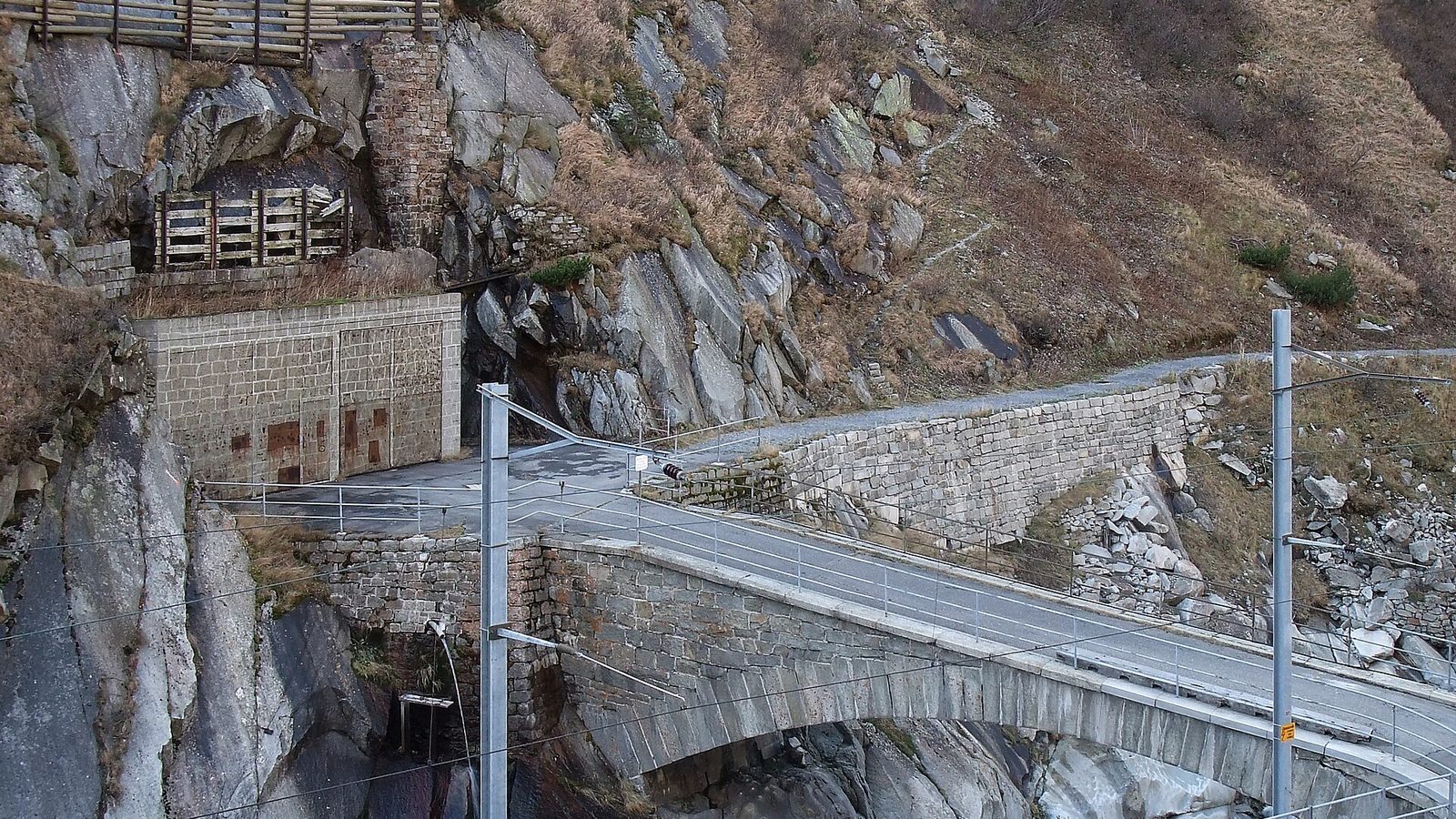
On Sunday, 28 January 1940, a train loaded with 88 tonnes of gold set off down the Schöllenen gorge. The rack railway was painfully slow, and the crew had to shovel fresh snow off the line. Its cargo came from Fort Bühl, an artillery fort at Andermatt that sits right above the Gotthard rail tunnel. The historian Ludo Groen pieced that journey together from the Swiss National Bank’s archives, and it is a good place to start the story of Swiss mountain gold vaults.
In 1938, the Swiss National Bank (SNB) finished a gold depot inside Fort Bühl, built to hold around 1 billion francs. At the time, that was roughly 200 tonnes of gold. Once war broke out, General Henri Guisan had much of it spread across other mountain sites, and by 1940 he had made the Alps the heart of Swiss defence.
Eight decades on, the mountains still guard gold, but much of it now belongs to private clients. After the Cold War, the army emptied its bunkers, and a handful became private vaults. Here is how a central bank’s emergency plan turned into a business, what non-bank gold storage in Switzerland really means today, and what it costs. A calculator further down does the sums for you.
Sources: Ludo Groen (Journal of Contemporary History; Mountains of Gold, 2026), ETH Zurich, Sarteri, Bloomberg via Le News.
Why the Swiss National Bank hid its gold in the mountains
In the mid-1930s, Europe was arming fast, and the gold the SNB kept at home sat in two city vaults, in Bern and Zurich. Both were easy targets. So the SNB's chief treasurer, Erich Blumer, started doing sums. In 1936, he worked out that evacuating the reserves from Bern alone would need 67 lorries, for 22,000 gold bars, 12,000 bags of coins and the banknotes.
The obvious answer was to put the gold where an invader would struggle to follow. That idea is the seed of today's Swiss mountain gold vaults. Offers soon arrived. The Jungfrau Railway, for instance, suggested its Eismeer station, a gallery cut into the Eiger at 3,161 metres. The bank turned it down. Guarding a vault on a mountain face would have been too expensive and impractical.
Instead, the SNB chose a site the army already guarded. Switzerland had been fortifying the Gotthard since 1886, soon after the rail tunnel opened in 1882. Fort Bühl, built in 1892, guarded the northern approach at Andermatt. The bank completed its gold depot there in 1938 and moved two-thirds of its gold into it, with a colonel named Hans Possert in charge of planning and supervision.
That choice made practical sense, and it also carried a message. The Gotthard was the old heart of the Confederation, the place where Swiss myths and Swiss engineering meet. Our story of the Gotthard Base Tunnel explains why this one mountain matters so much to the country.

The route up: snow, lorries and a rack railway
Moving gold into the Alps was less glamorous than it sounds. The SNB's convoys were usually two to four lorries with five or six men. With the bank's three-tonne trucks, a single delivery could carry up to 50 million francs in gold, so even a big transfer took many trips.
Each run left a paper trail, because this was still a Swiss bank. One receipt from May 1940, for example, shows 62 francs in expenses for a gold transport from Bern to Interlaken, including lunch for two drivers and five carriers. Secrecy, however, mattered more than thrift. Journalists, tourists and spies all used the same roads.
Fort Bühl was the hardest place to reach. From the north, the only way into the Urseren valley is through the Schöllenen gorge, a granite canyon where the Reuss crashes beneath the Devil's Bridge. For the gold, that meant what Groen calls an "excruciatingly slow cog railway". According to his book, the transports ran in minus eleven degrees, through snowstorms and under the threat of avalanches.
The gold did not stay long. In November 1939, Guisan ordered 700 million of the billion francs in the Gotthard depot moved to Interlaken, as part of spreading the reserves across the Alps. Hence that snowy train in January 1940. Today the trip from Göschenen takes a few minutes. If you make it, imagine rack-railway wagons creeping through the gorge with a fortune aboard.
Guisan's Réduit: the fortress that already held the gold
In June 1940, France collapsed. Suddenly Germany, Italy and German-occupied France surrounded Switzerland. The army could not hope to hold the long northern border, so its commander, General Henri Guisan, chose another plan. On 12 July 1940, the army adopted the Réduit, or National Redoubt: troops would pull back into the Alps and turn the mountains into a fortress.
On 25 July, Guisan gathered his senior officers on the Rütli meadow to explain the strategy. Three fortress zones would anchor it: St-Maurice in the west, the Gotthard in the centre and Sargans in the east. Germany drew up invasion plans that summer, but it never carried them out. Our articles on the bridges rigged to blow and the camouflaged bunkers show how the army built the Réduit.
For the SNB, the Réduit confirmed a plan already under way. When the army moved into the mountains, the bank's gold was already there, at the Gotthard and in Interlaken. During the war, according to Groen, the bank moved new shipments into the mountains within days of their arrival.
There is an uncomfortable side to this, too. The depots began as protection against an enemy. As the reserves grew, the city vaults could no longer hold all the incoming metal, and the mountain stores helped Switzerland keep trading gold, including with Nazi Germany. We cover that record in Switzerland and Nazi gold.

A network of hidden gold depots
Fort Bühl was only the start. During the war, the SNB built a whole network of Swiss mountain gold vaults, from the foothills to the Réduit.
In Interlaken, one of six heavy-duty ammunition magazines became the bank's second gold depot. Two engineers, Ferdinand Rothpletz and Friedrich Lienhard, helped expand its tunnel for the gold, and Blumer travelled there from Bern once or twice a month. The bank also fitted bunkers into the cellar of Spiez Castle on Lake Thun.
The most surprising site was at Amsteg, in the canton of Uri. In July 1941, the government ordered a bunker there for the Federal Council, the Swiss cabinet, to use if the army retreated into the Réduit. When Blumer inspected its strongroom in 1942, he found it too damp and its doors too weak. Even so, the SNB kept gold bars and coins in the bunker's vehicle garage from 1941 to 1945.
The commercial banks made plans of their own. The Union Bank of Switzerland rented the Gstaad Palace and planned a vault under its sun terrace, while Credit Suisse bought a run-down hotel in Interlaken as an evacuation site. Not every hotel plan went ahead. Explore every site on the map below.
Where Switzerland hid its gold, then and now
Gold circles mark wartime gold depots and bank plans, blue ones bunker vaults today, green ones fortresses you can visit. Tap a circle.
Switzerland
Gotthard close-up
Positions are approximate. Exact locations of private vaults are not public; markers show the village or massif named in published reports.
Goldfinger's neighbours: gold in the Cold War
In 1964, James Bond came to the Gotthard region. The crew shot several scenes of Goldfinger on the Furka Pass road, just west of Andermatt. According to Groen, the petrol station where Bond stops his Aston Martin was close to the Gotthard depot, where the SNB still kept 19,845 gold bars. Neither the film crew nor the audience had any idea.
Throughout the Cold War, the mountains stayed central to Swiss defence planning. By 1945, the country had already spent an estimated 8 billion francs on bunkers, at 2008 prices. The franc, for its part, remained legally tied to gold, even after the 1970s had turned it into the world’s favourite safe-haven currency. For many years the SNB held about 2,590 tonnes, one of the largest official reserves in the world, and the tie only ended in 2000, after voters approved a new constitution in 1999.
Selling the gold, and a vote to keep it
The bank then sold 1,300 tonnes between 2000 and 2005 and another 250 tonnes in 2007 and 2008. Since then, it has held 1,040 tonnes. In 2013, it revealed that it keeps about 70% in Switzerland, 20% at the Bank of England and 10% at the Bank of Canada. It has never said where the Swiss share lies.
Not everyone liked the sales. In 2014, an initiative demanded that the SNB hold at least 20% of its assets in gold, never sell any and bring all of it home. Voters rejected it by 77.3% on 30 November 2014. The vote showed a very Swiss instinct: gold is a symbol, but it is not a strategy. Our pieces on Swiss banking secrecy and why Switzerland is so rich follow the money further.
From Fort Bühl to today
Swiss National Bank gold, in tonnes. Tap a bar for details.
Sources: Swiss National Bank, BullionStar, ETH Zurich. The 1938 figure is an estimate.
From army bunkers to private gold vaults
The end of the Cold War emptied the mountains. In 1995, the Army 95 reform cut troop numbers by a third, to 400,000, and from the mid-1990s it vacated and declassified most of its fortresses and bunkers. Over the next two decades, the army sold many of them to private buyers. Cheese makers, mushroom farmers, museums, a hotel and data companies moved in.
Only a few became Swiss mountain gold vaults, or Gotthard bunker gold storage of any kind. In 2016, the Swiss defence department told Bloomberg that about ten former bunkers were storing gold and computer data. The popular idea of dozens of gold-filled caverns is, in other words, an exaggeration.
Amsteg: from cabinet bunker to private vault
Amsteg is the best example. Dolf Wipfli, an engineer from Uri, heard in 1995 that the army was selling bunkers, and his company, Swiss Data Safe, bought the old Federal Council shelter in the late 1990s. Getting the permits took years. By 2006, it held data, archives, art, precious metals and gemstones. In 2017, swissinfo reported that the bunker belonged to Swiss Gold Safe, which stores valuables there. So the vault where the SNB once kept wartime gold now holds private wealth.
Further down the valley, at Attinghausen, work on an army command bunker started in 1948. In 2011, the newly founded Deltalis turned it into a data centre, but the company left the colocation business in 2018.
The supply has now dried up. On 18 September 2023, army chief Thomas Süssli announced that Switzerland would stop selling its bunkers, as the war in Ukraine revived interest in defence. New private vaults are therefore being dug from scratch. Near Lungern, Brünig Mega Safe is building about 20 caverns under more than 100 metres of rock in the Brünig massif. In August 2026, swissinfo reported that work was well advanced and the vaults were due to open in 2027.
Non-bank gold storage in Switzerland: how it works
Why would anyone choose Swiss mountain gold vaults over a bank? The usual answer is trust. Ludwig Karl, the chief operating officer of Swiss Gold Safe, told CNBC in 2025 that the company's clients "have lower trust in government or financial systems". Behind that feeling sits a real legal difference.
At a bank, you can hold gold in three ways. A metal account is just a claim on the bank: St. Galler Kantonalbank, for one, warns that if the bank fails, the account becomes part of the bankruptcy estate. Physical custody means you own specific bars held in your custody account. A safe-deposit box means you own whatever is inside, while the bank simply rents you the space.
Non-bank gold storage in Switzerland works through a storage contract under the Swiss Code of Obligations. The vault keeps your bars separately, records them in your name and returns the same pieces to you. Because they remain your property, they are not part of the vault company's assets if it goes bust.
There are also practical points. Investment gold is exempt from Swiss VAT, but silver, platinum and palladium carry 8.1% unless they stay under customs bond, which is why many vaults offer bonded storage for those metals. The largest bonded store in the country is the Geneva Freeport, whose history goes back to 1849. Vault companies are not banks, so FINMA does not supervise them the way it supervises banks. Finally, a box in a vault is not a bank account, but that doesn't change your duty to declare wealth where you are tax-resident.
Calculator: what would your gold cost to store?
Swiss mountain gold vaults rarely publish prices, and storage fees vary more than most people expect. The calculator turns francs into kilos and bars, then compares published fees for each type of storage. Planning to store more than 50,000 francs outside the banking system? Pick that option to jump to the list of operators.
Swiss non-bank bullion and bunker storage calculator
See how much gold your money buys and what storing it costs.
- Bank safe-deposit boxYour bars, the bank’s box––
By size, not value: CHF 97–1,038 a year at Zürcher Kantonalbank (2024). Limited bank liability for contents.
- Bank metal account (unallocated)A claim on the bank, not bars––
0.20–0.30% a year, minimum CHF 50 (BCV, St. Galler Kantonalbank). If the bank fails, it joins the bankruptcy estate.
- Bank custody of physical barsYour own bars, held by the bank––
Example: BCV, 0.42% up to CHF 2 million, minimum CHF 60, plus CHF 200 per deposit and VAT for Swiss residents.
- Non-bank vault, allocatedYour own bars, under a storage contract––
Published rates: 0.12% (BullionVault) to 1% (SwissBullion.eu) a year, with monthly minimums, usually insured.
Alpine bunker vaults: prices on request, often with high minimums.
Estimates based on published fees, checked in October 2026. General information, not financial, legal or tax advice. You may still have to declare gold where you are tax-resident.
Who runs non-bank vaults in Switzerland?
If you want to store gold outside the banking system, these are the main types of operator: security and logistics groups, specialist Alpine vaults and dealers with their own storage. We list them in no particular order, and we have no commercial relationship with any of them.
- Swiss Gold Safe Segregated storage outside banks since 2006, bonded storage for silver and platinum, and safe-deposit boxes. Reported owner of the Amsteg bunker.
- Swiss Data Safe Vaults for precious metals and valuables in former army command bunkers at Amsteg.
- Loomis Security group with Swiss vaults; Loomis International stores and ships metals for private clients.
- Malca-Amit Logistics and vaulting company with a Zurich facility, serving banks and wealthy clients.
- BFI Bullion Allocated, segregated storage outside the banking system; the globalgold.ch address now leads here.
- VON GREYERZ Storage outside banks in Zurich and Singapore from CHF 500,000, and in a “Swiss Mountain Vault” from CHF 5 million.
Not ranked, and no fees or commissions involved. Read each storage contract, insurance policy and audit report before you sign.
Questions to ask any vault before you sign
A bunker makes a good story, but a contract makes good storage. Before choosing any vault, in a mountain or at an airport, get clear answers to these questions:
- Is my metal allocated and segregated, and will I get a bar list with serial numbers, weights and refiners?
- Who owns the vault, and what happens to my bars if the operator goes bankrupt?
- Who is the insurer, what is the limit, and what does the policy exclude? Many policies exclude war, terrorism and nuclear risks.
- Who audits the holdings, how often, and can I see the report?
- Can I visit, inspect my bars, or send my own auditor?
- What does it cost to leave, including withdrawal, transport and any re-assay?
- If I store silver or platinum, does the vault keep it under customs bond?
- Which documents do you need from me? Serious operators will ask for identification and proof of where the money came from.
These questions apply to Swiss mountain gold vaults as much as to airport warehouses. Any operator who is vague about the first four points is telling you something important.
Timeline: gold in the Alps from 1886 to 2026
These are the moments that turned the mountains into a vault.
From fortress to vault
Tap a date, or use the arrow keys. Red dots mark the turning points.
Guarding the tunnel
Four years after the Gotthard rail tunnel opens, work begins on forts to protect it.
Fort Bühl
The army builds an artillery fort at Andermatt, at the top of the Schöllenen gorge.
Doing the sums
SNB treasurer Erich Blumer finds that an evacuation from Bern would need 67 lorries.
Gold into the mountain
The SNB completes its gold depot at Fort Bühl, sized for about 1 billion francs.
Gold on the move
On Guisan’s orders, a rack-railway train takes 88 tonnes of gold out of the Gotthard depot.
The Réduit
The army adopts Guisan’s Alpine plan on 12 July. He presents it on the Rütli on 25 July.
A cabinet bunker
Work starts at Amsteg. The SNB keeps gold in its garage until 1945.
Goldfinger
A Bond film crew works near a depot still holding 19,845 SNB gold bars.
A smaller army
The Army 95 reform cuts troops to 400,000, and bunkers empty out.
Gold and the franc part ways
The legal link ends. The SNB sells 1,550 tonnes by 2008.
Voters say no
77.3% reject a plan to force the SNB to hold 20% of its assets in gold.
No more bunker sales
Army chief Thomas Süssli stops the sale of bunkers.
The archives open
Historian Ludo Groen publishes Mountains of Gold.
Where to see the Gotthard fortresses today
You can't visit a working gold vault, but you can walk through the fortresses that once guarded the gold route.
- Sasso San Gottardo: built in 1941–45 on the Gotthard Pass for the Réduit, in service until the end of 1998 and open to visitors since 2012. Its tunnels show how the army planned to live and fight inside the mountain.
- Forte Airolo: the first of the Gotthard forts, completed in 1890 above Airolo, at the southern end of the rail tunnel. It is now a museum.
- Fort Bühl, Andermatt: where the SNB opened its first Gotthard gold depot. It is not a museum and not normally open to the public, but the road and railway from Göschenen pass close by.
- The Schöllenen gorge and the Devil's Bridge: the route every gold convoy had to climb. Walk it in summer and look for the fortified doors in the rock.

The Gotthard Pass road usually closes from late autumn to late spring, so check opening dates before you go. For more on bunkers hidden in plain sight, see our guide to the Swiss nuclear bunker law.
Quiz: true or false?
True or false? Six facts about Swiss mountain gold vaults
Score: 0 / 6The Swiss National Bank’s first Gotthard gold depot was inside Fort Bühl at Andermatt.
True. The SNB completed the depot in 1938, sized for around 1 billion francs.
SNB gold once sat in the Eismeer station, high inside the Eiger.
False. The Jungfrau Railway offered it, but the SNB turned it down as too costly to guard.
In 2014, Swiss voters forced the SNB to hold 20% of its assets in gold.
False. 77.3% voted no, and every canton rejected the initiative.
A gold account at a bank always means you own specific bars.
False. A metal account is a claim on the bank. Only allocated, segregated storage gives you title to specific bars.
Investment gold is exempt from Swiss VAT, but silver is not.
True. Silver, platinum and palladium carry 8.1% VAT unless they stay under customs bond.
The Swiss army still sells its old bunkers to private buyers.
False. Army chief Thomas Süssli halted the sales in September 2023.
What Swiss mountain gold vaults say about Switzerland
The gold in the Alps tells a familiar Swiss story. A small country without an army big enough to win a war decided to make itself too costly to attack. It then put its wealth where that defence was strongest.
That logic has outlived the threat. The SNB no longer needs Fort Bühl, and the army has stopped selling its bunkers. Still, private clients from around the world pay to keep their bars inside Swiss granite, because the mountains promise something that a bank statement can't: a place that feels beyond the reach of crises.
That promise deserves a careful look, however. A vault is only as good as its contract, its insurer and its owner. Moreover, the history of these depots includes gold that Switzerland should never have accepted. As our story of Swiss neutrality shows, the country's safety has often depended on being useful to everyone. The mountain vaults are that idea, carved into rock, and they are not going anywhere.
FAQ: Swiss mountain gold vaults
What are Swiss mountain gold vaults?
They are high-security stores for gold and other valuables inside the Alps. The Swiss National Bank built the first ones from 1938, in army forts and ammunition tunnels. Since the 1990s, private companies have bought a handful of former army bunkers and turned them into vaults for clients’ gold, art and data.
Is gold stored in the Gotthard?
It was. The Swiss National Bank opened a gold depot inside Fort Bühl at Andermatt in 1938 and still held 19,845 bars there in the 1960s. Today the bank does not say where it keeps its Swiss gold. Private vaults operate in former bunkers nearby, for example at Amsteg.
How does non-bank gold storage work in Switzerland?
You sign a storage contract with a vault company, which keeps your bars separately and records them in your name. They stay your property, so they are not part of the company’s assets if it fails. Vault operators are not banks, so FINMA does not supervise them as it does banks. Check the insurance, audits and exit costs.
How much does it cost to store gold in Switzerland?
Published fees for allocated storage range from about 0.12% to 1% of the value a year, usually with a monthly minimum. Banks charge around 0.20–0.45% a year for metal accounts or custody, while a safe-deposit box costs a flat CHF 100 to 1,000 or so a year, depending on size.
Do you pay VAT on gold stored in Switzerland?
No, investment gold is exempt from Swiss VAT. Silver, platinum and palladium carry VAT at 8.1% unless they stay under customs bond, which is why many vaults offer bonded storage for those metals.
Where is the Swiss National Bank’s gold today?
The SNB holds 1,040 tonnes. It says it keeps about 70% in Switzerland, about 20% at the Bank of England and about 10% at the Bank of Canada. It does not reveal the Swiss locations.
Can you visit a Gotthard fortress?
Yes. Sasso San Gottardo on the Gotthard Pass and Forte Airolo are museums. Fort Bühl at Andermatt, where the SNB kept its gold, is not a museum and is not normally open to the public.
Sources and further reading
- ETH Zurich: The untold story of Switzerland’s banking gold (April 2026)
- Ludo Groen: The Alpine Vaults of the Swiss National Bank, 1939–46 (Journal of Contemporary History)
- gta Verlag: Ludo Groen, Mountains of Gold (2026)
- Sarteri: The secret architecture of Swiss trust (2026)
- Baunetz: Buchtipp – Mountains of Gold (in German)
- Der Bund: Wie 200 Tonnen Gold ins Gotthardmassiv gelangten (in German, June 2026)
- Beobachter: Bundesratsbunker – das grosse Schweigen im Réduit (in German, 2006)
- Swissinfo: Subterranean Switzerland – the cabinet bunker (2017)
- Swissinfo: Why bankers go bonkers for bunkers (2008)
- Swissinfo: The army’s revived bunker mentality
- Bloomberg via Le News: Secret Alpine gold vaults (2016)
- CNBC: Wealthy investors stash bullion in Swiss military bunkers (2025)
- DatacenterDynamics: Deltalis leaving colocation (2018)
- Swissinfo: A mega bunker for the assets of the super-rich at Brünig (2026)
- SRF: Tresore im Fels am Brünig (in German)
- Historical Dictionary of Switzerland: Devaluation of 1936 (in German)
- Wikipedia: National Redoubt (Switzerland)
- Wikipedia: List of fortifications in Switzerland
- Historical Dictionary of Switzerland: Andermatt (in German)
- Swiss National Bank: Questions and answers on gold
- BullionStar: Central bank gold policies – Swiss National Bank
- Année politique suisse: Gold initiative, vote of 30 November 2014 (PDF)
- St. Galler Kantonalbank: Factsheet Metallkonto (in German, PDF)
- BCV: Tariffs for financial services, March 2026 (PDF)
- Zürcher Kantonalbank: Safe-deposit box price list (in German, PDF)
- BullionVault: Tariff
- Goldmoney: Fee schedule (PDF)
- SwissBullion.eu: Storage
- Swiss Gold Safe: Bank-independent storage (in German)
- Gold Avenue: Gold price per kilo in CHF
Last updated 17 October 2026. Featured photo: a fortified entrance in the Schöllenen gorge, by Kecko, CC BY 2.0, via Wikimedia Commons.