On the morning of Saturday, 1 April 1944, the people of Schaffhausen heard the air-raid sirens and did what they had done hundreds of times before. They went outside to look. Allied bombers often droned over this little Swiss city on the Rhine on their way to Germany, and no bombing had ever followed.
This time, at about two minutes to eleven, the bombs started falling. In roughly 40 seconds, hundreds of high-explosive and incendiary bombs hit the old town, the railway station and the industrial quarter. When the smoke cleared, about 40 people were dead, the town museum was in flames and hundreds of families had lost their homes.
The bombers were American. Their target had been a chemical plant in Ludwigshafen, Germany, roughly 200 kilometres to the north. The Schaffhausen bombing was a mistake, and it wasn’t the last. This is the story of the day America bombed Switzerland, the raids that followed and the American airmen who ended up as unwanted guests of a neutral country.
Sources: Wikipedia (Aerial incidents in Switzerland in World War II), Swissinfo, Swiss National Museum.
Was Switzerland bombed in WW2?
Most people think of Switzerland as the country that sat out the Second World War. In a sense it did: no army invaded it, and its soldiers never fought a land battle. But its skies were anything but quiet.
In the spring of 1940, Swiss fighter pilots fought real air battles against the Luftwaffe and shot down 11 German aircraft before their government ordered them to stop. That June, the first bombs fell on Swiss soil: British aircraft heading for Italy hit Geneva and Renens. In December, stray RAF bombs fell on Basel and Zurich.
From 1943, as American daylight raids on Germany grew, the incidents multiplied. All in all, Allied aircraft dropped bombs on Switzerland about 70 times, killing 84 people. Almost all of these raids were accidents, the result of bad weather, failing equipment and the sheer difficulty of finding a target from six kilometres or more up. As our story of Swiss neutrality explains, being neutral didn't make a country invisible, or safe.
The worst of them all was the Schaffhausen bombing of 1 April 1944.
1 April 1944: forty seconds over Schaffhausen
The raid was part of a large American operation against targets in Germany. Over 400 bombers and their fighter escorts took off from England that morning. Heavy cloud forced much of the force to give up, and the B-24 Liberators of the second wave scattered across the sky looking for targets.
Accounts of how many bombed Schaffhausen range from about 15 to 50 aircraft, and one US mission record gives 38. Whatever the exact number, the result was the same. Around 400 bombs fell in less than a minute.
The damage was terrible for a small city. Bombs destroyed 67 buildings, including the railway station and the natural history museum. Fire swept through the Museum zu Allerheiligen, the city's main museum, and destroyed more than 80 paintings, among them works by the Renaissance painter Tobias Stimmer.
About 40 people died, though estimates have varied over the years, and around 270 suffered serious injuries. More than 400 people lost their homes, and many more lost their jobs when factories burned. One air-raid commander described the scene simply as a "horrible mess". On 4 April, the city buried its victims together in the Waldfriedhof, the forest cemetery.
Why were so many people in the streets? Because the sirens had cried wolf. Schaffhausen had heard hundreds of alarms during the war, and bombs had never followed a single one. The Schaffhausen historian Matthias Wipf estimates that the toll would have been about a third lower if people had taken shelter.
How do you mistake Schaffhausen for Germany?
It's tempting to assume someone must have meant it. At the time, rumours spread that the Americans had targeted a factory supplying Nazi Germany. Historians, however, agree that the Schaffhausen bombing was an accident. The explanation is a chain of small failures, each easy to understand on its own.
First, the weather. Thick cloud over France broke up the formation, so crews lost sight of each other and of the ground. Next came the wind. Winds far stronger than forecast pushed the bombers well south of their course and further than the navigators reckoned. Working out their position from time, speed and heading, the navigators believed they were still over Germany. On top of that, the new radar sets meant to help them find targets through cloud were unreliable.
Finally, geography played a cruel trick. Schaffhausen lies on the north bank of the Rhine, a river that elsewhere marks the border between Switzerland and Germany. Through a gap in the clouds, a town north of the Rhine looked like Germany. Explore three of the war's worst navigation errors below.
How do you mistake Switzerland for Germany?
Pick a raid to compare the intended target with the place that was actually bombed.
km off target, in a straight line
Blue: intended target · Red: bombed instead · Orange: where the crew thought they were
Apology, compensation and suspicion
The United States didn't try to deny what had happened. President Franklin D. Roosevelt sent a personal letter of apology after the Schaffhausen bombing, and General Carl Spaatz, the top US air commander in Europe, personally expressed his regret to Swiss diplomats in London. By October 1944, the US had paid four million dollars in restitution.
Not everyone in Washington was happy about it. Some members of Congress grumbled that Switzerland was earning money from a war in which it shed no blood. In Switzerland, meanwhile, many people suspected for years that the raid had been a warning shot. The archives have never supported that theory.
The Swiss also took practical steps. Towns near the border painted large white crosses on red backgrounds on their roofs, so that pilots would recognise neutral territory. It's one of the more unusual chapters in the story of the Swiss flag.
Schaffhausen rebuilt, and other Swiss towns helped. A fundraising appeal launched in Zurich collected about 150,000 francs, used partly to buy new works for the burned museum and partly for a memorial to the victims. Cantons, cities and private donors gave paintings by Albert Anker, Ferdinand Hodler and even Auguste Renoir. The collection that rose from the rubble is still part of the museum today.
The raids kept coming
Sadly, the Schaffhausen bombing didn't end the problem. As the war reached its final months, Allied air forces were attacking German railways and towns all along the Swiss border, and the mistakes continued.
On 22 February 1945, during a massive operation against German transport targets, bombers struck Swiss territory in 13 separate attacks. Stein am Rhein, the beautiful painted town upstream from Schaffhausen, suffered most. One pilot later reported that he had bombed "Ebingen", a town in Germany. In total, 21 people died that day across Switzerland. Today, a plaque on the town gate in Stein am Rhein remembers the raid, a short walk from the facades described in our guide to the best places to visit in Switzerland.
Zurich and Basel on the same morning
Then, on 4 March 1945, six B-24s hit Zurich itself. They had been heading for Aschaffenburg in Germany, but their radio navigation failed, their radar worked only now and then, and they lost the rest of their formation in bad weather. Believing they were over Freiburg, as most US accounts say, they dropped about 24 tons of bombs and incendiaries. Five people died. Almost at the same time, other bombers hit Basel.
The last attack came on 16 April 1945, on Brusio, a village near the Italian border in Graubünden. The map below shows the main incidents across the country, along with the places where interned American airmen spent the war.
Where the bombs fell, and where the airmen went
Red circles mark Allied bombings on Swiss soil, sized by severity. Blue squares mark where interned American airmen ended up.
Positions are approximate. The list covers the main recorded incidents; in total, Allied aircraft bombed Swiss territory about 70 times.
A court-martial presided over by a film star
The Zurich raid had an unusual epilogue. On 1 June 1945, the lead pilot, Lieutenant William Sincock, and his navigator, Lieutenant Theodore Balides, faced a court-martial in England for causing bombs to be dropped on friendly territory. The presiding officer was Colonel James Stewart, already a Hollywood star and by then an experienced bomber pilot himself.
The court acquitted both men. It accepted that the weather and failing equipment, not criminal negligence, were to blame. The trial still served a purpose: it showed the Swiss that Washington took the incidents seriously.
Who died, and where
Deaths from Allied bombs on Swiss soil, 1940–1945. Tap a bar for details.
Sources: Wikipedia (Aerial incidents in Switzerland in World War II), Swissinfo, SRF. Total: 84 deaths. Figures for individual raids vary slightly between sources.
The final reckoning came after the war. On 21 October 1949, the United States agreed to pay Switzerland CHF 62,176,433.06 as full and final compensation for damage to people and property, worth about 14.4 million dollars at the time.
Firing on friends: the Swiss side of the sky
Switzerland didn't simply absorb the raids. Its air force and anti-aircraft guns had orders to defend Swiss airspace against everyone, and from 1943 that increasingly meant American aircraft.
It was an awkward position. Swiss gunners were shooting at planes from the country most Swiss hoped would win the war. Over the course of the conflict, Swiss fighters shot down six Allied aircraft and anti-aircraft fire brought down four more, and 36 Allied airmen died. On 5 September 1944, American P-51 Mustangs escorting a damaged bomber clashed with Swiss Messerschmitts, and a Swiss pilot was killed.
For the Swiss, consistency was the point. A neutral country that fired on German intruders in 1940 had to be seen firing on American ones in 1944. It was the same logic that, years after the Schaffhausen bombing, kept the country preparing nuclear shelters for everyone: the state would defend its territory on its own terms, against all comers.
Uninvited guests: American airmen in Switzerland
The bombs are only half the story. Switzerland's position in the middle of Europe also made it a refuge for damaged Allied bombers that couldn't make it home. Over the course of the war, more than 250 aircraft of all nations crashed or landed in Switzerland, and about 1,700 American airmen ended up interned there.
Under international law, a neutral country had to keep foreign soldiers out of the war until it ended. So the Americans stayed. Officers lived in hotels in Davos, other crew members in Adelboden and in Wengen. Their planes were flown to Dübendorf airfield near Zurich and parked there for the rest of the war.
It sounds like a holiday in the Alps, and for some it almost was. Unlike the victims of the Schaffhausen bombing, the internees were at least safe. For many young men, though, it was maddening to sit in a ski resort while their friends were still fighting. Nearly 950 of them, more than half, tried to escape, often helped by sympathetic locals and the French Resistance. About 764 made it out.
The bombers themselves had a sadder fate. American mechanics came from England to repair them, crews flew them back after the war, and almost all were then scrapped. A B-17 that ditched in Lake Zug was raised in 1952 and toured Switzerland as an exhibit for two decades before it was scrapped in 1972.

Wauwilermoos: the camp America remembered
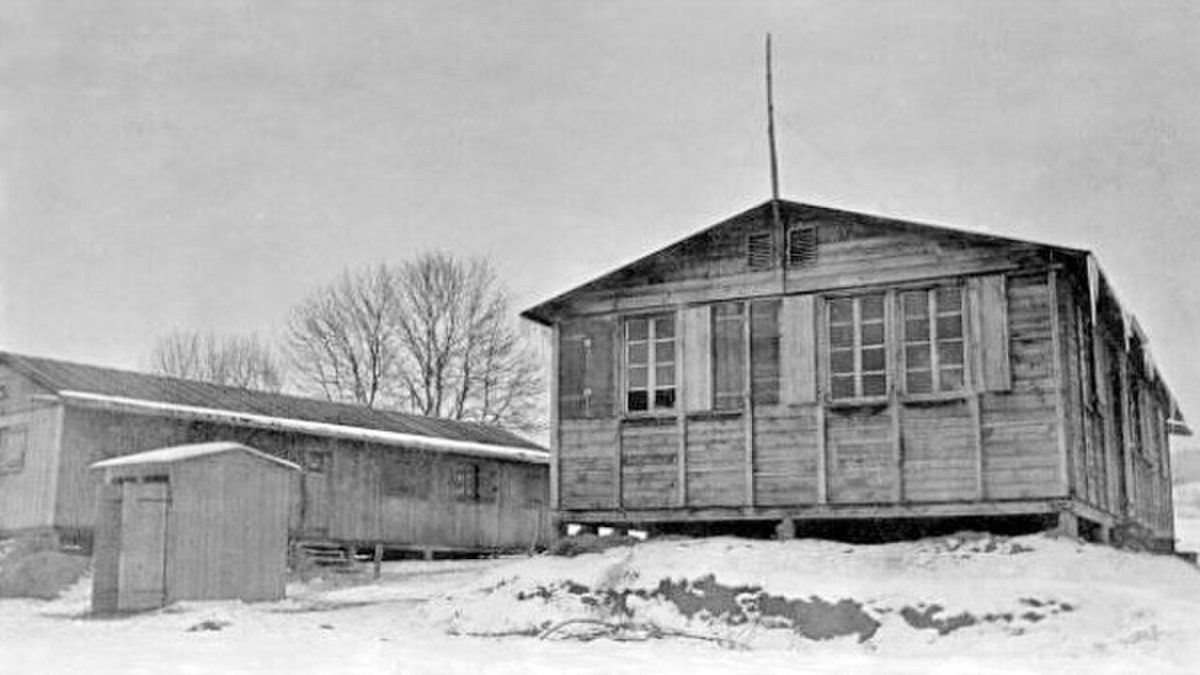
The Swiss could send those they caught to Wauwilermoos, a punishment camp on a drained marsh in canton Lucerne. Former inmates described mud, lice, straw beds, thin soup and barbed wire guarded by dogs. Its commandant, Captain André Béguin, was a Nazi sympathiser. About 150 Americans passed through the camp in 1944, until American protests won their release in November.
Some internees suffered far worse than hunger. The airman Dan Culler later wrote about being sexually assaulted by fellow inmates while guards ignored his complaints. In 1995, Swiss President Kaspar Villiger apologised to him in person.
In 1946, a military court finally sentenced Béguin to three and a half years in prison, for embezzlement and other offences, but never for his treatment of the prisoners. Recognition for the airmen took even longer. On 30 April 2014, eight surviving Wauwilermoos internees received the Prisoner of War Medal at the Pentagon, the first time it had been given for captivity in a friendly country.
Timeline: the bombing of Switzerland and its aftermath
From the stray bombs of 1940 to the final payment in 1949, here are the key moments. For the wider picture of the war years, see our Swiss history timeline.
From stray bombs to a final settlement
Tap a date, or use the arrow keys. Red dots mark the deadliest raids and the final payment.
Air battles and stray bombs
Swiss fighters down 11 German aircraft. In June, RAF bombs hit Geneva and Renens; in December, Basel and Zurich.
First American bombs
US bombs damage property at Samedan in the Engadin.
Schaffhausen
US B-24s bomb Schaffhausen. Around 40 people die.
The first payment
The US has paid four million dollars in restitution.
Out of Wauwilermoos
American protests win the release of US airmen from Wauwilermoos.
A day of 13 attacks
Bombs hit Stein am Rhein, Tägerwilen, Rafz and Vals. 21 people die.
Zurich and Basel
Six B-24s bomb Zurich by mistake, killing five. Bombs also fall on Basel.
The last raid
Brusio, in Graubünden, suffers the last raid of the war.
A Hollywood star’s court
Colonel James Stewart presides over the Zurich crew’s court-martial. The court acquits both men.
The camp commandant sentenced
A military court jails André Béguin, the Wauwilermoos commandant, for embezzlement and other offences.
Final settlement
The US agrees to pay CHF 62,176,433.06 in final compensation.
Recognition at last
Eight surviving Wauwilermoos internees receive the Prisoner of War Medal.
Where to remember the raids today
The scars are easy to miss today, but they're there if you know where to look.
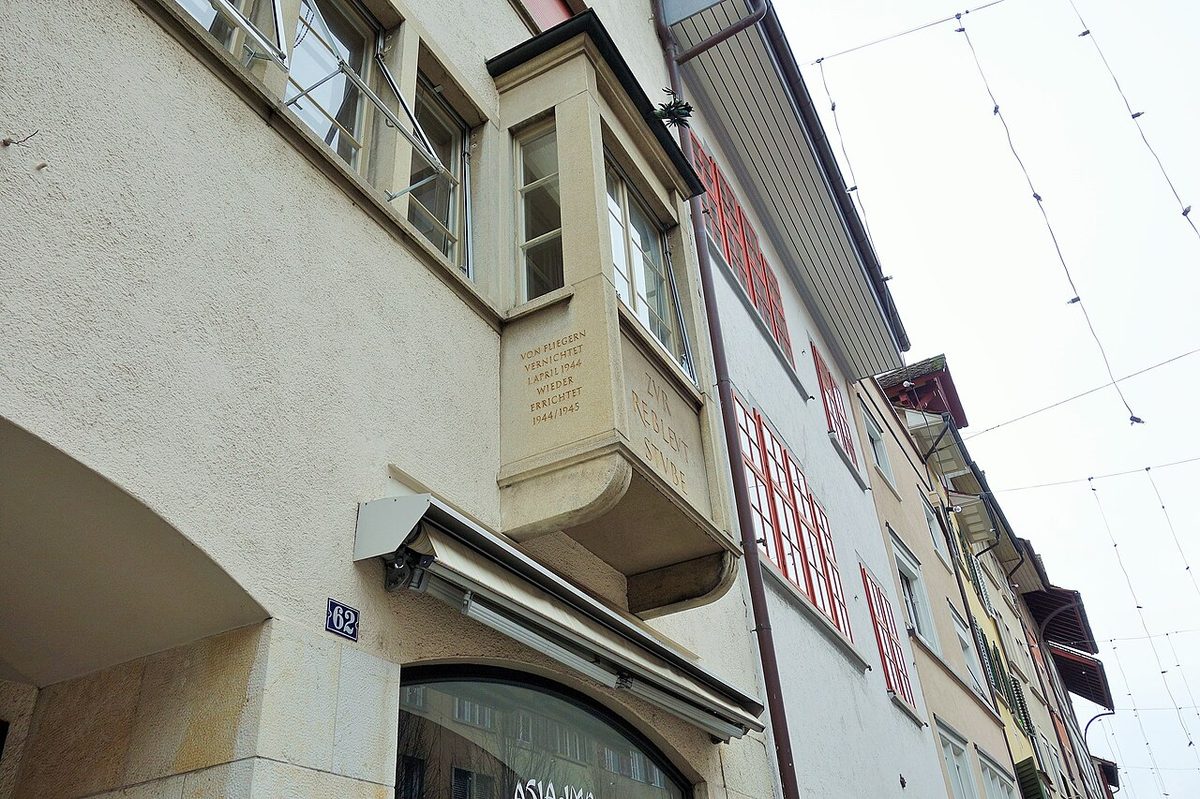
- Schaffhausen old town: on a rebuilt house in the Neustadt, an inscription on the oriel window reads that it was "destroyed by airmen on 1 April 1944" and rebuilt in 1944 and 1945.
- The Waldfriedhof: the forest cemetery where the victims were buried together.
- The Museum zu Allerheiligen: look for the works donated by Swiss cantons, cities and private citizens after the fire.
- Stein am Rhein: a plaque on the Untertor, the lower town gate, remembers the bombing of February 1945.
- The bells of Schaffhausen: every year on 1 April, the city's church bells ring in memory of the victims.
If you combine a visit with the Rhine Falls nearby, Schaffhausen makes an easy day trip from Zurich, and guided tours of the bombing sites are available in German.
Quiz: true or false?
How much do you remember? Six quick questions will tell.
True or false? Six facts about the bombing of Switzerland
Score: 0 / 6Switzerland was bombed only once during World War II.
False. Allied aircraft dropped bombs on Swiss soil about 70 times, killing 84 people.
The bombers that hit Schaffhausen were aiming for Ludwigshafen.
True. Their target was a chemical plant at Ludwigshafen, in Germany.
The United States refused to pay compensation.
False. It paid four million dollars by October 1944 and agreed a final settlement of over 62 million francs in 1949.
The Hollywood actor James Stewart presided over the court-martial after the Zurich raid.
True. Stewart was then a colonel and an experienced bomber pilot.
American airmen who landed in Switzerland were free to go home.
False. They were interned, and those caught escaping could end up in a punishment camp.
After the raids, some Swiss towns painted white crosses on their roofs.
True. The crosses were meant to show pilots they were over neutral territory.
What the raids reveal about Swiss neutrality
Many people treat the Schaffhausen bombing as a curiosity, a footnote to a war that mostly passed Switzerland by. It deserves more than that. It shows how thin the line between neutral and involved really was in the middle of a continent at war.
Switzerland traded with Nazi Germany, a story we tell in Switzerland and Nazi gold. It prepared to blow up its own bridges and tunnels, as we explain in Are Swiss bridges still rigged to blow?, and disguised its forts as fake Swiss chalets. And it still lost 84 of its people to bombs dropped by the side that would win the war.
That's the uncomfortable lesson of 1 April 1944. Neutrality is a political status, not a force field. The people of Schaffhausen who stepped outside to watch the bombers that morning paid for that difference with their lives, and the bells that ring every spring make sure the city doesn't forget.
FAQ: the bombing of Switzerland in World War II
Was Switzerland bombed in WW2?
Yes. Although Switzerland was neutral, Allied aircraft dropped bombs on Swiss territory about 70 times between 1940 and 1945, killing 84 people. The deadliest raid hit Schaffhausen on 1 April 1944.
Why did the US bomb Schaffhausen?
By mistake. The B-24s were meant to attack a chemical plant at Ludwigshafen in Germany. Bad weather broke up the formation, strong winds threw off the navigators, and the radar was unreliable, so the crews took Schaffhausen for a German town.
How many people died in the bombing of Schaffhausen?
About 40 people were killed and more than 200 injured. Some local accounts give a slightly lower figure for the deaths, and over 400 people lost their homes.
Did the United States pay compensation to Switzerland?
Yes. The US paid four million dollars by October 1944, and on 21 October 1949 it agreed to pay CHF 62,176,433.06 as full and final compensation for war damage.
What was Wauwilermoos?
Wauwilermoos was a Swiss punishment camp in canton Lucerne. Interned soldiers, including American airmen caught trying to escape, were held there in harsh conditions under a commandant who was later convicted of embezzlement and other offences.
How many American airmen were interned in Switzerland?
About 1,700. Most were housed in mountain resorts such as Adelboden, Wengen and Davos, while their damaged bombers were parked at Dübendorf airfield near Zurich.
Sources and further reading
- Wikipedia: Aerial incidents in Switzerland in World War II
- Wikipedia (German): Alliierte Bombenabwürfe auf die Schweiz
- US Office of the Historian: Foreign Relations of the United States, 1944, vol. IV, document 743
- Swiss Armed Forces: Inventory of army and war memorials, canton Schaffhausen (in German, PDF)
- Swissinfo: When the Americans bombed a Swiss city (cites higher death estimates)
- Swissinfo: 70th anniversary of mistaken US attack
- SRF: Als die US-Amerikaner Schaffhausen bombardierten (in German)
- Swiss National Museum blog: Art follows bombs
- 445th Bomb Group: Mission 46, 1 April 1944
- HistoryNet: Mistaken targets – when six B-24s accidentally bombed Zurich
- Swissinfo: Mayday – when bombers crashed in Switzerland
- Swissinfo via TagesWoche: POW medal recognises US aviators’ suffering
- Military Wiki: Wauwilermoos internment camp
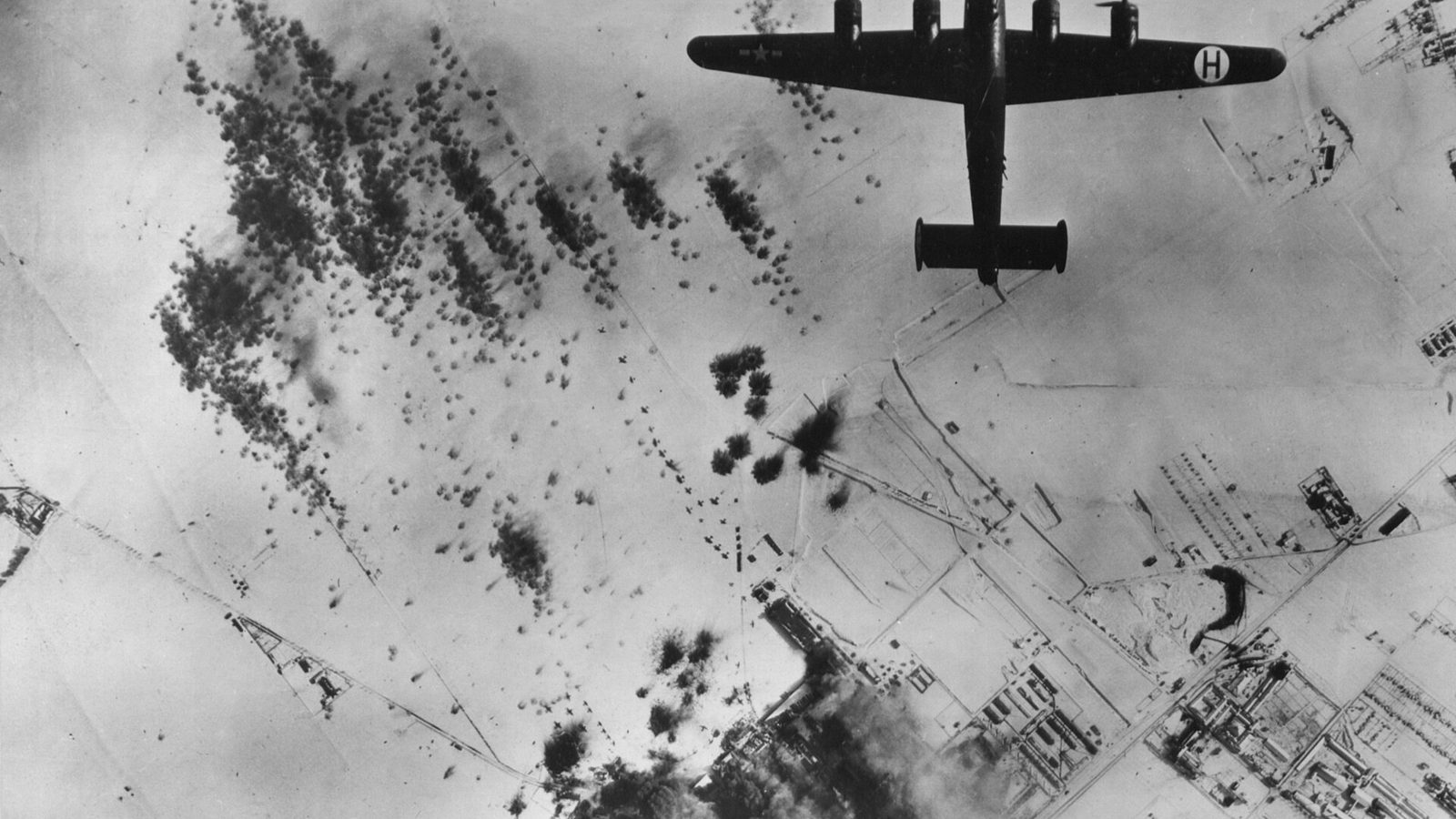
Last updated 16 October 2026. Featured photo: a B-24 Liberator over Gotha, Germany, 24 February 1944, US Army Air Forces, public domain, via Wikimedia Commons.