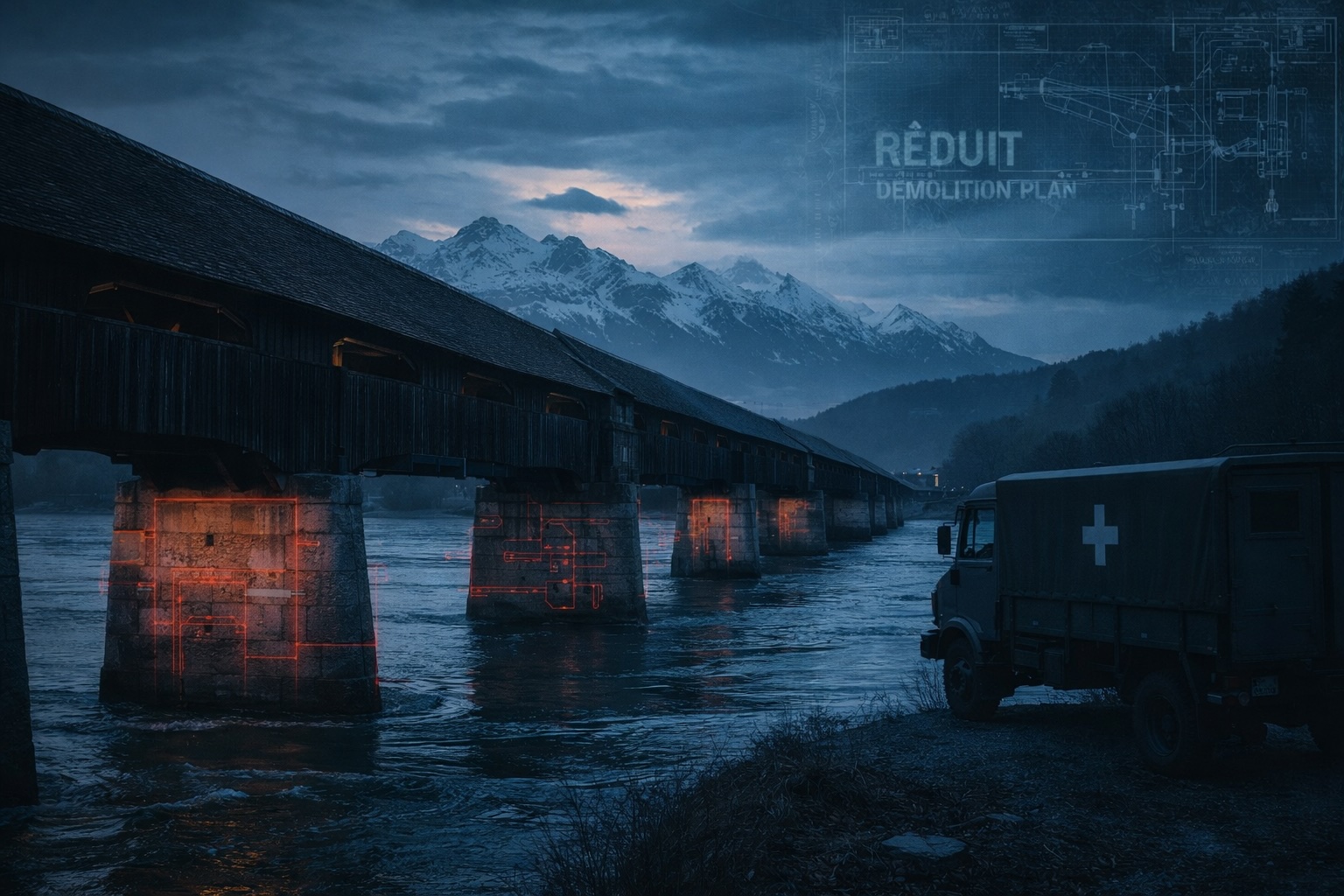
The bridge looks like any other in Switzerland. Stone piers. A clean arc over a cold river. Tourist coaches slow down for photographs. Hikers stop to consult maps. Children lean over the railing and watch the current below.
What the tourists don’t see are the hollow chambers drilled into the base of each pier. The sealed conduits running through the concrete. The cable pathways, now empty, that once carried detonation wires down to buried junction boxes in the riverbank.
For more than fifty years, this bridge — like thousands of others across Switzerland — was designed to destroy itself in under thirty seconds.
Switzerland wired its entire infrastructure to blow. Not as a threat to enemies. Not as a dramatic gesture. As cold, calculated engineering. The question that still circulates today is a simple one: did they ever fully unwire it?
The Réduit: Switzerland’s Scorched-Earth Masterplan
To understand the bridges, you need to understand the moment that created them.
June 1940. France has just surrendered to Nazi Germany in six weeks. Switzerland is now surrounded on all sides by Axis-controlled territory. Italy to the south. Germany to the north, east, and west. The Vichy French buffer is gone. Switzerland — a landlocked, resource-poor, non-aligned democracy — sits inside a fascist ring with no allies and no escape.
General Henri Guisan, Commander-in-Chief of the Swiss Army, makes a decision that will define Switzerland’s entire defensive posture for the next fifty years. On July 25, 1940, he calls his senior officers to the Rütli meadow — the symbolic birthplace of the Swiss Confederation — and delivers orders for the National Redoubt, known in French as the Réduit National.
The strategy is brutal in its logic. Switzerland will not try to defend its cities, its flatlands, or its economic centers. If Germany invades, those are sacrificed. Instead, the Swiss Army retreats into the Alps — into granite fortresses, hidden artillery positions, and tunnel networks that no conventional army can easily crack.
But the retreat only works if the invaders cannot follow quickly. Which means the roads have to go. The bridges have to go. The tunnels have to go.
Swiss military engineers begin drilling immediately. Into the piers of Rhine bridges. Into the walls of Alpine tunnels. Into the abutments of road viaducts. They calculate blast mathematics with the precision that Switzerland applies to everything: enough explosive to bring down the structure entirely, not enough to damage adjacent terrain that Swiss troops might need for their own retreat. Hollow chambers are formed into concrete during new construction. Access hatches are built in — locked, numbered, mapped in classified files that would not be declassified for decades.
The Gotthard Tunnel — the critical north-south rail artery through the Alps — gets special treatment. Multiple charge points. Redundant detonation systems. The tunnel represents such a strategic prize that its destruction is planned to be total and irreversible. A conquering army that wanted to use Swiss rail infrastructure would need years to rebuild.
The same treatment goes to the San Bernardino Pass, the Simplon Tunnel, and the major Rhine crossings. Each bridge becomes both a crossing and a potential controlled demolition. Each tunnel, both infrastructure and a potential tomb for an advancing army.
The Bridges You Crossed Without Knowing
The most famous example is the Säckinger Rhine Bridge — a covered wooden bridge connecting the Swiss town of Bad Säckingen with the German bank of the Rhine. It’s one of the longest covered wooden bridges in Europe, a landmark that draws photographers and architectural tourists. What nobody mentioned in the tourist brochures was that its ancient piers had been hollowed and packed with TNT.
The charges sat there through the entire Cold War. Military engineers inspected them on annual rotation. Conscripts on their refresher service checked the wiring, verified the detonator connections, and filed maintenance reports that were immediately classified. The bridge stood in its postcard-ready beauty, and somewhere in its stone foundations, explosives waited.
A few kilometres upstream, the Laufenburg Rhine Bridge — connecting the Swiss and German towns of the same name — received identical treatment. So did the road bridge at Koblenz AG, where the Aare meets the Rhine. So did dozens of crossings along the Rhine frontier from Basel to Schaffhausen. Schaffhausen, which lies on the north bank, also faced a danger no demolition charge could stop: in 1944, American bombers mistook the town for Germany.
The logic was strategic geography. The Rhine forms Switzerland’s northern border with Germany. In any invasion scenario from the north, German armour would need to cross the Rhine. Blowing every Rhine bridge simultaneously would strand an invasion force on the wrong bank while Swiss units retreated toward the Alpine core.
Further south, the demolition network extended into the Alpine infrastructure itself. The Lucendro Viaduct, carrying the Gotthard road, was wired. So were the approach roads to the Furka, Grimsel, and Susten passes — the mountain routes that any invading army would need to push through the Alps. From the air, Switzerland looked like a small, peaceful country. Underground, it was a continent-sized demolition charge with detonators scattered across a thousand trigger points.
Why Hitler Chose Not to Invade
Operation Tannenbaum — Germany’s contingency plan for the invasion of Switzerland — was real. The planning was detailed. Wehrmacht divisions were assigned. A proposed timeline existed. And then, repeatedly, it was shelved.
The reasons were multiple. Switzerland’s neutrality made it commercially valuable as a financial intermediary. Swiss industrial exports — precision instruments, weapons components, chemical products — were flowing to Germany anyway. Invasion risked destroying that relationship.
That commercial neutrality also enabled Crypto AG, the Swiss company that turned out to be a CIA front.
But the Réduit played a direct role. German military planners looked at the Swiss defensive posture and concluded that conquering Switzerland would cost more than it was worth. Estimates suggested that clearing a path through the Alps after Swiss demolitions would take six to twelve months of engineering work. By that point, the strategic situation would have changed entirely.
The bridges were part of that deterrent calculation. A Switzerland that could instantly sever every road and rail connection — forcing any invader to fight through rubble and mountain terrain — was a Switzerland that offered no easy prize. The demolition program didn’t just protect Switzerland. It made Switzerland not worth attacking.
The Cold War Expansion: 3,047 Sites and Counting
When the Second World War ended, a reasonable observer might have expected Switzerland to quietly remove the explosives and restore its infrastructure to peacetime normality.
Instead, the program expanded.
Soviet tank doctrine — vast armoured columns flooding across Central European plains — made the demolition network more relevant than ever. Soviet forces crossing into Western Europe would need every road and rail line they could find. A Switzerland that could instantly destroy its own infrastructure was a Switzerland that offered no supply corridor, no through-route, no easy passage.
By the 1970s, Swiss military planners had documented 3,047 demolition sites across the country. Some internal estimates put the figure higher — closer to 4,800. The charges had evolved from wartime ANFO and TNT mixtures to more stable plastic explosives that required less maintenance and had longer shelf lives. New bridges built after the war were sometimes designed from the foundation up with charge chambers incorporated into the structure — purpose-built for destruction.
The maintenance system ran on conscription. Switzerland’s militia army required most male citizens to serve annual refresher training throughout their twenties and thirties. A significant number of those training exercises involved demolition sites: checking electrical continuity in detonator circuits, verifying that charge chambers hadn’t been compromised by water ingress, replacing degraded components, and filing classified maintenance logs.
This meant that tens of thousands of Swiss men — over multiple generations — were aware that the bridge on their morning commute was rigged. They didn’t talk about it. Operational security was embedded deeply in Swiss military culture. But they knew.
The Long Dismantling: 1991 to 2015
The Berlin Wall fell in November 1989. Within eighteen months, Switzerland had begun the systematic dismantling of its demolition network.
The process was neither quick nor simple. Engineers had to locate every site — using classified maps that hadn’t been openly reviewed in decades. Some charge chambers had been sealed shut and forgotten. Some detonation wiring had degraded in ways that required careful handling before removal. The explosives themselves, while stable in design, had been sitting in concrete voids for up to fifty years.
Most of the dismantling happened quietly, invisibly, without press coverage or public acknowledgement. A contractor would arrive at a bridge, work for a few days in a sealed-off section of the structure, and leave. The charges came out in unmarked trucks. The voids were filled with concrete. The hatches were welded shut or removed entirely.
The exception was the Säckinger Rhine Bridge, which became the most public conclusion to the entire program. In October 2014, Swiss military engineers spent several weeks extracting the charges from the bridge’s piers. The work was deliberate and careful — the charges had been in place since the 1940s, and nobody wanted the last act of Switzerland’s demolition program to be an accidental detonation on a tourist landmark.
When the work was finished, the Swiss press covered it as an ending. A military spokesman confirmed that the Rhine frontier crossings had been cleared. After seven decades, the bridges were just bridges again.
The Laufenburg Bridge was cleared around the same period. By 2015, the official Swiss military position was that fixed explosive charges had been removed from all known bridge infrastructure.
Note the careful language: known infrastructure. Fixed charges.
Are Any Bridges Still Rigged? The Honest Answer
The Swiss military’s public position is that pre-placed explosive charges no longer exist in Swiss civilian infrastructure. This aligns with what independent experts have said: fixed demolition systems are a Cold War technology, and modern military doctrine favours mobile rapid-deployment teams that can place and detonate charges where needed, when needed, rather than maintaining a network of static installations that require constant maintenance and create security risks.
But the question refuses to die, for reasons that are more physical than conspiratorial.
Drive across any bridge in Switzerland that was built between 1940 and 1990, and you may notice things. Concrete patches on piers that are a slightly different shade to the surrounding material. Small sealed hatches near the waterline. Conduits that run down into the foundations and appear to go nowhere. Access panels that are bolted shut from the outside with hardware that looks newer than everything around it.
These traces are real. They’re the physical scars of a demolition program that ran for fifty years. Most of them represent former charge chambers that were emptied and filled. Some represent access pathways for detonation wiring that ran to now-removed junction boxes. They are archaeology, not active infrastructure.
But the Swiss military still won’t give a complete accounting of what was removed and where. The full archive of demolition site maps remains classified. And Swiss military doctrine explicitly preserves “infrastructure denial capability” — the trained capacity to blow bridges and tunnels quickly if strategic circumstances demanded it. The difference from the Cold War is that this capability now lives in the hands of specialist demolition units rather than pre-placed charges waiting in concrete.
It’s a meaningful distinction. But it’s not the same as saying the question is closed.
What Switzerland’s Demolition Doctrine Tells Us About Switzerland
The bridge program is fascinating not just as military history but as a window into Swiss national character.
Switzerland built one of the most beautiful transport networks in the world — elegant viaducts, efficient tunnels, bridges that won engineering awards — and then quietly rigged all of it to explode. The same precision that went into the construction went into the destruction planning. The same engineering perfectionism that makes Swiss infrastructure a global benchmark was applied to calculating exactly how many kilos of ammonium nitrate would drop each span into the river below.
This is the same country that requires every household to have a nuclear shelter by law. The same country that built hundreds of fake farmhouses hiding artillery positions. The same country whose legend of national identity is built on a man who shot an apple off his son’s head rather than bow to foreign authority.
Neutrality in Switzerland is not passive. It is an active, armed, deeply engineered position. The bridges were part of that stance. They said: we will trade with you, cooperate with you, welcome you as tourists — but if you come as conquerors, we will make this country uninhabitable before we surrender a meter of it.
The charges are gone from the piers. The doctrine they embodied is not.
Visiting the Evidence Today
You can still see the physical record of the demolition program without any special access. The Säckinger Rhine Bridge — now cleared — still stands. Standing on it and knowing what was once packed into its piers gives the structure a completely different weight.
The Festung Furgen near Andermatt, open to visitors, offers a deep-dive into the Réduit fortification system — bunkers, artillery positions, tunnel networks, and the broader logic of the Alpine defensive doctrine that drove the demolition program. In Andermatt itself, Fort Bühl even held the National Bank’s gold from 1938, as our story of the Swiss mountain gold vaults explains.
The Gotthard area more broadly is worth exploring on foot. The passes, the old military roads, the pillboxes built into rock faces, and the patched concrete on bridge abutments all tell the same story. Switzerland spent decades engineering its own destruction as the price of its survival.
That’s not a comfortable story. It’s not the Switzerland of cheese fondue, alpine meadows, and orderly banks. But it’s the Switzerland that’s actually there, underneath the postcards — and it’s one of the most extraordinary national defense stories in modern European history.
To understand how this doctrine fits into the broader sweep of Swiss military history, read the story of Switzerland’s mercenaries — the centuries-long arc from exporting soldiers to refusing all foreign wars.