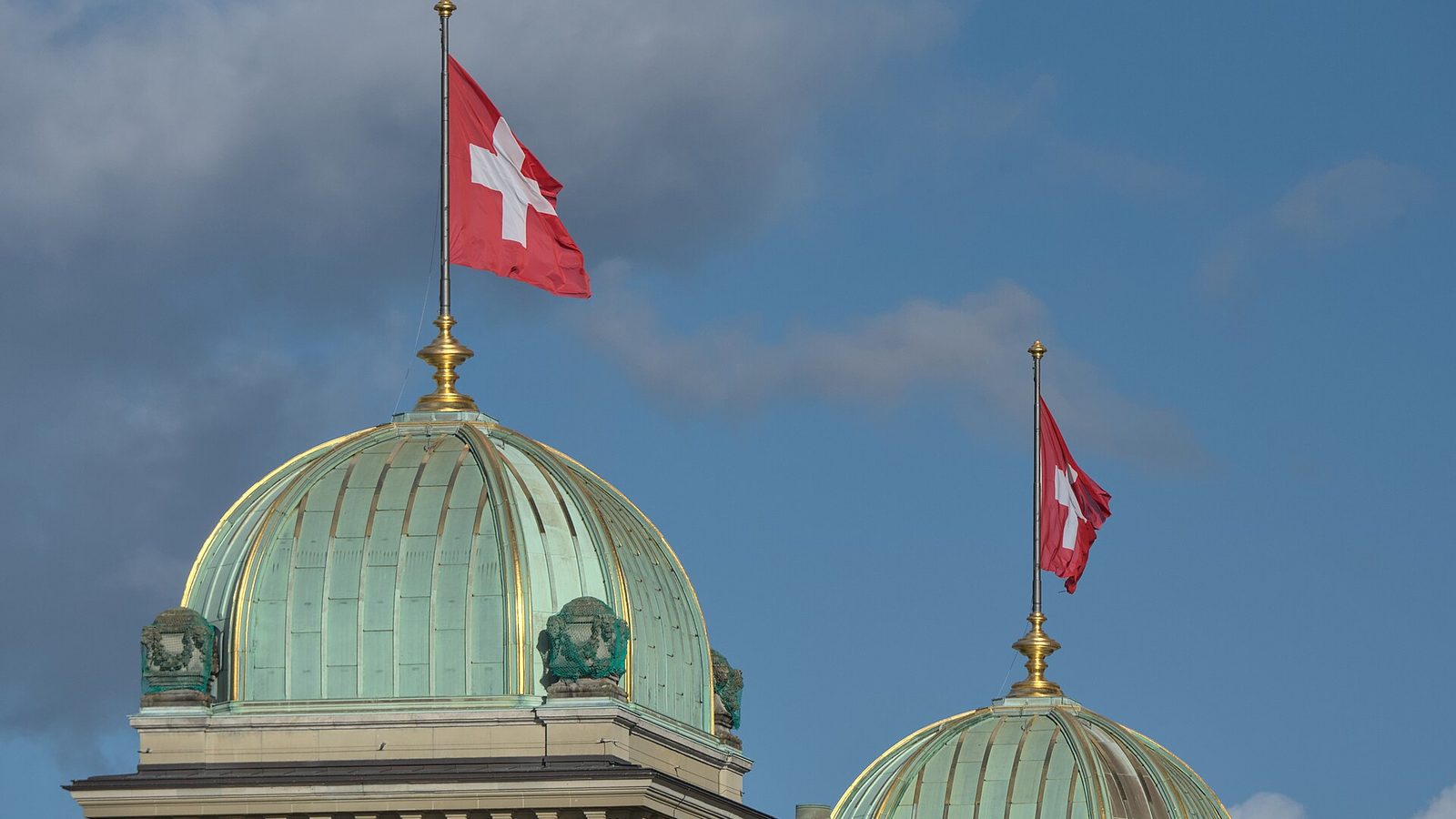
The Swiss flag is a white cross on a red square. Each arm of the cross is one-sixth longer than it is wide, and the cross never touches the edges. Only one other country in the world flies a square national flag: Vatican City.
That’s the textbook answer. The real story is stranger. The Swiss flag began as strips of white cloth sewn onto soldiers’ clothes in 1339, so they wouldn’t kill each other by mistake. It vanished completely under the French-imposed Helvetic Republic. And its most famous offspring, the Red Cross, now means “help” to millions of people who have never thought about Switzerland at all.
This guide covers the shape, the history, the lookalikes and the strict rules behind one of the world’s most recognisable flags. You can even build one yourself.
Sources: Coat of Arms Protection Act (2013), Swiss Federal Department of Foreign Affairs.
What the Swiss flag looks like, by law
Tradition shapes most national flags. With the Swiss flag, a federal law does the job, in one very precise sentence. The Coat of Arms Protection Act of 2013 describes the Swiss cross as "a white, upright, free-standing cross depicted against a red background, whose arms, which are all of equal size, are one-sixth longer than they are wide."
In practice, designers work on a grid of 32 by 32 units. Each arm is 6 units wide and 7 units long, so the whole cross spans 20 units. The law even sets the exact red: Pantone 485.
Try it yourself below. Change the shape, stretch the arms or swap the colours, and see what the law says.
Build the Swiss flag
Change the shape, the arms and the colours. See which choices the law allows.
Why is the Swiss flag square?
There's no single founding decision behind the square. Swiss military banners were often square, and when the federal army adopted one common flag in 1841, it kept that form. The new federal state of 1848 simply inherited it.
The only other square national flag belongs to Vatican City. There's a nice twist here. The Pope's bodyguards, the Swiss Guard, are Swiss citizens, a last survival of the old Swiss mercenary tradition. So the guardians of one square flag come from the country of the other.
On water, the Swiss flag changes shape
Look at the stern of any lake steamer in Switzerland, and you'll spot something odd. The flag there is rectangular. Swiss-registered ships at sea and on lakes fly a 2:3 version, written into maritime law in 1953. The cross stays the same size. Only the field gets wider.

Where the white cross came from
The white cross is far older than the Swiss state. In 1339, fighters from Bern and their allies faced an army of Fribourg and local nobles at the Battle of Laupen. To recognise each other in the chaos, they sewed white strips of cloth in the shape of a cross onto their clothing.
It was a practical idea, not a patriotic one. Medieval battles were confusing, and armour made everyone look alike. A simple cross solved the problem. Over the next two centuries, the mark spread to banners carried by Swiss troops abroad.

The red came from Schwyz
The colour most likely comes from the canton of Schwyz, whose plain red war banner went into battle with the early Confederates. Schwyz also gave the country its name. Its own flag today is red with a small white cross in the upper corner, a close cousin of the national one.
By 1540, the federal assembly of the cantons ordered "a red flag with a white upright cross" for Swiss troops sent to help the town of Rottweil. That's the first clear written mention of the design we know today.
The years without a cross
Then came a rupture. In 1798, French troops invaded and set up the Helvetic Republic. The new rulers banned the old symbols and introduced a green, red and yellow tricolour, modelled on revolutionary France.
It never caught on. Soon after the French left, the white cross returned. In 1815 it appeared on the seal of the restored Confederation, and in 1841 all federal troops finally marched under one common flag. When the modern federal state was born in 1848, after the short Sonderbund War, that army flag became the Swiss flag.
The Swiss flag timeline, from 1339 to Pantone 485
The story stretches over almost seven centuries. Tap through the key years below.
From cloth strips to Pantone 485
Tap a year, or use the arrow keys. Red dots mark the turning points.
The Battle of Laupen
Fighters from Bern and its allies sew white cloth crosses onto their clothes, so they can recognise each other in battle.
First written order
The federal assembly of the cantons orders "a red flag with a white upright cross" for Swiss troops sent to Rottweil.
The Helvetic tricolour
The Helvetic Republic bans the old symbols and flies a green, red and yellow tricolour.
The cross returns
After Napoleon, the Confederation adopts a seal with the white cross on red.
One flag for the army
All federal troops now march under one common flag: a white cross centred on a red square.
A nation’s flag
The new federal state takes the army flag as the flag of the whole country.
The reverse twin
The first Geneva Convention adopts the Swiss colours in reverse as its protective emblem.
Proportions fixed
A federal decree of 12 December fixes the shape: each arm one-sixth longer than it is wide.
A flag for the sea
A maritime law gives Swiss-registered ships a rectangular 2:3 version of the flag. Lake steamers fly it too.
Pantone 485
A new law sets the exact red and tightens the rules for the Swiss cross on products.
The Red Cross: the Swiss flag in reverse
In 1863, a group of Geneva citizens, inspired by Henry Dunant, founded what became the International Committee of the Red Cross. A year later, the first Geneva Convention needed a neutral sign to protect wounded soldiers and medics. The delegates chose a red cross on a white field, the Swiss colours reversed.
Even today, the 1949 Geneva Convention spells out the reason. The emblem was adopted "as a compliment to Switzerland" and is "formed by reversing the Federal colours". In other words, the most famous symbol of mercy in the world is a tribute to the Swiss flag.
Over time, the movement added the red crescent and, in 2005, the red crystal, so that every country could choose a sign without religious overtones. Even so, the original red cross on white remains by far the best known.
More famous than the original?
Here's the thought that stays with me. Far more people recognise the Red Cross than the Swiss flag. In a war zone, the red cross on white can mean the difference between life and death. For many people, it doesn't say "Switzerland" at all. It says "don't shoot".
That's also why misusing it is illegal in most countries. A pharmacy or a toy doctor's kit can't simply print a red cross on white. Ironically, the Swiss flag itself enjoys strong protection too, as we'll see below.
Swiss flag vs Danish flag, England and the Red Cross
Several flags look alike at first glance. The table shows how to tell them apart.
| Swiss flag | Red Cross emblem | Danish flag | England flag | |
|---|---|---|---|---|
| Shape | Square (2:3 on water) | No fixed shape | Rectangle, 28:37 | Rectangle, 3:5 |
| Colours | White cross on red | Red cross on white | White cross on red | Red cross on white |
| Cross | Free-standing, centred | Free-standing, centred | Reaches the edges, off-centre | Reaches the edges, centred |
| Means | Switzerland | Protection in war | Denmark | England |
| Since | 1841 (army), 1848 (nation) | 1864 | Legend: 1219 | Middle Ages |
Simplified. Proportions refer to the official national versions.
The key detail is the edges. On the Swiss flag, the cross floats freely in the middle. On the Danish flag, it reaches the edges and sits closer to the pole. England's St George's Cross also runs edge to edge, and it reverses the colours, just like the Red Cross.
Test yourself: Swiss flag or impostor?
Now put that knowledge to work. Six flags, six decisions. Watch out for the third one.
Swiss flag or impostor? Six flags to judge
Score: 0 / 6Start easy.
Swiss. A square red field and a free-standing white cross with arms one-sixth longer than wide.
Now this one.
The Red Cross emblem. It reverses the Swiss colours as a compliment to Switzerland. It stands for protection, not for any country.
Look closely.
Swiss, on water. Ships on Swiss lakes and Swiss-registered ships at sea fly this 2:3 version.
A northern cousin?
Denmark. The Dannebrog’s Nordic cross is off-centre and runs to the edges. Legend says it fell from the sky in 1219.
Careful with this one.
Savoy. Its cross touches the edges. Savoy was Geneva’s old enemy, the one defeated at the Escalade of 1602.
Last one.
Canton of Schwyz. Not the national flag, but its ancestor. Schwyz gave Switzerland its name and, very likely, its red.
Five mistakes people make with the Swiss flag
Because the design looks so simple, people get it wrong all the time, from sports broadcasters to souvenir makers. Here are the classic errors:
- Making it rectangular. On land, the Swiss flag is square. The 2:3 version belongs on boats.
- Letting the cross touch the edges. A cross that runs edge to edge belongs to Savoy or Denmark, not Switzerland.
- Drawing a plus sign. Arms that are too short or too thin make the cross look like a first-aid symbol.
- Adding a shield. A cross inside a shield is the Swiss coat of arms, which only the Confederation may use.
- Choosing a dark red. The official colour is a bright Pantone 485, not a deep crimson.
The flag you can't hang upside down
There's one mistake you simply can't make, though. Because the Swiss flag is square and perfectly symmetrical, it looks the same however you turn it. You can't fly it upside down or back to front. That's a small comfort for anyone decorating a balcony in a hurry on 1 August.
The Swiss flag in everyday life
For the Swiss, the flag isn't just for government buildings. You'll see it on chalets, mountain huts, cable cars and, of course, on chocolate wrappers.
Fahne, not Flagge
Language gives away how personal it feels. German speakers in Germany say Flagge. German-speaking Swiss usually say Fahne, an older word that also means a banner carried by a group. A Swiss Fahne belongs to a village band, a club or a regiment, and is carried rather than just hoisted.
1 August: a country of flags
On 1 August, the Swiss National Day, flags appear on balconies, bread rolls and even sausages. Children carry paper lanterns with the white cross, and fires burn on the hills. For one evening, a country that dislikes showing off covers itself in red. The date has been a federal public holiday only since 1994, after a popular vote, yet the flags feel as if they've always been there.
Flag throwing as an art
Then there's Fahnenschwingen, or flag throwing. A single performer swings and tosses a large flag around their body in slow, precise figures, often to the sound of yodelling or an alphorn. It's a fixture at yodel festivals and alpine celebrations, as our guide to Swiss traditional music and folklore explains.
The Swiss flag as a brand
A red square with a white cross sells. Watches, cheese, knives and chocolate all lean on it. That's why Switzerland protects the Swiss flag so carefully.
Since 2017, the "Swissness" rules decide who may use the Swiss cross on a product. For most foods, at least 80% of the raw materials must be Swiss. For industrial goods, at least 60% of the manufacturing costs must arise in Switzerland. The Swiss coat of arms, the cross inside a shield, is reserved for the Confederation itself.
You'll see the result on the famous red handle of the Swiss Army knife. That small cross is a legal promise as much as a logo. The Swiss Federal Institute of Intellectual Property even watches for misuse abroad, because one fake Swiss cross can damage the reputation of every genuine Swiss product.
What the Swiss flag really says
So what does the Swiss flag stand for? In my view, it tells three stories at once.
First, it's a recognition mark. It was born on a battlefield to say "we belong together", not "we are better than you". Second, it's a gift. Through the Red Cross, its colours became a sign of protection for everyone. Third, it's a promise of quality, guarded by law.
Notice what's missing, too. The flag belongs to no single canton, no ruling family and no party. In a country made of 26 proud Swiss cantons, that may be its greatest strength. Even the country's international code avoids picking a side, which is why Switzerland is "CH".
To place the flag's story in the wider sweep of Swiss history, explore our interactive Swiss history timeline.
FAQ: the Swiss flag
Why is the Swiss flag square?
The square shape most likely follows the old Swiss military banners. When the federal army adopted a common flag in 1841, it kept the square form, and the national flag inherited it. Only on lakes and at sea do Swiss ships fly a rectangular 2:3 version.
What does the Swiss flag mean?
The white cross began as a Christian recognition mark sewn onto Swiss fighters’ clothes, first recorded at the Battle of Laupen in 1339. Today the Swiss flag stands for the Confederation as a whole rather than any one religion or canton.
What is the difference between the Swiss flag and the Red Cross flag?
They reverse each other’s colours: a white cross on red for Switzerland, and a red cross on white for the Red Cross, chosen in 1864 as a tribute to Switzerland.
What are the official proportions of the Swiss flag?
The flag is square. Each arm of the cross is one-sixth longer than it is wide, and the cross spans 20 of 32 units of the flag’s width. The red is defined as Pantone 485.
Is the Swiss flag the same as the Danish flag?
No. Both show a white cross on red, but the Danish flag is rectangular and its cross runs to the edges, shifted towards the pole. The Swiss cross is centred and free-standing.
Can I use the Swiss flag on products?
Only if the product meets the Swissness rules, such as 80% Swiss raw materials for most foods and 60% of manufacturing costs in Switzerland for industrial goods. The Swiss coat of arms, the cross in a shield, is reserved for the Confederation.
Sources and further reading
- Federal Department of Foreign Affairs: The Swiss flag
- WIPO Lex: Coat of Arms Protection Act (2013, in force 2017)
- ICRC: Geneva Convention I (1949), Article 38
- Wikipedia: Flag of Switzerland (history and sources)
- Flags of the World: Switzerland
Last updated 2 October 2026. Featured photo: August Geyler, Wikimedia Commons, CC BY-SA 4.0.