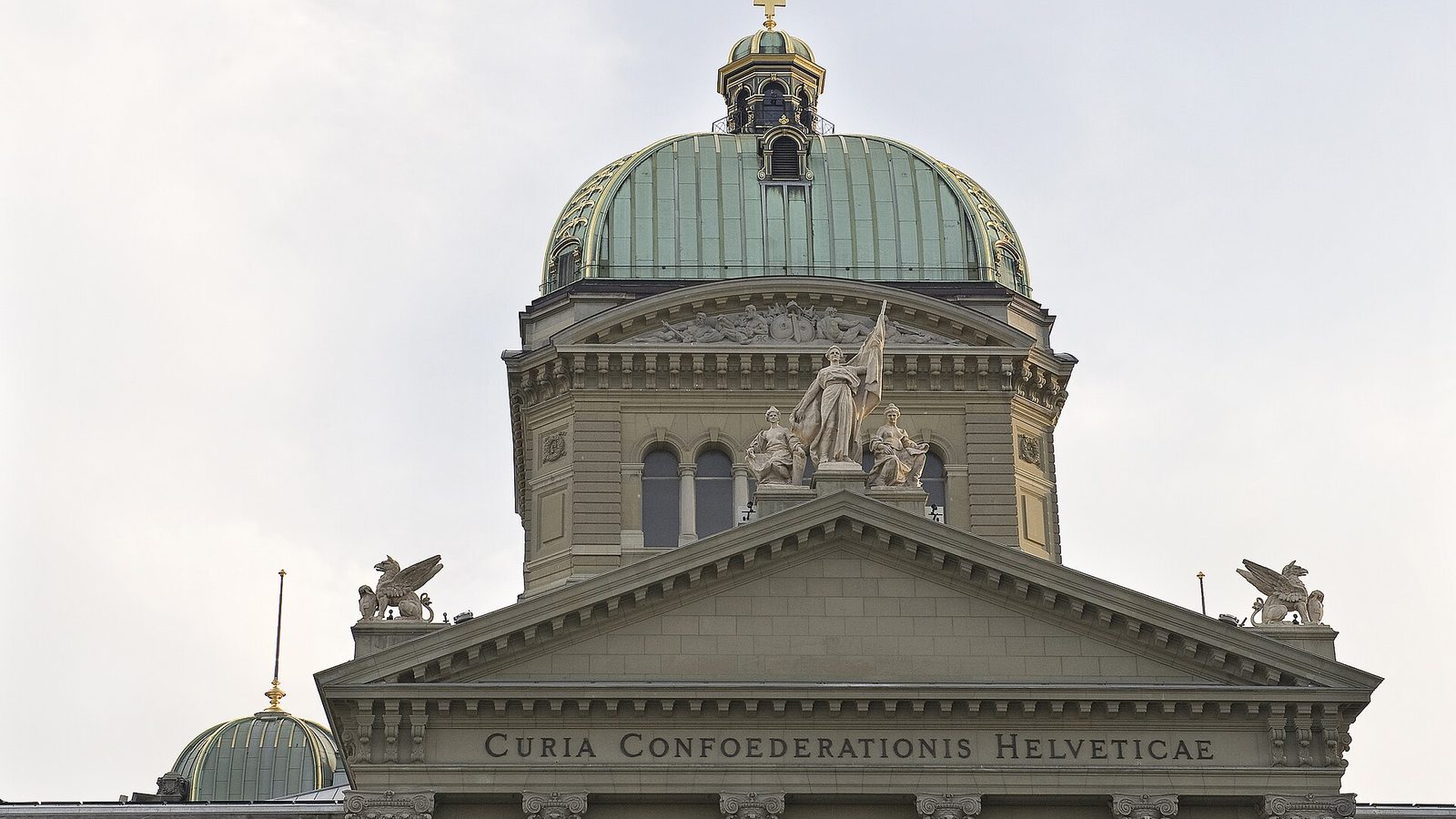
Why is Switzerland “CH”? Because CH stands for Confoederatio Helvetica, the Latin name of the Swiss Confederation. Switzerland has four national languages, and picking German Schweiz, French Suisse, Italian Svizzera or Romansh Svizra would have favoured one region. So the Swiss chose a language nobody speaks any more.
It’s a very Swiss solution, and the deeper you dig, the stranger it gets. The “Helvetii” of the name were a Celtic people that Julius Caesar defeated and sent home. The word “confederation” hasn’t been strictly true since 1848. And the country actually uses at least three different codes, depending on whether you’re driving, banking or watching the Olympics.
Here is the full story behind Confoederatio Helvetica, from Roman battlefields to your web browser.
Sources: Swiss Federal Chancellery, OFCOM, ISO 3166.
What does Confoederatio Helvetica mean?
Confoederatio Helvetica means "Helvetic Confederation". The first word comes from the Latin foedus, a treaty or alliance. The second refers to the Helvetii, the Celtic people who lived on the Swiss plateau in Roman times.
In everyday life, the country goes by four official names, one per national language: Schweizerische Eidgenossenschaft, Confédération suisse, Confederazione Svizzera and Confederaziun svizra. On a Swiss passport cover, the country's name appears in all four national languages, plus English. On a car sticker or a coin, there's simply no room.
Why Latin?
That's where Latin comes in. It belongs to no Swiss language region, so it offends nobody. It was also the old language of scholars and churches across Europe, which gave it a certain dignity. Better still, educated people abroad could read it, so the name worked outside the country as well as inside.
The Swiss post office faced the same problem early on. Four languages won't fit on a postage stamp, so Swiss stamps simply say HELVETIA. Coins followed the same logic, and so, eventually, did the international codes. Confoederatio Helvetica became Switzerland's neutral ground, a little like the country itself.
Who were the Helvetii?
The Helvetii were a Celtic people who lived between the Jura, Lake Geneva and the Rhine. In 58 BC, they set out to migrate west into Gaul. Julius Caesar blocked them, defeated them in battle and ordered the survivors back home to rebuild their villages.
Caesar described the episode in his account of the Gallic War, and that's largely why we remember the name. The Helvetii themselves gradually disappeared into the Roman world. Their name, however, outlived them by two thousand years.
Helvetia, the woman on your coins
From the 17th century, artists began to picture the Swiss Confederation as a woman called Helvetia. She usually carries a spear and a shield with the Swiss cross. Later, in 1798, revolutionary France turned the old Confederation into the "Helvetic Republic", which made the adjective official for a while.
Helvetia never left. She stands on every half-franc, one-franc and two-franc coin, framed by a ring of 23 stars. Each star stands for a canton in the old count, where the six half-cantons make three. The 23rd star arrived after Jura became a canton in 1979.

Helvetia takes a break
Helvetia also turns up in stone and bronze. A statue group of her stands above the Latin inscription on the Federal Palace in Bern, shown at the top of this page. In Basel, however, she looks far more relaxed. Next to the Middle Bridge over the Rhine, sculptor Bettina Eichin's Helvetia on Her Journey sits on a wall. Her spear and shield lie beside her, and she gazes at the river like a tired traveller.
Many locals love her precisely because she looks so human. She's a national symbol on her day off.
Latin in your pocket
Now look at the smaller change. The 5, 10 and 20 centime coins show a head of Liberty and the full Latin name: CONFOEDERATIO HELVETICA. The 10 centime coin is a record breaker. Its design and alloy have stayed the same since 1879, and it entered the Guinness Book of Records as the oldest original currency still in circulation.

The five-franc coin hides one more Latin surprise. Its edge reads DOMINUS PROVIDEBIT, "the Lord will provide", framed by 13 stars in groups of ten and three. Many Swiss believe the groups stand for the Ten Commandments and the Holy Trinity. The federal mint, Swissmint, has politely called that idea "unfounded speculation". I find that rather charming. Even the myths on Swiss money get fact-checked.
Why not S, SW or SZ?
CH was in use on Swiss cars long before computers needed country codes. When the International Organization for Standardization published its first list of country codes in 1974, it simply kept CH.
Even if the Swiss had wanted a code based on an English or German name, the obvious letters were already busy. S is Sweden's car code, and SE is its ISO code. SZ went to Swaziland, today Eswatini. Seen that way, Confoederatio Helvetica wasn't only diplomatic. It was also practical.
What about +41?
One Swiss code has nothing to do with the name at all. The international dialling code, +41, comes from a numbering plan that grouped Europe under numbers starting with 3 and 4. So if you're looking for Latin in a Swiss phone number, you won't find any.
Where you'll meet CH in daily life
Once you start looking, the two letters are everywhere:
- On cars: the white oval sticker on Swiss vehicles abroad.
- In addresses: letters from abroad often add CH before the postcode, as in CH-3003 Bern.
- Online: every .ch website, including the federal government's admin.ch.
- In prices: CHF on bank statements and exchange boards.
- In language: linguists call Swiss-only words, such as Velo for bicycle, Helvetisms.
CH, CHE, SUI, CHF: decoding Switzerland's codes
Confoederatio Helvetica explains CH. But Switzerland actually travels under several codes. Try the decoder below, then read on for the trickiest ones.
Decode Switzerland’s codes
Tap a code to see what it stands for and where you’ll meet it.
- Language
- Where you see it
- Good to know
Why SUI at the Olympics and the World Cup?
In sport, Switzerland is SUI, from the French Suisse. The International Olympic Committee and FIFA both have French roots, and their country codes often follow French names. That's why Swiss fans see SUI on the scoreboard, even though the car park outside is full of CH stickers. There's a neat irony, too. The IOC itself is based in Lausanne, so its own address ends in CH.
CHE: the code on your invoice
Then there's CHE, the three-letter version of CH under the international ISO standard. You'll find it in the machine-readable line of a Swiss passport. More surprisingly, every Swiss company carries it too. The business identification number on any Swiss invoice starts with CHE, followed by nine digits.
Confoederatio Helvetica through time: from the Helvetii to .ch
The story spans more than two thousand years. Tap through the key moments below.
From the Helvetii to .ch
Tap a date, or use the arrow keys. Red dots mark the turning points.
The Helvetii lose to Caesar
Julius Caesar defeats the Helvetii, a Celtic people trying to migrate west, and sends them home. Their name will outlive them by 2,000 years.
The oath fellows
Uri, Schwyz and Unterwalden swear an alliance. The members call themselves Eidgenossen, “oath companions”, the root of the German name for the Confederation.
Helvetia is born
Artists and writers start to picture the Confederation as a woman named Helvetia, after the old Celtic tribe.
A Helvetic Republic
Revolutionary France turns the Confederation into the Helvetic Republic. It lasts only five years, but “Helvetic” becomes an official word for the country.
A confederation in name
Switzerland founds its modern federal state, but keeps the old word “confederation”, even though it now has a central government.
Helvetia on coins
A standing Helvetia with the word HELVETIA starts to appear on the new franc coins. She is still there today.
Latin on small change
The 10 centime coin gets a head of Liberty and the full Latin name, CONFOEDERATIO HELVETICA. Its design has not changed since.
A typeface goes global
Two Swiss designers create the Neue Haas Grotesk. In 1960 it takes the name Helvetica, “the Swiss one”, and conquers the world.
.ch goes online
Switzerland gets its internet domain. CH is now part of millions of addresses.
.swiss arrives
A second domain, .swiss, opens for Swiss companies and organisations.
So where does the name Switzerland come from?
If the learned name is Helvetia, the everyday one comes from a single canton: Schwyz. Neighbours began to call all the Confederates "Schwyzer", after the canton whose fighters were among the best known. It wasn't always a compliment. During the wars of the late 15th century, German mercenaries mocked their Swiss enemies as Kuhschweizer, or "cow-Swiss".
The Confederates took the name and wore it with pride. Schweiz became the German name of the country, and the other languages followed with Suisse, Svizzera and Svizra. English went its own way, with "Switzer" for a Swiss person. In Shakespeare's Hamlet, the king even calls for his Swiss guards: "Where are my Switzers? Let them guard the door."
So Switzerland carries two names at once. One is popular and comes from a mountain canton. The other is scholarly and comes from Caesar's Latin. Confoederatio Helvetica is the second, and that's exactly why it works as a neutral label.
Myth or reality: is Switzerland really a confederation?
Here's the twist that even many Swiss miss. Strictly speaking, Switzerland stopped being a confederation in 1848.
A confederation is a loose alliance of sovereign states, like the old Confederacy of cantons. In 1848, however, Switzerland became a federal state, with a central government, a federal parliament and, from 1850, a single currency. The name simply stayed. Today the cantons keep a lot of power, as our guide to the 26 Swiss cantons shows, but they're no longer independent states.
Oath companions
The German name tells an even older story. Eidgenossenschaft comes from Eidgenossen, or "oath companions", the men who swore alliances in the Middle Ages. It's less "confederation" than "fellowship of people who swore to help each other". The famous oath of 1291 and the legend of William Tell belong to that world.
So is "Confoederatio Helvetica" a myth? Not quite. It's a historical name that the Swiss kept on purpose. Tradition explains part of it. I suspect the rest is tact: the old word hides a strong central state behind a softer, older idea. The same instinct explains why Switzerland has no official capital of Switzerland, only a "federal city".
Helvetica: the font that carries Switzerland's name
There's one more place you meet the old name every single day, often without noticing. In 1957, designers Max Miedinger and Eduard Hoffmann created a clean, modern typeface at the Haas type foundry near Basel. They called it Neue Haas Grotesk.
In 1960, the foundry and its German partner gave it a new name for international markets: Helvetica, "the Swiss one". It went on to appear on transport signs, tax forms and countless company logos around the world. For many people, Helvetica is the most Swiss thing they've ever read, even if they've never set foot in the country.
Why a font became a Swiss export
The timing was no accident. In the 1950s, designers in Zurich and Basel were building what the world later called the Swiss Style: clean grids, plenty of white space and sans-serif type that tried to be as neutral as possible. Helvetica fit that idea perfectly. A typeface meant to speak to everyone, without an accent, could hardly have found a better name. In a way, it's Confoederatio Helvetica in typographic form.
Test yourself: which code would you see?
Ready to put Confoederatio Helvetica and its cousins to the test? Six real-life situations, six codes.
Which code would you see? Six real-life tests
Score: 0 / 6On the back of a Swiss car driving in France?
CH. The oval country sticker uses the Latin initials, not SUI.
Next to a Swiss athlete’s name at the Olympics?
SUI. The Olympic movement uses the French name, Suisse.
On a currency exchange board?
CHF. CH for the country, F for franc.
In the machine-readable line of a Swiss passport?
CHE. Passports use the three-letter ISO code.
On a Swiss one-franc coin?
HELVETIA. The full Latin name appears on the 5, 10 and 20 centime coins and the 5-franc coin instead.
Painted on the tail of a Swiss-registered plane?
HB. Aircraft prefixes come from an international list and have nothing to do with the name.
What CH really says about Switzerland
Step back, and the two letters tell you a lot. A country with four languages refused to rank them, so it reached for a fifth one that belongs to nobody. A modern federal state kept an old, gentler name. And a Celtic people defeated two thousand years ago ended up on every Swiss car.
To me, that's the essence of Confoederatio Helvetica. It's a compromise you can carry in your pocket.
Next time you're stuck behind a Swiss car in a traffic jam, think of everything packed into that little oval: a Celtic tribe, a Roman general, a Baroque allegory, a 19th-century coin and a modern web address. Not bad for two letters. If you'd like to see how the Swiss balance their living languages, read our guide to the Swiss languages. For the cross that sits next to the letters on so many products, see our story of the Swiss flag.
FAQ: Confoederatio Helvetica and the CH code
Why is Switzerland abbreviated CH?
CH stands for Confoederatio Helvetica, Latin for “Helvetic Confederation”. Switzerland has four national languages, so a Latin name avoids favouring German, French, Italian or Romansh.
What does Confoederatio Helvetica mean?
It means “Helvetic Confederation”. Confoederatio comes from the Latin word for an alliance or treaty. Helvetica refers to the Helvetii, a Celtic people who lived on the Swiss plateau in Roman times.
Why does Switzerland use SUI in sports?
International sports bodies such as the IOC and FIFA give each country a code, often based on French. SUI comes from Suisse, the French name for Switzerland.
What is the difference between CH and CHE?
Both are official ISO codes for Switzerland. CH is the two-letter version used for web domains and cars. CHE is the three-letter version used in passports and Swiss company ID numbers.
Is Switzerland really a confederation?
Not in the strict sense. Since 1848, Switzerland has been a federal state with a central government. The word “confederation” survives in its official names as a link to the old alliance of cantons.
Is the Helvetica font named after Switzerland?
Yes. Max Miedinger and Eduard Hoffmann created it in 1957 as Neue Haas Grotesk at a foundry near Basel. In 1960 it took the name Helvetica, from the Latin name for Switzerland.
Sources and further reading
- OFCOM: Internet domain names (.ch and .swiss)
- Wikipedia: .ch (history of the domain)
- Swissmint, the Swiss federal mint
- Wikipedia: Coins of the Swiss franc
- ISO: Country codes (ISO 3166)
- Wikipedia: Postage stamps and postal history of Switzerland
Last updated 2 October 2026. Featured photo: Parliamentary Services of the Federal Assembly (parlament.ch), via Wikimedia Commons, used with attribution.