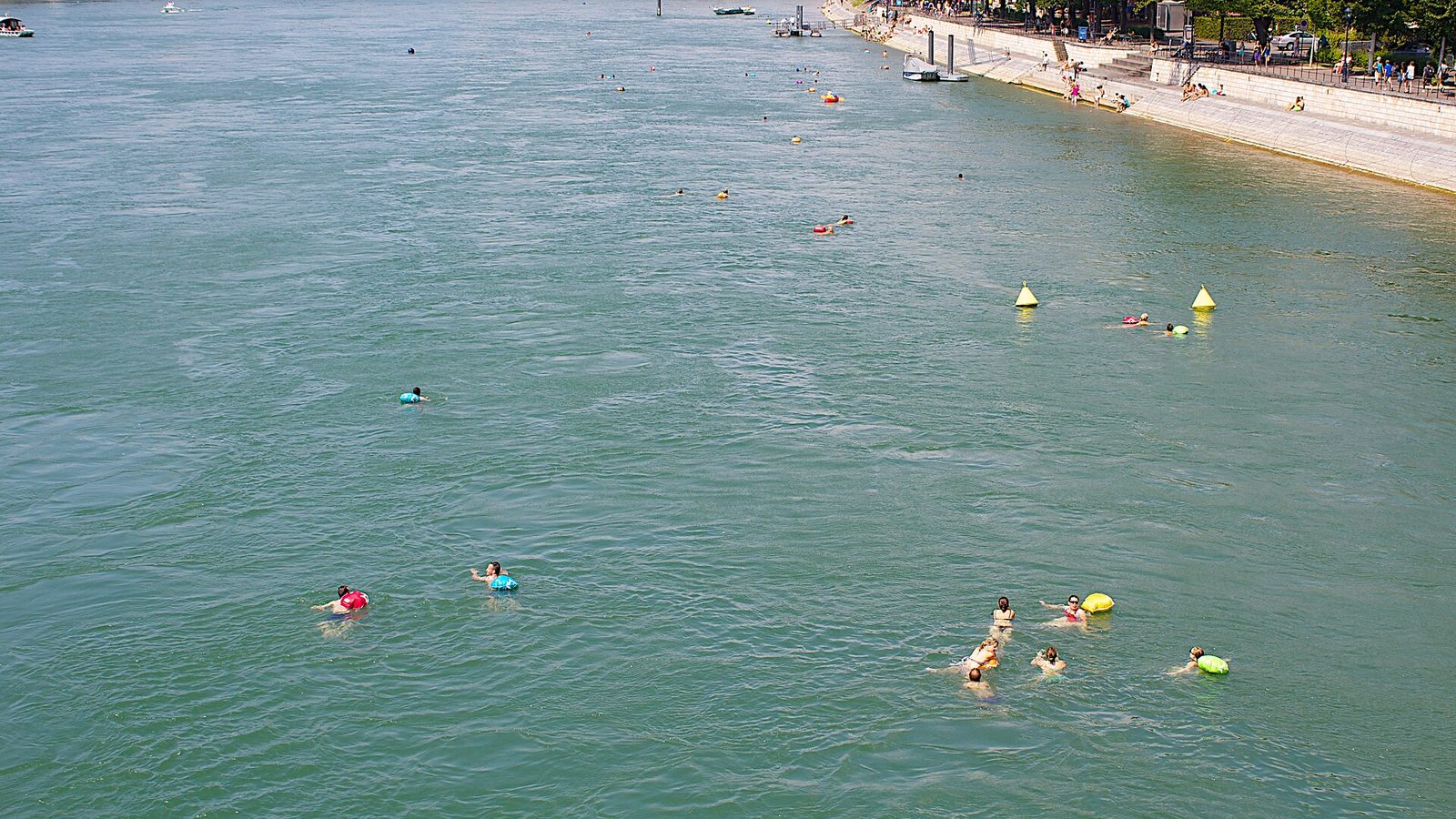
River swimming in Switzerland looks like this. At half past five on a hot July evening in Bern, office workers in swimwear stroll upstream along the river, dry bags under their arms. Then they step into the green Aare and let the current carry them back towards the city centre, past the Federal Palace, in about twenty minutes. In Basel, the same thing happens on the Rhine, with hundreds of colourful fish-shaped bags bobbing past the cathedral.
It isn’t an extreme sport or a tourist gimmick. For many locals, it’s simply how summer works, and in Bern it’s even on the federal list of the country’s living traditions.
So why do the Swiss float home from work? And how can you join them without getting into trouble? This guide covers the history, the routes, the rules and the risks, with a planner and a safety check you can use before you jump in.
Sources: Swiss National Library, Basel Tourism, SLRG and BFU (2026).
Why the Swiss float home from work
In most countries, a city river is something you look at. In Bern and Basel, it's something you get into. Three things make river swimming in Switzerland possible.
First, the water is clean. Decades of investment in sewage treatment turned Swiss rivers into places where you'd happily swim. Second, the current does the work. You don't need to be fast, only strong enough to steer and to get out in time. Third, access is free and built into the city. Steps, railings and public baths line the banks, as naturally as bus stops line a street. In Bern, the river baths are even free.
A commute by current
Put those together, and you get something unusual: a river that works like public transport. Some people float to a meeting point, others after work, and a few even swim part of the way home. River swimming in Switzerland is less about sport than about rhythm. You walk up, you float down, you dry off in the sun.
Bern: the Aare, the parliament and a 300-year habit
Bern's love affair with the Aare is old. Records from 1721 already mention boys swimming in a side channel at the Marzili, just below today's Federal Palace. People nicknamed the upper part the Bubenseeli, or "boys' pond". By the late 18th century, the river around the city was packed on summer days, with swimmers of both sexes.
The authorities weren't always pleased. At one point, they limited swimming to three places and banned it at others. The Lorraine bath opened in 1892, on a quieter bend of the river. Around 1900, the city also bought land at the Marzili after a legal battle with private owners, and the open-air bath grew from there. Generations of Bernese children learned to swim in those two places.
Why the Aare looks so green
Then there's the colour. The Aare reaches Bern from Lake Thun, fed by water from the Bernese Alps. On a sunny day, it glows a startling green-blue. It's also cold. Even in high summer, the Aare often stays below 20 °C, which is why locals check the temperature before they decide.
A living tradition with a last exit
Today, Aare swimming in Bern sits on the official list of Switzerland's living traditions. That doesn't make it harmless. Below the Marzili, a weir and the old town's bends make the river dangerous, so the city marks its exits clearly.

The sign above says "last exit" in three languages, a very Swiss mix you'll recognise from our guide to the Swiss languages. When you see it, you get out. No argument.
The Marzili under construction
One practical note for 2027 and beyond. Bern is renovating the Marzili pool in four stages, a project planned to run until 2029, alongside flood-protection work on the river. From September 2025 to the end of May 2026, swimming and boating between the Eichholz and the Dalmazi bridge were banned. Similar winter closures may follow, so check the City of Bern's notices before your first float of the season.
Basel: the Rhine and the fish-shaped bag
Basel offers the other great version of river swimming in Switzerland, on a bigger river. The Rhine is wider and faster than the Aare, and it carries real cargo ships. Even so, on a summer evening, thousands of people float through the centre of a city that is also one of the 26 Swiss cantons.
The classic route starts below Museum Tinguely, on the Kleinbasel side. From there, swimmers drift about 3 km past the old town to just before the Dreirosen bridge. Two wooden river baths, the Rheinbad Breite and the Rheinbad St. Johann, offer changing rooms and showers for a small fee.
The Wickelfisch: a Basel invention
Then there's the bag. The Wickelfisch, or "wrap fish", is a fish-shaped waterproof bag invented in Basel. You roll your clothes, phone and keys inside, fold the top several times and close it. It keeps everything dry, floats beside you and makes you easy to spot. Since 2010, the name has been a registered trademark.

I love this little object. It turns a risky idea, swimming with your belongings in a major shipping river, into something tidy and almost cheerful. Like a lot of good Swiss design, it solves a practical problem first, and the charm comes later.
The Basel Rhine Swim
Once a year, Basel turns river swimming into a festival. Since 1980, the local branch of the Swiss Lifesaving Society has organised the Basel Rhine Swim, a supervised mass float of about 1.8 km. On top of that, Basel's sports office runs free supervised group swims on summer Tuesday evenings, accompanied by SLRG lifeguards. Booking is required.
Plan your float in Bern or Basel
Ready to try river swimming in Switzerland yourself? Choose a city and a route below. Each card includes a warning worth reading twice.
Plan your float
Choose a city, then a route. Always check today’s conditions first.
What to bring for your first float
You don't need much, but the right kit makes a big difference:
- A dry bag. A Wickelfisch or similar roll-top bag holds your clothes, phone and keys, because you won't come back to where you started.
- A swim buoy. The BFU now recommends one for every river swim. It floats behind you and makes you visible.
- A bright swim cap. Boat crews and other swimmers spot you much sooner.
- Sandals in the bag. You'll walk back through the city, and pavements get hot.
- Sun cream. Twenty minutes on the water is twenty minutes in full sun.
Where to check the conditions
Before every swim, look at live data. In Bern, many locals use the Aare.guru website, which shows the water temperature and flow at a glance. The federal hydrological service publishes official river data too. In Basel, the canton's open data portal shows the Rhine temperature and water level. If the river is high, brown or unusually fast, stay on the bank.
The rules every river swimmer should know
River swimming in Switzerland feels relaxed, but it runs on clear rules. The Swiss Lifesaving Society, known as the SLRG, publishes a set of river rules. Basel's tourism office adds its own. Put together, they come down to a short list:
- Only strong, experienced swimmers should swim in rivers and lakes.
- Check the conditions. In Basel, swim only when the water is above 18 °C and the gauge reads below 650 cm.
- Never swim alone, and keep your companion in sight.
- Know your exit and the one after it. Get out early.
- Avoid bridge pillars, weirs and ports. Eddies can pull you under.
- Give way to ships. They can't stop or swerve quickly.
- Leave inflatables at home. Air mattresses and toys don't belong in a fast current.
- Keep cold swims short. Cold water causes cramps and saps your strength.
Run through the 60-second check below before every swim. It takes less time than changing into your swimwear.
Ready to float? The 60-second check
Tick every line that is true for you today.
The sobering numbers
Here's the part most travel guides leave out. In 2025, 43 people drowned in Switzerland, according to the SLRG and the Swiss Council for Accident Prevention, the BFU. Fifteen of those deaths happened in rivers, and 34 of the victims were men. The long-term average is around 50 deaths a year.
The BFU also found that nearly 40% of river swimmers use no flotation aid at all. It now recommends a swim buoy as standard kit, much like a helmet for skiing. So, enjoy the river, but don't treat it like a pool. The current never takes a day off. None of this should scare you off, though. It should simply make you respect the water.
Three centuries of river swimming in Switzerland
From the boys' pond of 1721 to the renovation of the Marzili, the story of river swimming in Switzerland is longer than most people think. Tap through the key moments below.
Three centuries in the current
Tap a year, or use the arrow keys. Red dots mark the turning points.
Boys in the Marzili
Records show boys swimming in an Aare side channel at the Marzili in Bern. The upper part is nicknamed the "Bubenseeli", the boys’ pond.
A crowded river
By the late 18th century, the Aare around Bern is packed on summer days, with swimmers of both sexes.
The Lorraine bath opens
Bern builds an open-air bath at the Lorraine. Generations of children learn to swim here and at the Marzili.
Lifesavers organise
After many fatal accidents, the Swiss Lifesaving Society, the SLRG, is founded to make open water safer.
The modern Marzili
The old side channel is largely filled in, and the Marzili takes the shape most Bernese know today.
Basel jumps in
The first official Basel Rhine Swim takes place. It becomes a summer fixture for thousands.
A fish is protected
The Wickelfisch, Basel’s fish-shaped dry bag, becomes a registered trademark.
Renovation begins
Bern starts renovating the Marzili in stages, a project planned to run until 2029.
Beyond Bern and Basel
Bern and Basel are the stars, but they're not alone. Zurich has river baths on the Limmat, where locals swim and sunbathe in the middle of the city. Along the Aare between Thun and Bern, rubber boats drift down the river all summer, a classic day out for families and friends.
Wherever you go, the same principle applies. Look for official entry and exit points, ask locals where they swim and read the signs. River swimming in Switzerland is a local art, and every town has its own rules.
Quiz: would a local do it?
Think you've got the instincts of a Bernese lifeguard? Six quick decisions about river swimming in Switzerland will tell.
Would a local do it? Six river decisions
Score: 0 / 6The Aare is 16 °C and you’re a strong swimmer. Float?
Many locals would. The Aare is often cool, even in summer. Keep it short, because cold water drains strength fast.
It rained hard all night and the river is brown and fast. Float?
Stay out. High, murky water hides debris and makes exits harder to reach.
You’re in Basel and want to jump off the Middle Bridge for fun.
Don’t. Bridge jumping is forbidden in Basel, and the pillars create dangerous eddies.
A Rhine cargo ship is coming upstream. Who gives way?
You do. Ships always have priority and cannot stop quickly. Move towards the bank.
Your phone and clothes need to come with you. Best option?
The dry bag. In Basel, the fish-shaped Wickelfisch is a local classic. It also floats and makes you visible.
You missed your usual exit. What now?
Take the next safe exit. That is why locals always know two. Never swim on towards a weir.
What river swimming says about Switzerland
In the end, river swimming in Switzerland tells you something about the country itself. The rivers are public. Nobody sells tickets to the Aare or the Rhine. The infrastructure is excellent, from steps and railings to live water data. Yet the final decision rests with you, the swimmer.
That's also why river swimming in Switzerland feels so different from a day at the beach. No lifeguard watches every metre of the river, yet almost everyone around you knows the rules and follows them.
That mix of shared rules and personal responsibility runs through Swiss life. You'll find it in Swiss direct democracy, where citizens decide the big questions themselves. You'll also find it in the way Switzerland treats its landscape as something to use, not just admire. For more ideas, see our list of the best places to visit in Switzerland, or explore the federal city in our story about the capital of Switzerland.
And if you do float past the Federal Palace one summer evening, wave at the windows. Somebody inside is probably wishing they were in the water with you.
FAQ: river swimming in Switzerland
Is it safe to swim in the Aare in Bern?
It can be, for strong swimmers in good conditions. The current is fast and the water is often cold. Check the temperature and level, know your exit, never swim alone and avoid the river after heavy rain.
Where do you get in and out of the Aare in Bern?
The classic float starts at the Eichholz and ends at the Marzili pool. A quieter option runs from near the Altenberg footbridge to the Lorraine pool. Use the marked steps and railings to get out.
How do you swim in the Rhine in Basel?
Most people get in below Museum Tinguely, put their clothes in a dry bag such as a Wickelfisch, and float about 3 km along the Kleinbasel bank to just before the Dreirosen bridge.
What water temperature is good for river swimming in Switzerland?
Basel recommends a Rhine temperature above 18 °C. The Aare in Bern is often colder. In cold water, keep swims short and get out at the first sign of shivering.
What is a Wickelfisch?
A fish-shaped waterproof bag invented in Basel. You roll your clothes and phone inside, close it tightly and float with it down the Rhine. It has been a registered trademark since 2010.
Do you need a permit to swim in Swiss rivers?
No. River swimming in Switzerland is free and public, but local bans apply near weirs, ports, construction sites and some bridges.
Sources and further reading
- Swiss National Library: In search of Aare swimming in Bern
- Bern Welcome: The River Aare
- Basel Tourism: Swimming in the Rhine
- City of Bern: River rules (SLRG Flussregeln, PDF)
- blue News: 43 people drowned in Switzerland in 2025
- nau.ch: Aare closed between Eichholz and Dalmazi bridge (2025)
Last updated 2 October 2026. Conditions change daily: always check local water data before swimming. Featured photo: Lars Steffens, Wikimedia Commons, CC BY-SA 2.0.