Why is Switzerland so rich? To understand it, start in the spring of 1817, when people in eastern Switzerland were eating grass and wild plants. The summer before had never really arrived, the harvest had failed, and bread prices had exploded. In the decades that followed, some Swiss communes would decide it was cheaper to pay for poor families to sail to America than to feed them at home.
Two centuries later, the average adult in that same country owns more than any other adult on earth. Ask people why Switzerland is so rich, and most will say banks, secrecy or Nazi gold. Those answers aren’t completely wrong, but they miss the real story, which is far stranger and far more human.
Switzerland didn’t get rich in spite of being poor. It got rich because it was poor, landlocked and short of almost everything. Every weakness forced a clever answer, and each of those answers became a business.
Why is Switzerland so rich? The short answer
Here’s the quick version, before we dig into the history. So why is Switzerland so rich, in a nutshell? Five things work together:
- High-value exports. With no raw materials, the Swiss sell know-how packed into small, expensive goods: medicines, watches, machines and precision instruments.
- Brains instead of soil. Excellent universities, a respected apprenticeship system and a culture of research make Swiss workers among the most productive anywhere.
- Stability as a product. A slow, consensus-driven political system, a strong franc and a debt brake make Switzerland a place where money feels safe.
- Openness. Switzerland has always imported talent, from French Huguenot watchmakers to today’s foreign researchers.
- Scarcity. No coal, no sea and no big home market forced specialisation early.
Banks matter too, but they’re more a result of this wealth than its cause. Here’s the picture in four numbers.
Sources: UBS Global Wealth Report 2026, Federal Office for Customs and Border Security (FOCBS), BAK Economics for the Swiss Bankers Association (2024 data), WIPO.
A country that used to export its own people
For most of its history, Switzerland's main export wasn't cheese or chocolate. It was people. From the 15th century onwards, young men from poor mountain valleys went to fight in foreign armies, and their pay flowed home to the cantons. Our story of the Swiss mercenaries shows how far that trade reached, all the way to the Pope's guard in Rome.
The hunger years
Then came the shock of 1816, the "year without a summer". A volcanic eruption in Indonesia had filled the atmosphere with ash. In Switzerland, snow fell in the mountains even in midsummer, crops rotted in the fields and the next spring brought famine. Eastern Switzerland was hit hardest, and people who had nothing left ate grass and wild plants to fill their stomachs.
Paid to leave
Emigration became a survival strategy. Some communes even paid the passage of poor families, simply because it cost less than years of poor relief. In 1855, for example, the Aargau village of Rothrist sent 305 of its poorest residents to America. A decade earlier, settlers organised by an emigration society in Glarus had founded New Glarus in Wisconsin, a town that still celebrates its Swiss roots. By 1888, the federal government even had its own emigration office.
It's hard to imagine now, but only towards the end of the 19th century did more people start arriving in Switzerland than leaving it.
Every weakness became a business model
So how does a country go from eating grass to topping the world's wealth tables? The answer runs like a thread through Swiss history. Each time Switzerland hit a wall, it found a way to sell its way around it.
Try it yourself below. Pick one of seven weaknesses and see where it led.
The scarcity engine: seven weaknesses, seven fortunes
Tap a weakness to see how Switzerland turned it into money.
- The problem
- The Swiss answer
- Where it led
Light, small and expensive: the secret of Swiss exports
The most important lesson about why Switzerland is so rich is simple. If you have no coal, no iron and no port, you can't compete by making heavy, cheap things. Instead, you make things where the value lies in skill, not in material.
Watches by the window
Watchmaking is the perfect example. In the Jura mountains, farming families spent long winters indoors. Many of them filed, polished and assembled watch parts at home, then sold them to merchants in the valley. A tiny watch movement was worth a lot and weighed almost nothing, so the cost of carrying it over the mountains hardly mattered. That logic still shapes the industry today, and it explains a lot about why Swiss watches are so expensive.
Lace for the world
Textiles told a similar story. Around 1910, machine embroidery from St. Gallen was Switzerland's single biggest export. Fashion houses from Paris to New York bought Swiss lace, and the city's merchants grew immensely wealthy.

But embroidery also showed the danger of depending on one product. When fashion changed after World War I, demand collapsed in 1920–21, and tens of thousands of people lost their work. Eastern Switzerland learned the hard way that skill alone isn't enough. You also have to keep moving.
Too small to stay at home: the global mindset
A country of a few million people, split by language, can never fill its factories with local customers. So Swiss companies learned early to sell everywhere.
Food is a good example. In Vevey, on Lake Geneva, the German-born pharmacist Henri Nestlé developed a milk-and-cereal food for babies who couldn't be breastfed. He launched Farine lactée in 1867, and it soon sold across Europe and beyond. Meanwhile, in Cham, the American-run Anglo-Swiss Condensed Milk Company was turning Swiss milk into tins for the world. In 1905, the two companies merged.

Look at the poster above. It doesn't just sell baby food. It sells Switzerland itself: cows, alpine flowers and the Ranz des Vaches, the old herders' song. Long before "Swiss made" was a legal term, Swiss companies understood that the country's image was a valuable ingredient. The same idea later helped Swiss chocolate, Swiss cheese and the Swiss Army knife conquer the world.
Mountains in the way? Dig through them
Switzerland's mountains were a barrier to trade, but they also sat on top of the most important route in Europe. Whoever could cross the Alps quickly would control the trade between Germany and Italy.
The Swiss built their first railway in 1847, a short line between Zurich and Baden. Within a few decades, they had done something much bolder: a 15-kilometre railway tunnel under the Gotthard, opened in 1882. Building it killed at least 170 workers, and around 200 by most estimates. You can read that dramatic story in our guide to the Gotthard Base Tunnel, the third and deepest way through the same mountain.
The mountains paid off in other ways too. British tourists started arriving in large numbers after the first organised Thomas Cook tour in 1863. Rivers and glaciers became hydropower, the "white coal" that still produces more than half of Swiss electricity.
The Basel chemistry miracle
If you want one answer to the question "why is Switzerland so rich?" today, look at Basel. The story there begins with silk.
From ribbons to medicines
In the 19th century, Basel had a large silk ribbon industry, and silk needed dyes. When chemists learned to make synthetic dyes from coal tar, Basel's dye makers jumped in. Firms that later became Ciba, Geigy and Sandoz grew up along the Rhine, conveniently close to the French and German borders.
The uncomfortable truth about patents
Here's a detail that rarely makes it into the glossy brochures. Until 1907, Swiss patent law didn't cover chemical inventions at all. As a result, Basel firms could legally copy processes developed in Germany. Only under heavy German pressure did Switzerland start granting patents on chemical processes. Patents on chemical substances themselves came only in the late 1970s. In other words, the world's pharma superpower got its start partly by copying.
Pharma takes over
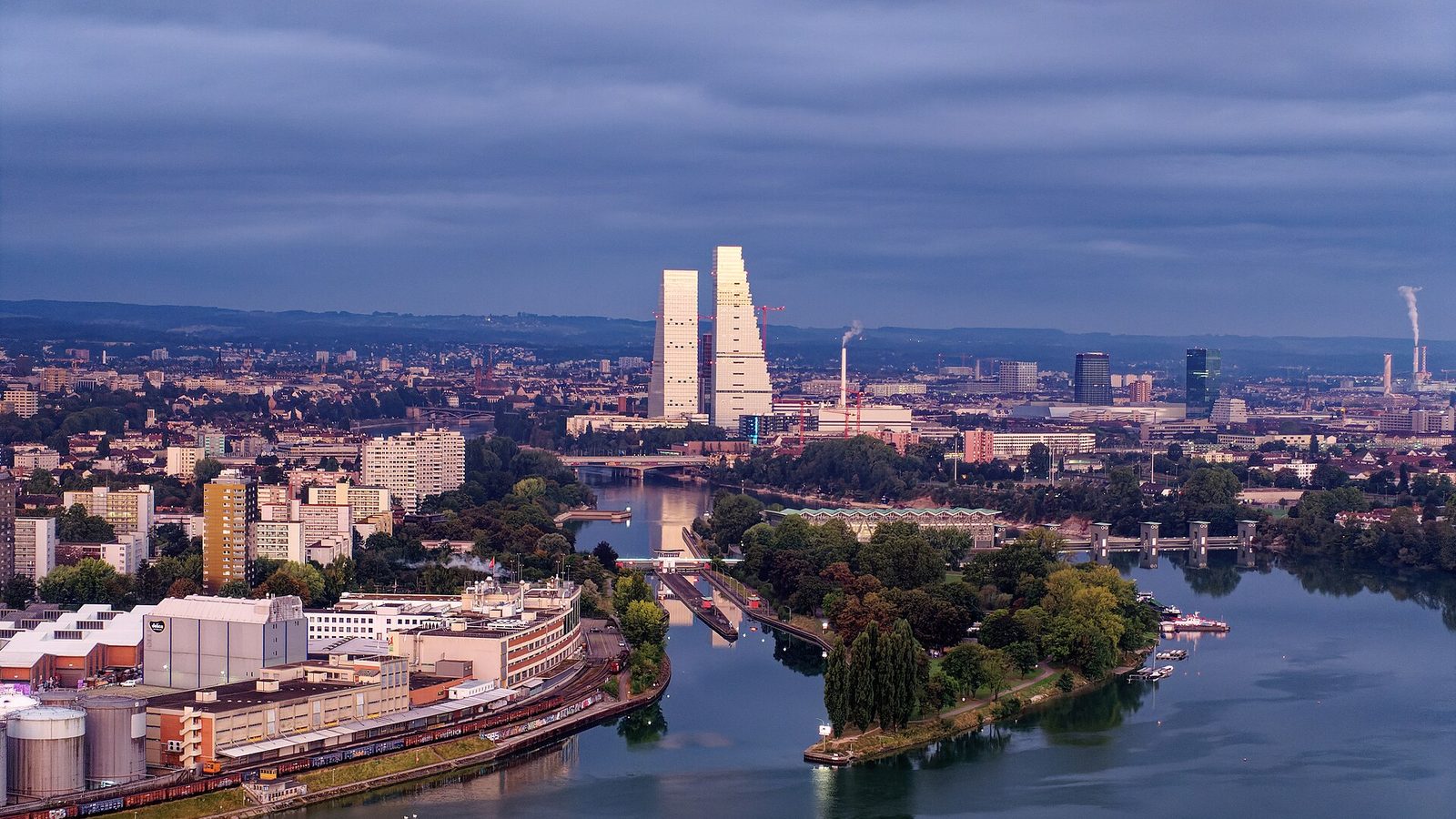
From dyes, it was a short step to medicines. In 1896, Fritz Hoffmann-La Roche founded Roche in Basel. A century later, Ciba-Geigy and Sandoz merged to form Novartis. Today, the Roche towers, the tallest buildings in Switzerland, rise above the Rhine like a monument to that journey. Together, chemicals and pharmaceuticals now make up more than half of everything Switzerland sells abroad.
What Switzerland sold to the world in 2025
Goods exports, CHF 287 billion in total. Tap a segment.
Source: Federal Office for Customs and Border Security, annual results 2025 (business-cycle total, excluding gold and other precious metals). Watch figure: Federation of the Swiss Watch Industry.
Why is Switzerland so rich if not because of banks?
Of course, banks are part of the reason why Switzerland is so rich. Zurich and Geneva are major financial centres, and Swiss banks manage enormous sums for clients from around the world. Even so, banks and insurers together account for only about 8.8% of the Swiss economy.
Notice the order in which things happened, too. Alfred Escher founded the Schweizerische Kreditanstalt in 1856 to pay for railways, not the other way around. Banking grew out of an economy that was already industrialising. Later, the infamous secrecy law of 1934 attracted foreign money, often untaxed. Our deep dive into Swiss banking secrecy shows how that model rose, and how it finally collapsed.
Then there's the darkest chapter. During World War II, the Swiss National Bank bought large amounts of gold from Nazi Germany, some of it looted. That history is real, and we cover it in our article on Switzerland and Nazi gold. However, Switzerland was already one of Europe's richest countries before the war. The gold trade made a few institutions richer and the country's reputation far poorer, but it doesn't explain Swiss prosperity.
Stability you can sell
Perhaps the least visible reason why Switzerland is so rich is trust. For a small country surrounded by large and often warring neighbours, stability was a matter of survival. Over time, it became a competitive advantage.
Slow politics, safe money
Switzerland's political system is famously slow. Seven ministers share power, and citizens can challenge almost any law at the ballot box. That's frustrating for reformers, but it also means that rules rarely change overnight. Investors love that. You can see how it works in our explainer on Swiss direct democracy.
Competing cantons
Then there's federalism. The 26 Swiss cantons set their own tax rates and compete for companies and residents. Some critics call it a race to the bottom. Supporters call it healthy competition that keeps governments lean.
Neutral and frugal
Add Swiss neutrality, which kept the country out of both world wars, and a population that votes for frugality. In 2001, nearly 85% of voters approved a "debt brake" that limits federal borrowing. Few other countries would vote to tie their own government's hands like that.
From famine to pharma: a timeline
Tap through the key moments that explain why Switzerland is so rich today, from the famine of 1816 to record exports.
From famine to pharma: 1816–2025
Tap a date, or use the arrow keys. Red dots mark turning points.
The year without a summer
Volcanic ash cools Europe. Harvests fail, and famine strikes eastern Switzerland in 1816–17.
New Glarus
Settlers from Glarus, organised by an emigration society, found New Glarus in Wisconsin.
First railway
The “Spanish Bun Railway” opens between Zurich and Baden.
One market
The new federal constitution ends customs duties between the cantons.
ETH Zurich
The federal polytechnic starts training engineers and chemists.
A bank for railways
Alfred Escher founds the bank that later becomes Credit Suisse.
Nestlé
Henri Nestlé launches his infant food, Farine lactée, in Vevey.
Gotthard
The Gotthard railway tunnel links northern Europe with Italy.
Roche
Fritz Hoffmann-La Roche founds his company in Basel.
Patents
Under German pressure, Switzerland starts granting patents on chemical processes.
Embroidery
St. Gallen embroidery is the country’s biggest export.
Factories intact
Swiss industry survives World War II undamaged and ready to sell.
Quartz shock
Cheap electronic watches cost the industry roughly two-thirds of its jobs.
Debt brake
Nearly 85% of voters approve limits on federal borrowing.
Record exports
Exports hit CHF 287 billion, despite a US tariff shock.
Then and now
Looking at the whole journey, a pattern appears. Switzerland's wealth didn't come from one lucky break. It grew from a long series of adjustments, each one a response to a crisis.
| Around 1850 | Today | |
|---|---|---|
| Main exports | Cheese, cattle, cotton and silk textiles, watches, and soldiers for foreign armies | Medicines, chemicals, watches, machines, precision instruments |
| Where wealth came from | Cottage industry, trade and money sent home by emigrants and mercenaries | Research, high-value manufacturing, finance and services |
| Migration | More people leaving than arriving | More than a quarter of residents hold a foreign passport |
| Typical worker | A family working at home on a loom or a watch part | A lab technician, engineer or skilled apprentice-trained specialist |
Sources: Historical Dictionary of Switzerland, Federal Statistical Office.
The other side of Swiss wealth
Asking why Switzerland is so rich also means asking who exactly is rich. Before you pack your bags for Zurich, it's worth looking at the less glamorous side of the numbers. Average wealth is high partly because a small group of people is extremely rich. The median Swiss adult, the one exactly in the middle, owns about $145,555. That's comfortable, but it ranks only eighth in the world. UBS also found that, after inflation, median wealth fell by roughly 15% between 2000 and 2025.
Life is expensive, too. Most households rent rather than own their home, health insurance premiums rise almost every year, and a simple lunch in Zurich can cost as much as dinner elsewhere.
A risky dependence
The economy also leans heavily on a few sectors and markets. In August 2025, the United States hit many Swiss goods with a 39% tariff, one of the highest it imposed on any country. It was cut to 15% that November, and US tariff rules have shifted several times since. Even so, the shock showed how exposed the model is. When more than half your exports come from one industry, and a fifth go to one country, a single political decision can hurt.
Quiz: real reason or myth?
Think you've got it? Test yourself on six common claims about why Switzerland is so rich.
Real reason or myth? Six claims about Swiss wealth
Score: 0 / 6Switzerland got rich mainly from Nazi gold.
Myth. The wartime gold trade was real and shameful, but Switzerland was already one of Europe’s richest countries before 1939.
Banks are the main engine of the Swiss economy.
Myth. Banks and insurers together produce about 8.8% of the economy. Industry, above all pharma, matters far more.
More than half of Swiss goods exports are chemicals and pharmaceuticals.
Real. In 2025, the share was 53%, a record CHF 152 billion.
Swiss communes once paid poor citizens to emigrate.
Real. In the 19th century, paying a family’s passage to America was often cheaper than supporting them at home.
Switzerland is rich in natural resources.
Myth. Apart from water, stone and some salt, there is almost nothing to dig up. That scarcity is the whole story.
The average Swiss adult is a millionaire.
Myth. Average wealth is about $910,000, but the median is $145,555. About 13% of adults are dollar millionaires.
What Swiss wealth really teaches us
So, why is Switzerland so rich? Not because of luck, gold or treasure in the ground. It's rich because generations of people in a cramped, cold and resource-poor country refused to accept their limits. Families worked by the window through long winters. Engineers dug through mountains, while chemists copied, learned and specialised. Merchants, meanwhile, sold to anyone who would buy.
That story also has its shadows: the soldiers who died for foreign kings, the families shipped across the ocean and the secret accounts that hid other people's money. But the core lesson is hopeful. A country doesn't need oil or a coastline to prosper. It needs skills, trust and the stubborn habit of turning problems into products.
If you want to see how all of this fits into the bigger picture, our Swiss history timeline covers 700 years in one place.
FAQ: why is Switzerland so rich?
Why is Switzerland so rich?
Switzerland is rich because it turned its weaknesses into strengths. With no raw materials and no sea, it specialised in light, high-value goods such as watches, machines and medicines. Add excellent education, political stability, a strong franc and openness to foreign talent, and you get one of the most productive economies in the world.
Is Switzerland rich because of its banks?
Only partly. Banks and insurers together account for about 8.8% of Swiss economic output. Industry, especially pharmaceuticals, plays a bigger role. Chemicals and pharma made up 53% of Swiss goods exports in 2025.
How did Switzerland become rich?
Over about two centuries. In the 19th century, Switzerland moved from cottage industries such as textiles and watchmaking to railways, chemistry and food processing. Its industry survived both world wars intact, and after 1945 high-value manufacturing, finance and research pushed incomes to the top of the world rankings.
What is Switzerland’s biggest export?
Chemical and pharmaceutical products. In 2025, they earned CHF 152 billion, more than half of all goods exports. Watches came second among the well-known brands, at CHF 25.6 billion.
Was Switzerland always rich?
No. In the early 19th century, Switzerland was a poor mountain country. Famines struck in 1816–17, and thousands of people emigrated to America. Some communes even paid poor families to leave.
Is everyone in Switzerland rich?
No. Average wealth is very high, but it is unevenly spread. The median adult has about $145,555, and most households rent rather than own their home. Living costs, especially housing and health insurance, are also among the highest in the world.
Sources and further reading
- UBS: Global Wealth Report
- SME Portal (Swiss Confederation): Record exports driven by chemicals and pharmaceuticals
- BAK Economics for the Swiss Bankers Association: The economic impact of the Swiss financial sector (2025)
- WIPO: Global Innovation Index
- Federation of the Swiss Watch Industry: Swiss watch exports in 2025
- Swiss National Museum blog: The “emigration” savings model (Rothrist, 1855)
- Swiss Federal Archives: Switzerland, land of emigration
- SECO: Swiss–US trade relations
Last updated 3 October 2026. Featured photo: Achilaos, via Wikimedia Commons (CC BY-SA 4.0).