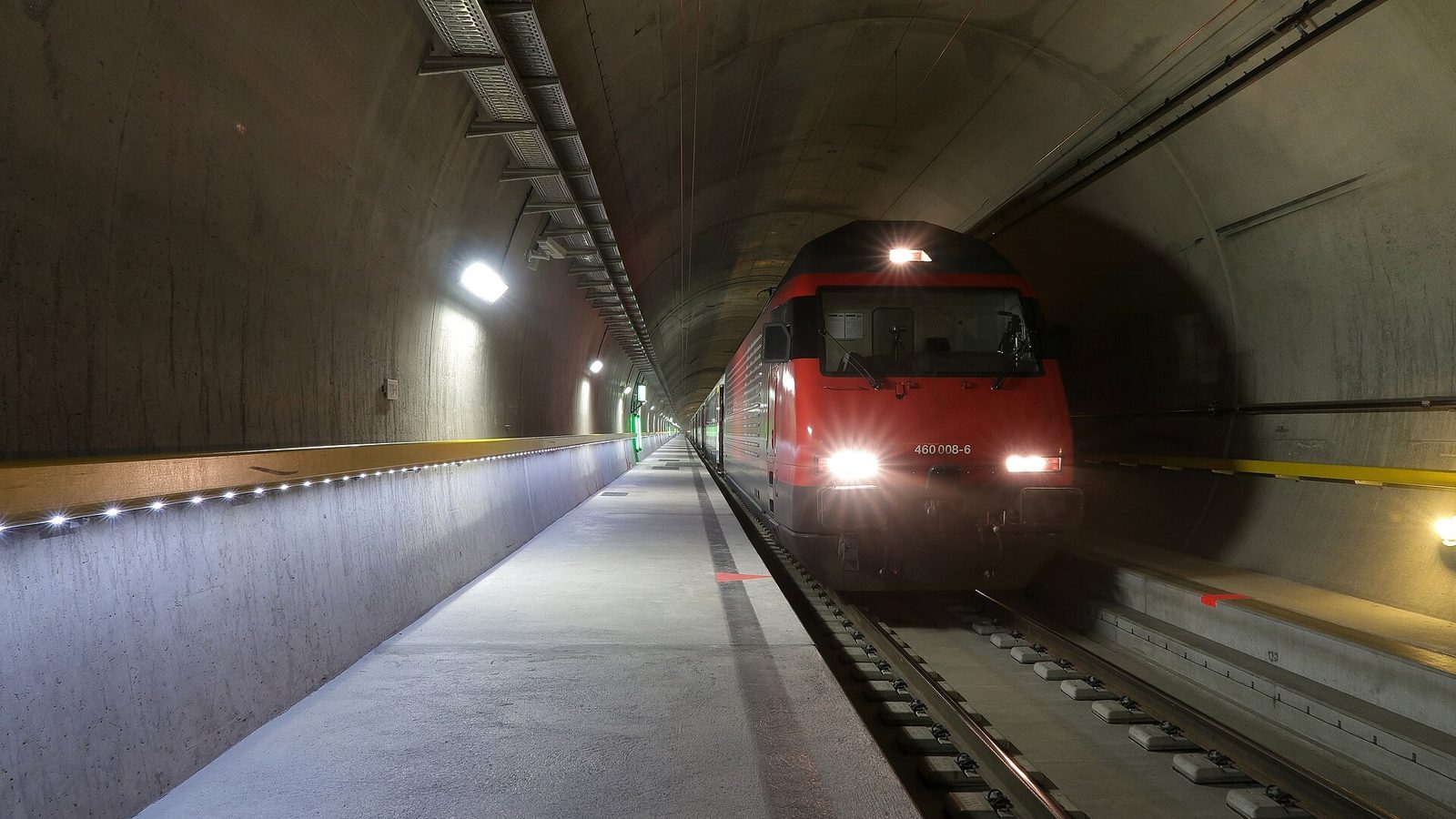
On 29 February 1880, deep inside the Swiss Alps, two teams of exhausted miners broke through the last wall of rock between them. The man who had promised to build their tunnel wasn’t there to see it. Louis Favre had collapsed and died inside the mountain seven months earlier. Today, a train passes far beneath his tunnel through the Gotthard Base Tunnel, at 57 kilometres the longest railway tunnel in the world.
This is the story of a mountain that Switzerland has crossed three times, at three different heights: over the top, through the middle and, finally, right at the bottom. Each crossing was faster than the one before. Each cost more money. And each, in its own way, cost lives.
It’s also a story about voters, lorries, a legendary goat and an opening ceremony that half the internet decided was a satanic ritual. Let’s go underground.
The Gotthard Base Tunnel at a glance
Before we dig into the history, here are the basic facts. The Gotthard Base Tunnel runs 57.1 km under the Alps, from Erstfeld in the canton of Uri to Bodio in Ticino. It consists of two single-track tubes, linked every 325 metres by cross-passages that double as escape routes. Its highest point lies at just 549 metres above sea level, so trains run almost on the level, as if the mountain weren’t there at all.
Sources: Federal Department of the Environment, Transport, Energy and Communications (DETEC), SBB.
The tunnel opened on 1 June 2016, exactly 134 years after the old Gotthard railway began regular timetabled service on 1 June 1882. Fittingly, the new tunnel is the bottom layer of a very old story.
One mountain, three crossings
The best way to understand the Gotthard Base Tunnel is to see it next to the two crossings that came before it. Tap each route below to compare them.
One mountain, three crossings
Tap a route to see how high it climbs. Heights are to scale; distances are simplified.
Sources: DETEC factsheet on the Gotthard Base Tunnel, Historical Dictionary of Switzerland. Simplified profile; mountain heights are indicative.
As you can see, every new crossing went lower. Lower meant shorter, flatter and faster, but it also meant more rock overhead, more heat and far more money.
Over the top: the pass and the Devil's Bridge
For centuries, the only way across was over the top, at 2,106 metres. The route had one terrible obstacle: the Schöllenen gorge, a narrow, roaring canyon on the northern side. Sometime in the 1200s, people managed to bridge it, and the Gotthard became one of the most important trade routes between northern Europe and Italy.
A deal with the devil
Naturally, the Swiss explained such a feat with a legend. According to the story, the people of Uri couldn't build the bridge, so the devil offered to do it. His price was the soul of the first living being to cross. When the bridge was finished, the clever villagers sent a goat across first. The furious devil grabbed a huge boulder to smash the bridge, but an old woman scratched a cross into the stone, and he dropped it. The "Devil's Stone" still lies near Göschenen.
Uri, by the way, is the canton of William Tell. You can read about whether he really existed in our article Was William Tell real?
The Tremola
In 1830, a proper road for carriages finally crossed the pass. On the southern side, its successor, the cobbled Tremola, still winds down towards Airolo in about two dozen hairpins. It's one of the most beautiful roads in the Alps, and a highlight of our guide to scenic drives in Switzerland.

Even so, the pass remained slow and dangerous. Snow closed it for months, and avalanches killed travellers. If Switzerland wanted to profit from trade between north and south, it had to go through the mountain, not over it.
Through the middle: the 1882 tunnel
The man behind the first tunnel was Alfred Escher, Zurich's railway king, banker and politician. He chaired the Gotthard Railway Company and secured money from abroad. Italy and Germany, both eager for a direct rail link, together paid most of the subsidies. In 1872, the Geneva engineer Louis Favre won the contract with a bold promise: he would dig the 15-kilometre tunnel in eight years, or pay heavy penalties.
Hell under the mountain
The work was brutal. Thousands of men, most of them poor Italians, drilled and blasted their way forward with compressed-air drills and dynamite. Inside, the air was hot, damp and full of dust and fumes. Water poured from the rock. Accidents with explosives, falling rock and wagons killed at least 170 workers according to the official list, and about 200 by most estimates. Many more fell ill from a parasitic worm that thrived in the tunnel's conditions.
Shots at Göschenen
In July 1875, workers at Göschenen went on strike over pay and conditions. A local militia was sent in and opened fire. Four workers were killed. It remains one of the darkest moments in Swiss labour history, and it's rarely mentioned in the proud accounts of the tunnel.

Favre's last walk
Favre never saw his tunnel finished. On 19 July 1879, he collapsed during an inspection deep inside the mountain and died. Seven months later, on 29 February 1880, the two teams broke through. Their surveyors had done remarkable work: the two tunnels met almost perfectly.
The railway opened in 1882, and it transformed Switzerland. Escher, however, had resigned in 1878 amid cost overruns. The bank he had founded to finance railways later became Credit Suisse, as our story about Swiss banking secrecy explains.
The road tunnel and the fire
A century later, cars and lorries got their own way through. The Gotthard road tunnel, 16.9 km long, opened on 5 September 1980. Soon, it was one of the busiest freight routes in the Alps.
Then, on 24 October 2001, two lorries collided inside the tunnel. The fire that followed killed 11 people. The disaster shocked Switzerland and strengthened a conviction that had been growing for years: heavy freight belonged on trains, not on mountain roads. In 2016, voters approved a second road tube, due to open around 2030, so that the old one can be renovated.
At the bottom: building the Gotthard Base Tunnel
The old railway had one big weakness. To climb to its tunnel, trains had to spiral up steep ramps. Near Wassen, the line loops around so much that passengers see the village church three times, from three different angles. Heavy freight trains needed extra locomotives, and speeds stayed low.
The Gotthard Base Tunnel solved that problem by going straight through the base of the mountain. However, building it was a challenge on a different scale.
Four giant moles
Engineers split the work into five sections, each with its own access point. Four huge tunnel-boring machines, each around 400 metres long with its support train, chewed through the rock. In Sedrun, in the middle of the mountain, crews reached the tunnel level through shafts about 800 metres deep, like a mine.
Heat, water and soft rock
Deep inside, the rock reached 46 °C, so the tunnel had to be cooled. In places, the rock was so soft and squeezing that the machines got stuck. Altogether, crews removed around 28 million tonnes of rock. Nine workers died during construction.
A breakthrough on live TV
On 15 October 2010, the boring machine broke through the last metre of rock between Sedrun and Faido, and Swiss television broadcast it live. Miners cheered and held up a statue of Saint Barbara, their patron saint. After eleven years of main construction, the east tube was finally connected. The west tube followed in March 2011.
Why Swiss voters paid for it
Here's the part that makes the Gotthard Base Tunnel uniquely Swiss. It wasn't simply a government decision. Citizens voted for it, more than once.
In 1992, 64% of voters approved the New Rail Link through the Alps, known as the NRLA. Two years later, voters went further. They narrowly approved the Alpine Initiative, which wrote into the constitution that freight crossing Switzerland should travel by rail, not by road. In 1998, they also approved a way to fund it, including a fee on heavy lorries.
Neighbouring countries weren't always pleased, but the message was clear. The people of Uri and Ticino were tired of endless lorries roaring through their valleys. In effect, the Swiss voted to protect the Alps by digging under them. It's a perfect example of Swiss direct democracy at work.
The world's longest railway tunnels
When it opened, the Gotthard Base Tunnel took the world record from Japan's Seikan Tunnel. Here's how it compares with other famous tunnels.
How the Gotthard Base Tunnel measures up
Length in kilometres. Tap a tunnel for details.
The Brenner Base Tunnel between Austria and Italy, due in the early 2030s, is set to become longer once its bypass link is counted. Sources: DETEC, tunnel operators.
The opening ceremony and the internet's satanic myth
On 1 June 2016, Switzerland threw a party. Angela Merkel, François Hollande and Matteo Renzi joined Swiss leaders for the opening. The highlight was a show by the German theatre director Volker Hesse, with about 600 people on stage, amateurs and professionals alike.
The show was strange, even by the standards of modern theatre. Dancers in workers' overalls moved through clouds of smoke. Dancers dressed as haystacks twirled across the stage. A figure with the horned head of an ibex towered over the crowd. Within days, online videos claimed it was a satanic ritual staged for a secret elite.
What it really meant
In reality, the explanation is much less sinister. The show told the story of the mountain, its workers and its legends. Its overalls honoured the tunnel builders, while the rough, natural costumes drew on Alpine folk traditions, much like the masked New Year figures in our story about Swiss Christmas traditions. And the horned figure? It was an ibex, the wild goat of the Alps that also appears on the coat of arms of Graubünden.
In other words, it was Alpine folklore turned into avant-garde theatre, with a touch of Swiss humour. If you enjoy those old customs, our guide to Swiss folk music and folklore is a good next stop.
Quiz: true or false?
Think you know your Gotthard myths from the facts? Test yourself with six quick questions.
True or false? Six claims about the Gotthard
Score: 0 / 6The Gotthard Base Tunnel is the longest railway tunnel in the world.
True. At 57.1 km, it overtook Japan’s Seikan Tunnel when it opened in 2016.
The 2016 opening show was a satanic ritual.
False. It was a theatre performance about the mountain, its workers and its legends, created by director Volker Hesse.
Hundreds of performers took part in the opening show.
True. About 600 people took part, amateurs and professionals alike.
Building the 1882 tunnel cost more than 150 workers their lives.
True. The official list names 171 victims, and most estimates put the toll at about 200. Most were Italian.
The European Union paid for most of the base tunnel.
False. Switzerland paid for it, mainly through a federal fund backed by a heavy vehicle fee and fuel and value-added taxes.
The base tunnel climbs higher than the 1882 tunnel.
False. Its highest point is just 549 m, about 600 metres lower than the old tunnel.
800 years of crossing the Gotthard
From a bridge built by the "devil" to the world's longest railway tunnel, tap through the key moments below.
Crossing the Gotthard, 1200s–2024
Tap a date, or use the arrow keys. Red dots mark turning points.
The Devil’s Bridge
A bridge over the Schöllenen gorge opens the Gotthard route to traders and pilgrims.
A road for carriages
Coaches can cross the pass on a proper road for the first time.
Digging begins
Louis Favre’s company starts work on the railway tunnel.
The strike
Troops fire on striking workers in Göschenen. Four are killed.
Favre dies
On 19 July, Louis Favre collapses and dies inside the tunnel.
Breakthrough
On 29 February, the two teams meet under the mountain.
Trains roll
The Gotthard railway opens, linking northern Europe with Italy.
Road tunnel
The 16.9 km road tunnel opens on 5 September.
Voters say yes
64% of voters approve the New Rail Link through the Alps.
Alpine Initiative
51.9% vote to move transit freight from road to rail.
Main works begin
Excavation of the base tunnel starts.
Fire
Two lorries collide in the road tunnel. Eleven people die.
Breakthrough
On 15 October, the boring machine breaks through between Sedrun and Faido.
Opening
The tunnel opens on 1 June and enters full service on 11 December.
Derailment
A freight train derails on 10 August. Full service returns in September 2024.
Riding the Gotthard today
If you take a train between Zurich and Lugano or Milan, you'll almost certainly pass through the Gotthard Base Tunnel. The ride takes around 20 minutes, mostly in darkness, and it's surprisingly smooth. There's no view, of course, but there's something moving about crossing the Alps in the time it takes to drink a coffee.
For the views, take the old line instead. The Gotthard Panorama Express combines a boat trip on Lake Lucerne with a train ride over the historic route, past the Wassen church and through Favre's tunnel. It runs in the warmer months, and it's one of the most memorable journeys in the country. You'll find more ideas in our list of the best places to visit in Switzerland.
A tunnel that can break
The new tunnel isn't invincible. On 10 August 2023, a freight train derailed inside it after a wheel broke, badly damaging the track. One tube stayed closed for more than a year, and full service only returned in September 2024.
What the Gotthard says about Switzerland
The Gotthard isn't just a mountain for the Swiss. It sits at the heart of the country, both on the map and in its imagination. During World War II, its fortresses formed the core of the National Redoubt, and its bridges and tunnels were wired with explosives, a story we tell in our article on Swiss bridges rigged to blow.
It also explains a lot about Swiss prosperity. A country without a coastline turned its biggest obstacle into Europe's busiest shortcut. That's a theme you'll find throughout our guide to why Switzerland is so rich.
Above all, the Gotthard Base Tunnel is a monument to the people who dug through the mountain. Next time your train slips into the darkness at Erstfeld, spare a thought for the nine workers who died building it. Remember, too, the roughly 200 who died above them in the 1870s, and Louis Favre, who walked into his tunnel one summer day and never walked out.
FAQ: the Gotthard Base Tunnel
How long is the Gotthard Base Tunnel?
The Gotthard Base Tunnel is 57.1 km long, the longest railway tunnel in the world. It has two single-track tubes. Including all cross-passages and access shafts, the tunnel system measures more than 150 km.
How long does it take to go through the Gotthard Base Tunnel?
Passenger trains need around 20 minutes. They travel at up to 200 km/h, while freight trains are slower.
How deep is the Gotthard Base Tunnel?
At its deepest point, about 2,300 metres of rock lie above the tunnel. The tunnel itself stays low, with its highest point at only 549 metres above sea level.
How much did the Gotthard Base Tunnel cost?
About CHF 12.2 billion. Swiss voters approved the project in 1992, and it was paid for through a federal fund for rail infrastructure.
Can you drive a car through the Gotthard Base Tunnel?
No. The base tunnel is for trains only. Drivers use the Gotthard road tunnel, which opened in 1980, or the pass road over the top, which is open in summer.
Was the Gotthard tunnel opening ceremony satanic?
No. The 2016 opening show was an artistic performance about the Gotthard, its workers and Alpine legends. Claims that it was an occult ritual spread online but are not supported by any evidence.
Sources and further reading
- Federal Department of the Environment, Transport, Energy and Communications: The Gotthard Base Tunnel, factsheet (PDF)
- Swissinfo: Switzerland celebrates the Gotthard tunnel (1 June 2016)
- Swissinfo: Gotthard tunnel, dancing haystacks not whirling dervishes
- Federal Office of Transport: Transfer of transalpine freight traffic from road to rail
- Swiss National Museum blog: Vincenzo Vela’s Victims of Labour
- Historical Dictionary of Switzerland: Gotthardbahn (in German)
- Federal Roads Office: Second Gotthard road tube (in German)
Last updated 3 October 2026. Featured photo: Kecko, via Wikimedia Commons (CC BY 2.0).