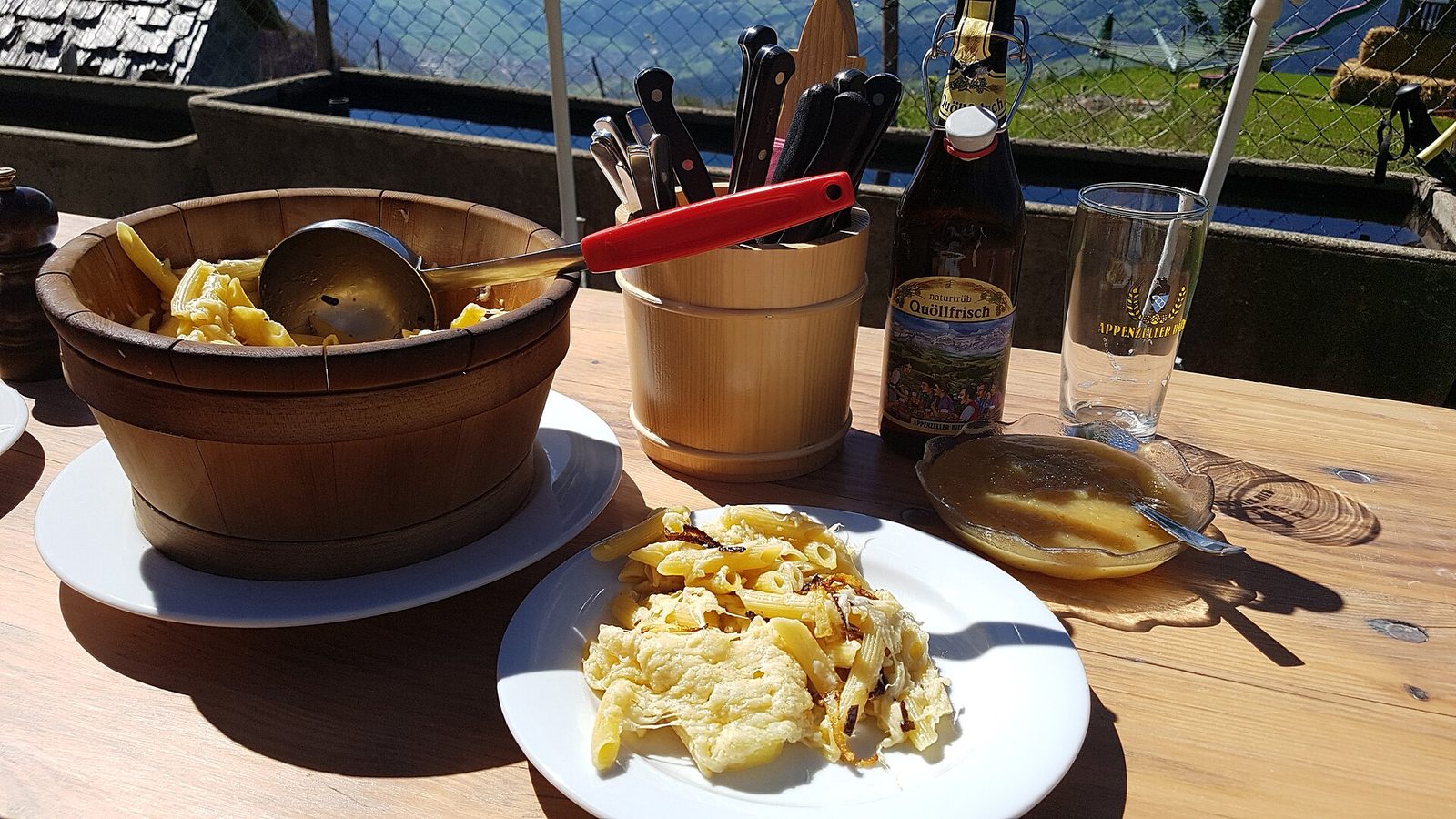
If you want to understand traditional Swiss food, start high above a valley in central Switzerland, where a farmer is carrying a wooden bowl out of her alp hut. Inside is a steaming tangle of macaroni, potatoes, melted cheese and crisp onions. On the side sits a small dish of applesauce. Hikers at the long wooden table go quiet for a moment. This is Älplermagronen, and for many Swiss, it tastes exactly like summer.
Ask ten Swiss people to describe traditional Swiss food, though, and you’ll get ten different answers. A farmer in Bern will talk about rösti. Someone in Lugano will mention polenta, while a family in Graubünden will start on capuns, a dish many Swiss outside Graubünden know only from restaurants. The truth is that Switzerland doesn’t have one kitchen. It has at least four, one for each language region, and dozens of local dialects in between.
This guide takes you through traditional Swiss food region by region, settles the question of the Swiss national dish as far as anyone can, and shows you what to eat, when and where. Cheese gets its own chapter elsewhere on this site, in our guide to Swiss cheese varieties. Here, we focus on the dishes.
What is traditional Swiss food?
In short, traditional Swiss food is mountain farm food, shaped by its neighbours. Most classic dishes were invented to use what a farm or an alp produced: potatoes, milk, cheese, cured meat, flour and dried fruit. Not much was ever thrown away. Stale bread went into fondue or sweet bread puddings, while leftover potatoes became rösti.
At the same time, each region borrowed from the culture next door. German-speaking Switzerland eats a lot like southern Germany and Austria, only with more cheese. French-speaking Switzerland shares its love of wine, charcuterie and long lunches with France. Ticino, south of the Alps, cooks very much like Lombardy. As a result, traditional Swiss food is less a single cuisine than a patchwork, stitched together by dairy and by a deep respect for local products.
That respect is official, too. The Culinary Heritage of Switzerland project has documented more than 400 traditional products, from sausages to biscuits. Around 40 foods carry a protected AOP or IGP label, like a passport proving where they come from.
Sources: Culinary Heritage of Switzerland, Swiss Association of AOP-IGP.
Is there a Swiss national dish?
Officially, no. Switzerland has never named a national dish, and given how proud each region is of its own food, it probably never will. Unofficially, though, the debate is lively, and five contenders come up again and again.
| Contender | Home region | The case for | The case against |
|---|---|---|---|
| Rösti | Bern and German-speaking Switzerland | Eaten all over German-speaking Switzerland. It even gave its name to the country’s language divide. | Many French-speaking Swiss see it as a German-Swiss dish. |
| Cheese fondue | French-speaking Switzerland | World-famous, shared from one pot and eaten in homes across the country. | Its national status owes a lot to a 20th-century marketing campaign. |
| Raclette | Valais | An old herders’ dish built on a protected cheese, Raclette du Valais AOP. | Outside the Valais, it’s mostly a winter party food. |
| Cervelat | Everywhere | The sausage that every region grills, often called the national sausage. | It’s a sausage, not a dish. |
| Zürcher Geschnetzeltes | Zurich | A restaurant classic of veal in cream sauce, usually served with rösti. | It’s a city dish, firmly tied to Zurich. |
There is no official ranking. This table reflects how the debate usually goes in Switzerland.
Rösti or fondue?
If you force the Swiss to choose, most will name rösti or fondue. Rösti began as a breakfast for farmers in the canton of Bern: grated potatoes fried in butter until they form a golden cake. It's so closely tied to German-speaking Switzerland that the invisible line between the German- and French-speaking parts of the country is called the Röstigraben, the "rösti ditch".
Cheese fondue has the bigger international reputation. Yet its rise to Swiss national dish is a surprisingly recent and rather commercial story. Until the mid-20th century, it was mainly eaten in French-speaking western Switzerland. How it conquered the whole country, with help from a government-backed cheese cartel and the Swiss Army, is a tale we tell in full in The Fondue Conspiracy.
My own answer? If a Swiss national dish exists, it's probably the humble cervelat. It's the one thing every region grills on 1 August, from Geneva to St. Gallen.
Traditional Swiss food, region by region
Now for the fun part. Switzerland's 26 cantons all have their own specialities, but they group naturally into a handful of food regions. Tap through them below, then read on for the stories behind the dishes.
Traditional Swiss food, region by region
Tap a region to see its signature dishes, sweets and secrets.
- Signature dishes
- Something sweet
- Local secret
- Don’t miss
German-speaking Switzerland: potatoes, sausages and something sweet
The largest region is also the most hearty. Here, traditional Swiss food means potatoes, sausages, creamy sauces and an impressive range of biscuits.
Bern: rösti and a victory platter
Bern gave the country rösti, but its most spectacular dish is the Berner Platte. It's a huge platter of boiled and smoked meats, sausages, bacon, beans and sauerkraut. According to local legend, it was first served to celebrate the Bernese victory over French troops at Neuenegg in March 1798. The French won the war, but the platter stayed.
Every November, Bern also holds the Zibelemärit, an onion market that fills the streets of the Old Town with plaited onion strings and onion tarts. If you visit the capital of Switzerland on the fourth Monday of the month, follow your nose.

Zurich, St. Gallen and the northeast
Zurich's signature dish is Zürcher Geschnetzeltes, thin strips of veal in a creamy mushroom sauce, served with a crisp rösti. The city also gave the world muesli. Around 1900, the Zurich doctor Maximilian Bircher-Benner served a mix of soaked oats, grated apple, nuts and lemon juice to his patients. Today, Birchermüesli is a breakfast staple across the country.
Further east, the St. Galler Bratwurst rules. It's a pale sausage of veal and pork, and locals have one strict rule about it: no mustard. In Appenzell, try Mostbröckli, smoked and air-dried beef, and the small, almond-filled gingerbreads called Biberli.
Basel and central Switzerland
Basel's food calendar revolves around Fasnacht, its famous carnival. After the 4 a.m. Morgestraich parade, revellers warm up with Mehlsuppe, a soup made from roasted flour. The rest of the year, the city's sweet calling card is the Basler Läckerli, a spiced honey biscuit.
Central Switzerland, meanwhile, is home to Älplermagronen, the dish from our opening scene. A popular story, which food historians treat with caution, claims pasta reached the Alps with the Italian workers who dug the first Gotthard rail tunnel in the 1870s. Their hard lives are part of our story about the three Gotthard crossings. For dessert, Zug offers the Zuger Kirschtorte, a layer cake soaked in kirsch, with no cherries in sight.
Graubünden: the strangest names in Swiss food
In the mountainous southeast, traditional Swiss food gets wonderfully unfamiliar. Many dishes have Romansh names, which makes sense in the only canton where Romansh is an official language. Our guide to the Swiss languages explains why that matters so much.
Capuns, Pizokel and Maluns
The star is capuns: little parcels of spätzli dough mixed with dried meat, wrapped in chard leaves and simmered in milk and broth, then topped with cheese. Every family claims its own recipe. Pizokel are thick little dumplings, sometimes made with buckwheat flour and often baked with cabbage and cheese. Maluns may be the humblest of all, grated potatoes roasted slowly in butter and flour until they turn into golden crumbs.

Air-dried beef and a walnut tart
Graubünden is also famous for Bündnerfleisch, beef cured and air-dried in the mountain wind, then sliced as thin as paper. For something sweet, there's the Engadiner Nusstorte. It's a shortcrust tart filled with caramel and walnuts that keeps for weeks, which made it a popular souvenir for travellers.
Ticino: Italian soul, mountain pantry
Cross the Gotthard to the south, and the food changes as quickly as the language. Traditional Swiss food in Ticino means polenta stirred for an hour in a copper pot, risotto, brasato braised in red wine and seasoned luganighe pork sausages.
The best place to eat it is a grotto. Originally, grotti were cool stone cellars in the woods where families stored wine and cheese. Over time, many turned into rustic restaurants with granite tables under chestnut trees. In autumn, those chestnuts become the region's other staple, roasted on street corners or turned into flour, cakes and purée. Pair it all with a glass of local Merlot.
Valais: raclette, rye bread and a pie called cholera
The Valais, the long sunny valley of the upper Rhône, gave the world raclette. Herders once melted half a wheel of cheese by the fire and scraped the soft layer onto potatoes. Today, it's a winter party favourite all over the country, but the protected Raclette du Valais AOP still comes only from here.
The Valais also has one of the oddest names in European cooking: cholera. It's a covered pie of potatoes, leeks, apples and cheese. Some say it dates from a 19th-century cholera epidemic, when people stayed home and cooked with whatever they had. Others link it to a dialect word for coal.
Try the dark, dense Walliser Roggenbrot AOP, a rye bread made to last for weeks, and look out for saffron from the tiny village of Mund. It's one of the very few places in Switzerland where saffron grows.
French-speaking Switzerland: Lake Geneva and the Jura arc
In Romandy, as the French-speaking west is called, traditional Swiss food comes with a glass of wine. Vineyards line Lake Geneva, and charcuterie is a serious art form.
Vaud and Geneva
The Vaud classic is papet vaudois, a creamy stew of leeks and potatoes topped with saucisson vaudois or the cabbage-flavoured saucisse aux choux. Along the lake, the wine villages around Vinzel serve malakoffs, crisp fried cheese fritters. Legend says Swiss mercenaries invented them during the Crimean War siege of Malakoff in 1855. In reality, the recipe took shape decades later, but the story fits the long history of the Swiss mercenaries perfectly.
Geneva has its own sausage, the fennel-scented longeole, and a protected vegetable, the spiny cardoon, which locals bake into a gratin at Christmas. December also brings the Escalade, when children smash chocolate cauldrons. You can read more about it in our guide to Swiss Christmas traditions.
Fribourg, Neuchâtel and the Jura
Fribourg throws the biggest food party of the year. The Bénichon, a harvest festival held in the autumn, comes with a menu that can last all afternoon: cabbage soup, ham and smoked meats, roast leg of lamb, small poached pears, meringues with double cream and cuchaule, a saffron brioche spread with sweet Bénichon mustard. Fribourg is also famous for fondue moitié-moitié, a half-and-half blend of two local cheeses.
In the Jura, November means the Saint-Martin feast in the Ajoie, a marathon menu of pork dishes. Neuchâtel's Val-de-Travers, meanwhile, is the birthplace of absinthe. Switzerland banned the green spirit in 1910 and only legalised it again in 2005.
Why Swiss food is the food of hard times
Look closely at all these dishes and a pattern appears. Traditional Swiss food comes from a country that was, for centuries, poor. Mountain farmers had to make every calorie count and every product last.
That's why so many classics are built around preservation. Meat was air-dried in the mountain wind, and cheese was made in summer to feed families through the winter. Bread was baked to keep for weeks, and potatoes, which spread across the country in the 18th century, became a lifeline during hunger years. Our story of why Switzerland is so rich begins with exactly those hard times, when some people survived on grass and wild plants.
In other words, the comfort food that tourists queue for today was once survival food. That, to me, is what makes it so moving. Every plate of rösti or capuns carries a little of that history.
A year of traditional Swiss food
Swiss food follows the seasons and the festival calendar closely. Tap through the year below to see what's on the table, and when.
A year of Swiss food
Tap a month, or use the arrow keys. Red dots mark the big food festivals.
Three Kings’ cake
On 6 January, families share a sweet bread crown with a tiny plastic king hidden inside. Whoever finds it wears the paper crown.
Fasnacht
Carnival season brings flour soup, onion and cheese tarts, and wafer-thin fried Fasnachtschüechli.
Osterfladen
Bakeries sell Easter tarts filled with rice or semolina pudding.
Up on the alp
Herds move to high pastures, and alp huts serve Älplermagronen, cheese and fresh cream.
National Day
Barbecues everywhere: cervelats, bratwurst and a bread roll topped with a Swiss flag.
Bénichon
Fribourg’s harvest feast serves an endless menu of soups, meats, saffron bread and meringues.
Chestnuts and Metzgete
Roasted chestnuts on street corners and pork feasts called Metzgete in country inns.
Onions and Saint Martin
Bern holds its Zibelemärit, and the Ajoie celebrates Saint Martin with a giant pork feast.
Samichlaus and Escalade
Children get bread men called Grittibänz, and Geneva smashes chocolate cauldrons.
Quiz: Swiss or not?
Plenty of dishes around the world carry the word "Swiss". Fewer of them have ever been near Switzerland. Can you tell which is which?
Swiss or not? Six dishes with a Swiss connection
Score: 0 / 6Swiss roll
Not Swiss. The rolled sponge cake is famous in Britain, but nobody knows why it got its name, and it isn’t a Swiss speciality.
Capuns
Swiss. Little parcels of dough and dried meat wrapped in chard leaves, straight from Graubünden.
Swiss steak
Not Swiss. It’s an American dish of tenderised, braised beef. The name is often linked to “swissing”, a way of rolling cloth, but nobody can prove it.
Cholera
Swiss. A Valais pie of potatoes, leeks, apples and cheese. The name may come from a 19th-century epidemic, or from a dialect word for coal.
Muesli
Swiss. The Zurich doctor Maximilian Bircher-Benner served it to his patients around 1900.
Maluns
Swiss. Grated potatoes roasted slowly in butter with a little flour, from Graubünden.
Where to eat traditional Swiss food
Here's the good news: you don't need a fancy restaurant to try traditional Swiss food. In fact, the best versions are usually found in simple places.
- Alp huts and mountain restaurants. In summer, many alps serve their own cheese, cream and Älplermagronen to hikers.
- Village inns. Look for a Beiz, Gasthof or café with a short daily menu. The dish of the day is often the most traditional choice.
- Grotti in Ticino. Rustic, outdoor and seasonal, they're perfect for polenta, cured meats and Merlot.
- Festivals. The Bénichon, Saint-Martin, Zibelemärit and Fasnacht are edible history lessons.
- Butchers and bakeries. Many regional specialities, from sausages to Nusstorte, are easiest to find there.
For ideas on where to go, see our list of the best places to visit in Switzerland. And if you have a sweet tooth, our guide to the Swiss chocolate experience covers the country's most famous sweet export.
What Swiss food tells you about Switzerland
Traditional Swiss food is a lot like the country itself. It's small, regional and stubbornly local. It speaks four languages, borrows from its neighbours, then quietly insists that its own version is better. And while the world thinks of Switzerland as one big fondue pot, the Swiss know that the real flavour lies in the valleys, where every canton still cooks a little differently.
So when you travel, don't stop at the famous dishes. Order the thing with the strange name. Ask what the locals eat on a Tuesday. That's where traditional Swiss food really lives.
FAQ: traditional Swiss food
What is the most traditional Swiss food?
Traditional Swiss food is simple farm food: rösti, cheese dishes such as fondue and raclette, sausages, air-dried meats, pasta bakes like Älplermagronen and, in Ticino, polenta and risotto. Each language region has its own specialities.
What is the national dish of Switzerland?
Switzerland has no official national dish. Rösti and cheese fondue are the most common answers. Raclette, the cervelat sausage and Zürcher Geschnetzeltes are often mentioned too.
What food is Switzerland famous for?
Switzerland is best known for cheese, chocolate, fondue, raclette and rösti. Inside the country, regional dishes such as capuns, polenta, papet vaudois and Berner Platte matter just as much.
What do Swiss people eat for breakfast?
Most Swiss breakfasts are simple: bread, butter, jam, cheese and coffee, or Birchermüesli. On Sundays, many families eat Zopf, a braided butter bread. Rösti began as a farmers’ breakfast in the canton of Bern.
Is Swiss food different in each region?
Yes. German-speaking Switzerland leans towards potatoes, sausages and hearty sauces, French-speaking Switzerland towards cheese, wine and charcuterie, and Ticino towards Italian dishes such as polenta and risotto. Graubünden has dishes found nowhere else.
Which Swiss dishes should I try first?
Start with rösti, cheese fondue or raclette, then go regional: capuns in Graubünden, polenta in a Ticino grotto, papet vaudois around Lausanne and Älplermagronen in an alp hut.
Sources and further reading
- Culinary Heritage of Switzerland (Patrimoine culinaire suisse)
- Swiss Association of AOP-IGP: Register of Swiss designations of origin
- Swissinfo: ‘Cervelat is the ultimate Swiss food’
- Region of Fribourg: History and tradition of the Bénichon
- City of Bern: Zibelemärit (in German)
- Swiss National Museum blog: The Ticino grotto
- Wikipedia: Malakoff (food)
Last updated 3 October 2026. Featured photo: Uwe Häntsch, via Wikimedia Commons (CC BY-SA 2.0).