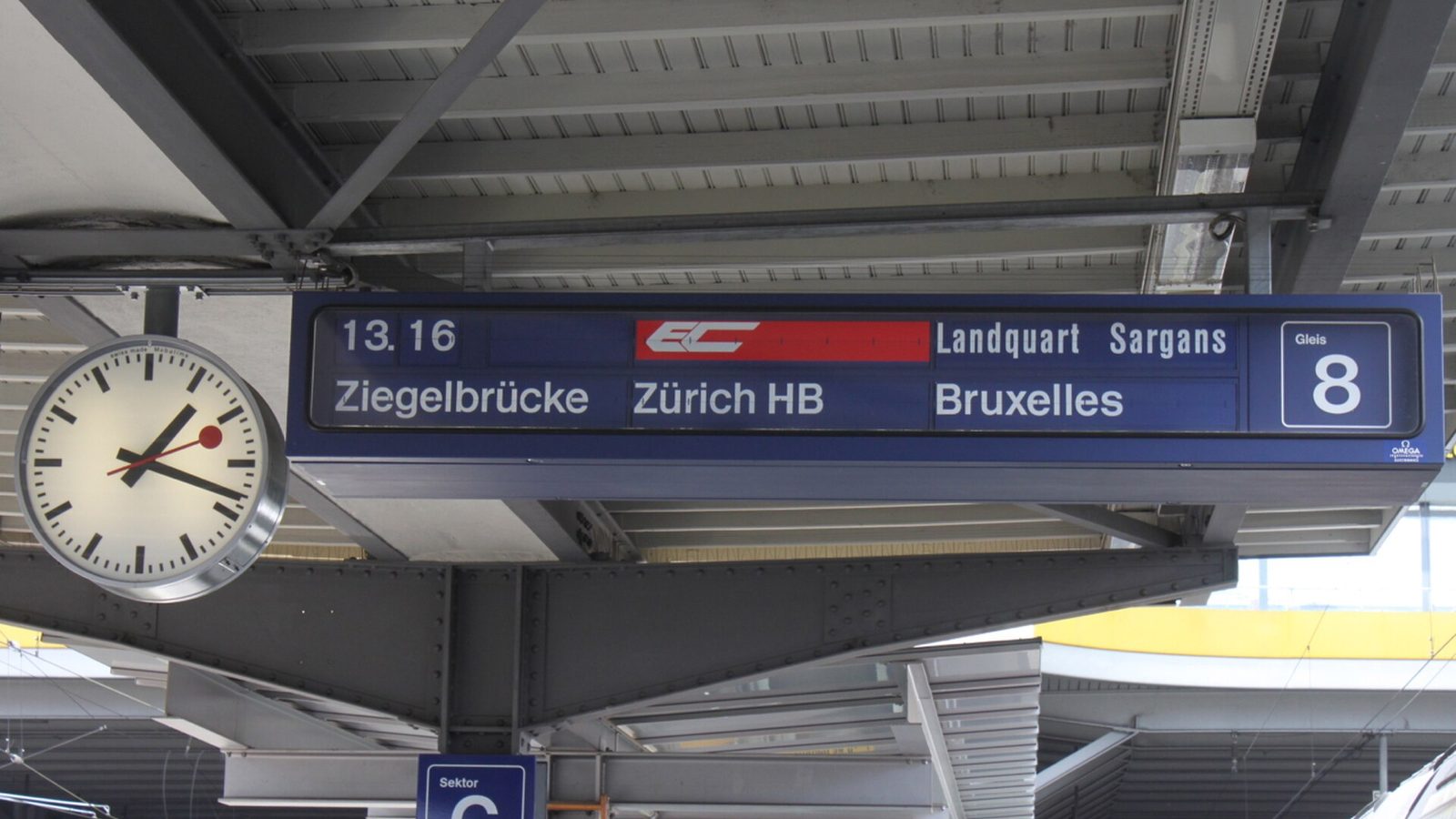
Stand on any Swiss platform just before a train leaves and watch the Swiss railway clock above your head. The red second hand sweeps round the face, reaches the top and then does something no ordinary clock does. It stops. For about a second and a half, nothing moves. Then the minute hand jumps, the red hand sets off again, and a train pulls out on the dot.
Most travellers never notice. Those who do usually assume it’s broken. It isn’t. That pause is the whole point of the clock, a design so simple and so clever that it ended up in museum collections, on millions of wrists and, in 2012, on millions of iPads, without anyone asking the Swiss Federal Railways first.
This is the story of that clock: the engineer who drew it, the trick that keeps a whole country’s stations in step, the deal that made Apple pay, and what it all reveals about how Swiss trains really run on time.
Sources: SBB, Historical Dictionary of Switzerland, Swiss Museum of Transport, Tages-Anzeiger via NBC News.
The minute that lasts 58.5 seconds
Start with what you can see. The Swiss railway clock, often simply called the SBB clock, has no numbers at all. Thick black bars mark the hours, thin ones mark the minutes, and two plain black hands do the rest. The only colour is the second hand: a thin red stick ending in a red disc.
Watch that red hand for a full minute and you'll spot the secret. It doesn't take 60 seconds to go round the face. It takes about 58.5. Then it waits at 12, perfectly still. When the next minute begins, the minute hand jumps forward in one clean step and the red hand sets off again.
You don't need to travel to Switzerland to see it. The replica below runs on your own device's clock. Press "Skip to the pause" if you don't want to wait.
Watch the minute that lasts 58.5 seconds
Left: a replica of the Swiss station clock, running on your device’s time. Right: an ordinary clock for comparison.
Side by side, the difference is obvious. An ordinary clock ticks along evenly forever and never asks anyone's permission. The Swiss station clock runs slightly fast, then waits to be told that the new minute has started. In other words, it isn't really a clock on its own. It's one part of a system.

Why does the Swiss station clock stop?
To understand the pause, go back to the early 1940s. The Swiss Federal Railways, the SBB, needed hundreds of station clocks that all showed exactly the same time. A train timetable has no seconds in it, and Swiss trains leave on the full minute, so every clock in every station had to agree.
The minutes were the easy part. Each station had a master clock that sent an electric pulse to the other clocks once a minute, and each pulse pushed the minute hands forward by one step. As long as the pulses arrived, every minute hand in the station agreed.
The second hand was the problem. It couldn't be driven by pulses every second, so it got its own small electric motor, running off the mains. That motor's speed follows the frequency of the power grid, which wobbles a little. Left alone, each red hand would slowly drift away from the master clock.
Hans Hilfiker's solution was brilliantly lazy. Instead of chasing a perfect power supply, he made every motor run a little fast, so the red hand finishes its lap after about 58.5 seconds. Even if the grid frequency dipped, it would still reach the top in time. At 12, a catch holds it in place until the minute pulse releases it. The pause wipes out whatever errors built up during the minute, and every clock starts the next minute together.
See the drift for yourself
The demonstration below speeds up time. Without the pause, six clocks whose motors run at slightly different speeds drift further apart every minute. Switch on Hilfiker's pause and watch them line up again at the top of every minute.
Six stations, six clocks: why the pause matters
Each clock’s second hand runs on its own motor, and tiny differences in speed add up. Time is sped up: one minute passes every 10 seconds.
Today, the original technical problem has gone. Modern clocks receive time signals accurate to a fraction of a second, so the pause could easily be engineered away. The SBB keeps it anyway, because it has become the clock's signature. Even the large digital clock at Bern Wankdorf station pauses at the end of each minute.
Hans Hilfiker: the engineer behind a national icon
The man who designed the Swiss railway clock wasn't a watchmaker. Hans Hilfiker was born in Zurich in 1901, trained as a precision mechanic and then studied electrical engineering at ETH Zurich. In the late 1920s, he was in Argentina, advising the army's telecommunications troops and working on telephone lines, including one across the Paraná River.
He joined the SBB in 1932, in its Zurich construction department. Swiss stations at the time used a jumble of clocks from different makers, and they didn't always agree. Hilfiker's answer, developed with the clockmaker Moser-Baer of Sumiswald, dates from 1944 and spread across the network over the following years. He also designed platform roofs, including the one at Winterthur-Grüze, and later ran the railway's section for fixed electrical installations.
Then, in 1958, he left the railways for Therma, a Swiss maker of kitchen appliances. There, he helped shape a standard for fitted kitchens. If you've ever wondered why Swiss kitchen units are often 55 centimetres wide rather than the European 60, part of the answer leads back to the same engineer. He died in Locarno in 1993, aged 91.
The red disc on a stick
The clock's most famous feature took a few years to settle in. Hilfiker's first station clocks had no second hand at all. The red hand that made the design iconic is shaped like the signal paddle that railway staff raised to tell a driver the train could leave.
It was tested at Zurich's main station during the war years, and by 1947 Hilfiker was making the case for it. Sources still disagree on when it became standard, with dates up to the mid-1950s. A Hilfiker clock of the 1947 type in the Swiss Museum of Transport in Lucerne has it.
The idea was practical: passengers could see at a glance how many seconds were left before departure. The effect was almost poetic. Every Swiss station became a countdown.
Anatomy of a design icon
Good design often looks obvious after someone else has done it. Hilfiker's dial is a lesson in leaving things out. Tap through its parts below.
Anatomy of a design icon
Tap a part of the clock to see why Hilfiker drew it that way.
- What you see
- Why it matters
The result belongs to the same Swiss tradition as the Swiss Army knife: objects designed to work first and look good as a side effect. Today, the Museum of Modern Art in New York and the Design Museum in London both list the Swiss railway clock among the classics of 20th-century design. For a railway clock that was simply meant to be readable from the far end of a platform, that's quite a career.
Five details of the SBB clock most people never notice
Once you know the pause, you start seeing other quirks. Here are five that even regular commuters tend to miss.
- The minute hand never glides. On most clocks, it creeps forward all the time. On the SBB clock, it waits a full minute and then jumps, so there's never any doubt about which minute you're in.
- The red hand is usually ahead of the real time. Because it laps the face in 58.5 seconds, it gains a little every second. Halfway through the minute, it's already about three-quarters of a second ahead.
- The hour hand moves in tiny steps. It's geared to the same minute pulse, so it shifts by a small notch every time the minute hand jumps.
- Many platform clocks are double-sided. Hung at right angles to the track, they can be read from both directions, like the clock at Brienz in the photo above.
- The pause has spread beyond Switzerland. Station clocks in other countries have borrowed both the look and, in some cases, the stop at 12.
How a railway clock took on Apple
In September 2012, Apple released iOS 6. Among the new features was a clock app for the iPad. Its face looked very familiar to anyone who had ever caught a Swiss train. It was, unmistakably, the Swiss railway clock.
Nobody had asked the SBB. The day after the update appeared, an SBB spokesperson said the railway was proud that Apple had chosen its design, but made it clear that the design was not licensed. Rather than going to court, the two sides talked. On 12 October 2012, they announced a licence agreement.
Neither side published the terms. A few weeks later, the Zurich newspaper Tages-Anzeiger reported that Apple had paid around 20 million Swiss francs. Neither Apple nor the SBB has confirmed the figure. If it's right, those 58.5 seconds of design are among the most valuable in railway history.
There's a twist, too. A year later, iOS 7 brought a new look to Apple's software, and the Swiss station clock quietly disappeared from the iPad.
From platform to wrist
Apple wasn't the first company to see the commercial value of the SBB clock. The Swiss brand Mondaine has sold licensed wristwatches with the station clock's face since 1986. In 2013, it went further with the Stop2Go, a watch whose second hand races round the dial in about 58 seconds and then pauses at 12, just like the original.
It's a rare Swiss watch whose design came from a railway engineer rather than a watchmaker. Our story of why Swiss watches are so expensive explains the industry it joined.
Swiss time before the station clock
Long before Hilfiker drew the Swiss railway clock, Switzerland had to decide what time it actually was. Until the mid-19th century, towns kept their own local time based on the sun, and noon in Geneva came several minutes after noon in Zurich.
The telegraph changed that. From 1853, telegraph and post offices across the country used Bern mean time, roughly half an hour ahead of Greenwich. From 1860, the observatory in Neuchâtel set it each day and wired it to Bern. The railways followed, and for decades Bern time effectively ran the country. The city's famous Zytglogge clock tower had kept its time since the Middle Ages, and you can still see its astronomical clock in our guide to the best places to visit in Switzerland, and in our tour of the cultural treasures of Switzerland.
Then, on 1 June 1894, Switzerland adopted Central European Time, the same as most of its neighbours. One country, one time, at last. Bern itself, as we explain in our article on the capital of Switzerland, has never officially been named the capital.
The summer Switzerland became a time island
Swiss time had one more surprise in store. On 28 May 1978, voters rejected a law that would have introduced summer time. Farmers had launched the referendum, and about 52% said no. Interestingly, the French-speaking cantons of Geneva, Vaud and Neuchâtel voted yes, tired of train and TV schedules that didn't match France.
The result had consequences. In 1980, Germany and Austria moved their clocks forward, and for one summer Switzerland ran an hour behind almost every neighbour. Parliament revised the law, a new referendum attempt failed to collect enough signatures, and in 1981 Switzerland joined the rest of Europe. It's a classic case of Swiss direct democracy at work.
How Swiss trains stay on time
The Swiss railway clock is the symbol, but it isn't the reason the trains are punctual. The real secret is the way the whole timetable is built.
The clock-face timetable
In 1982, the SBB introduced the Taktfahrplan, or clock-face timetable. Instead of a different schedule every hour, trains on most lines now leave at the same minutes past every hour. Passengers no longer need to look anything up, and connections repeat like clockwork all day. The switch reportedly gave the network about 20% more connections overnight.
Hubs that meet on the hour
The next step was bolder. In 1987, voters approved Rail 2000 with 57% support. Its central idea was the node principle: trains should arrive at the big hub stations shortly before the full or half hour and leave shortly after, so passengers can change in every direction.
For that to work, journeys between hubs had to take just under an hour, or just under half an hour. Speed was only a means to an end. The planners' motto was to run "as fast as necessary, not as fast as possible". When the first stage opened in December 2004, a new line cut the Zurich–Bern journey from 69 minutes to just under an hour. The 56-minute target followed in December 2007, once new signalling allowed 200 km/h. Drag the slider below to see the principle in action.
How Swiss trains meet on the hour
Drag the slider through the minutes around the full hour at a hub station.
- 1Bern → St. Gallen: in at :54, out at :02
- 2Basel → Chur: in at :55, out at :03
- 3St. Gallen → Bern: in at :56, out at :04
- 4Chur → Basel: in at :57, out at :06
A simplified illustration of the node principle, not a real timetable. In practice, hubs such as Zurich, Bern and Basel are linked by journeys of just under an hour or half an hour.
Three minutes, not five
The SBB also measures itself strictly. A train only counts as on time if it arrives less than three minutes late, a tighter limit than several neighbouring countries use. In 2025, 94.1% of passenger trains met that standard, the best result on record. In 2024, passengers made 98.7% of their connections.
SBB punctuality, 2021 to 2025
Share of passenger trains arriving less than three minutes late. Tap a year for details.
Source: SBB annual punctuality figures, as reported by IamExpat, Railway Journal and blue News. The Swiss three-minute threshold is stricter than the limits used in several neighbouring countries.
A nation of train riders
All this has turned the Swiss into Europe's keenest rail travellers. In 2024, the average resident travelled 2,519 kilometres by train, far ahead of any other European country. Massive projects such as the Gotthard Base Tunnel keep extending the network, and they're part of the story of why Switzerland is so rich.
Who rides the train most in Europe?
Kilometres travelled by train per inhabitant in 2024. Tap a country for details.
Source: LITRA (Swiss public transport information service), as reported by Swissinfo.
Where to see the most famous Swiss railway clocks
Almost every Swiss station has a Hilfiker clock, but a few are worth a detour.
- Zurich main station: in the main hall, a large four-sided version of the clock stands on a steel column. It's one of the country's classic meeting points.
- Aarau: a giant clock on the station facade, about nine metres across, is the largest station clock in Switzerland and the second-largest in Europe.
- Bern Wankdorf: the big digital clock here still pauses at the end of every minute, a tribute to its analogue ancestor.
- The Swiss Museum of Transport, Lucerne: its collection includes a Hilfiker clock of the 1947 type, along with locomotives and railway objects from every era.
Abroad, the design has travelled too. Railway stations from Hong Kong to Santiago de Chile have used versions of it.


The Swiss railway clock through history
From the Bern time of the 1850s to the iPad, here are the key moments in the story. For the bigger picture, see our Swiss history timeline.
From Bern time to the iPad
Tap a year, or use the arrow keys. Red dots mark the turning points.
Bern sets the time
Telegraph and post offices switch to Bern mean time.
One time for the whole country
On 1 June 1894, Switzerland adopts Central European Time.
A new clock for every station
Hilfiker designs the new station clock, driven by minute pulses from master clocks.
The case for a red hand
Hilfiker argues for a red second hand, after trials at Zurich main station.
Voters say no to summer time
About 52% of voters reject a law on daylight saving time.
A time island in Europe
For one summer, Switzerland runs an hour behind almost all its neighbours.
The clock-face timetable
Trains on most lines start leaving at the same minutes every hour.
From platform to wrist
Mondaine starts selling licensed watches with the station clock’s face.
Rail 2000 opens
The first stage of Rail 2000 brings Zurich–Bern under an hour.
Apple copies the clock
iOS 6 puts the design on iPads without permission. A licence follows within weeks.
Record punctuality
94.1% of SBB passenger trains arrive less than three minutes late.
Quiz: true or false?
How well do you know the clock now? Six quick questions will tell.
True or false? Six facts about the Swiss railway clock
Score: 0 / 6The red second hand takes exactly 60 seconds to go round the face.
False. It takes about 58.5 seconds, then waits at 12 for the minute pulse.
The clock’s designer was a watchmaker.
False. Hans Hilfiker was an electrical engineer at the SBB. The clocks were built by the firm Moser-Baer.
Apple used the design in iOS 6 without asking first.
True. The SBB objected, and the two sides agreed a licence a few weeks later.
The red disc on the second hand copies a dispatcher’s signal.
True. It is shaped like the paddle used to signal that a train could leave.
Switzerland was the first country in Europe to adopt summer time.
False. Voters rejected it in 1978, and in 1980 Switzerland was an hour behind its neighbours for the summer.
A Swiss train counts as on time if it arrives less than five minutes late.
False. The SBB uses a stricter three-minute threshold.
Why a pause became a symbol
It would have been easy to design the Swiss railway clock to look perfect. Instead, Hans Hilfiker designed it to admit a small imperfection and fix it once a minute. That honesty is part of its charm. The pause tells you, quite openly, that the system is checking itself.
Maybe that's why the clock feels so Swiss. It isn't about precision for its own sake. It's about many small parts agreeing on the same moment, from master clocks to timetables to the passengers who know their train will leave when the red hand sets off. Next time you're on a Swiss platform, wait for the pause. For a second and a half, the whole country seems to hold its breath.
FAQ: the Swiss railway clock
Why does the Swiss railway clock stop every minute?
The red second hand is driven by its own motor, set to run slightly fast so it completes a lap in about 58.5 seconds. It then waits at 12 until the master clock sends the minute pulse. That pause keeps every station clock in step, even when the power grid makes the motors run a little fast or slow.
How long does the Swiss station clock pause?
About a second and a half. The second hand reaches 12 after roughly 58.5 seconds and restarts when the pulse for the new minute arrives.
Who designed the Swiss railway clock?
Hans Hilfiker (1901–1993), an electrical engineer at the Swiss Federal Railways. His design dates from 1944, and the clocks were built by Moser-Baer of Sumiswald.
Did Apple pay for the Swiss railway clock design?
Yes. After Apple used the design in iOS 6 in 2012 without permission, it agreed a licence with the SBB. The Tages-Anzeiger reported a fee of about CHF 20 million, but neither side confirmed the terms.
Where can I buy a Swiss railway clock?
Mondaine has sold licensed wristwatches with the design since 1986 and also makes wall clocks. Its Stop2Go models even copy the pause at 12.
Are Swiss trains really always on time?
Not always, but most are. In 2025, 94.1% of SBB passenger trains arrived less than three minutes late, a record. The clock-face timetable and planned connections at hub stations help keep the system on schedule.
Sources and further reading
- Historical Dictionary of Switzerland (HLS): Hans Hilfiker (in German)
- Swiss Museum of Transport collection: SBB station clock by Hans Hilfiker, 1947
- SRF: The SBB clock has set the pace for 80 years (in German)
- Galaxus: The moment Switzerland stands still
- NBC News: Apple reportedly pays $21 million for using clock design
- aBlogtoWatch: Mondaine Stop2Go
- Swissinfo: When Switzerland was a “lost island” in Europe
- Swiss National Museum blog: The iconic Swiss station clock
- The Local: Swiss rail firm agrees clock deal with Apple (12 October 2012)
- Wikipedia: Rail 2000
- Railway Journal: SBB punctuality reaches five-year high
- blue News: 2025 was a record year for SBB punctuality
- Swissinfo: The Swiss are once again European train champions
Last updated 16 October 2026. Featured photo: NAC, via Wikimedia Commons (CC BY-SA 4.0).