Chur does not announce itself like a record-holder. It arrives quietly: a train glides into a compact cantonal capital, shoppers cross a traffic-free lane, and a cathedral tower appears above rooftops pressed against the mountain. Yet beneath those ordinary streets lie prehistoric traces, Roman walls, a medieval bishop’s city and the civic scars of fire and Reformation. That accumulation—not a single photogenic monument—is why Chur deserves more than the hour many rail travellers give it.
Known as Switzerland’s oldest city, Chur is most rewarding when the phrase becomes a question: what exactly survives from so much time? This independent guide answers it carefully, then turns the history into a practical trip: where to walk, which museums add real context, what hotels and a day cost, when to ride to Brambrüesch, and how to build one day without crossing the same streets repeatedly.
Chur at a glance: best for archaeology, regional history, architecture and a small city-plus-mountain break.
Minimum useful stay: one full day. Ideal: two nights. Rail: about 75 minutes from Zurich on the fastest direct services; always confirm the current timetable with SBB.
Editorial verdict: Chur is not a miniature Zurich. Its value is concentration: several thousand years of evidence within a centre you can cross on foot.
Is Chur really Switzerland’s oldest city?
The short answer is yes—with an important definition. Chur Tourism bases the title on archaeological finds in today’s city area: evidence of hunter-gatherers goes back roughly 13,000 years, while permanent settlements appear in the Bronze and Iron Ages. The Romans conquered the region in 15 BC, and Curia later stood on an important Alpine route. That is a remarkable sequence of human presence and settlement.
But “oldest city” should not be read as “an unchanged urban municipality has operated here since 11,000 BC.” Archaeology, permanent settlement, Roman administration and medieval city government are different stages. Even the often-repeated suggestion that fourth-century Chur was the capital of the Roman province Raetia Prima is treated cautiously by the Historical Dictionary of Switzerland: the available evidence does not currently prove it. Chur’s case becomes stronger, not weaker, when the uncertainty is stated honestly.
The useful way to read Chur is vertically: prehistoric ground below Roman Curia, the bishop’s precinct above the trading streets, and modern Graubünden culture occupying both.
Quick answer: Chur is best for travellers who want Roman layers, medieval lanes, serious museums and an Alpine viewpoint in one compact, walkable base.
Allow: one full day for the essentials; two days if you add museums, Brambrüesch or a slow Graubünden meal. Best window: May–October for long walking days; December for the old-town atmosphere; winter for city-plus-snow combinations. Main trade-off: the centre is small and quiet after shopping hours, while museum, cable-car and cathedral access can be seasonal.
Language: German; Romansh is part of Graubünden's identity, and English is widely usable in visitor-facing places. Car needed: No—the centre and every itinerary below work by foot and public transport.
What does Chur cost in 2026?
Accommodation is the variable that changes the trip most. These are planning ranges in Swiss francs, not promises of availability. They were checked on 30 October 2026; festivals, fairs, weekends, views and cancellation terms can move the same room far outside the range.
| Accommodation type | Planning range per night | How to read it |
|---|---|---|
| Hostel / dorm bed | CHF 45–80 | Per person; supply varies |
| Budget private room | CHF 140–180 | Per room; usually outside the prime view |
| Typical mid-range double | CHF 180–287 | Per room; date and event sensitive |
| Upper-upscale / landmark | CHF 340–600+ | Views, major events and suites can exceed this |
Price evidence: Switzerland Tourism's current Chur accommodation listings. The ranges above combine that benchmark with the city’s current accommodation mix; always price your exact dates.
Daily spending comparison, excluding the hotel
The chart is a planning model, not an average: economy assumes bakery or supermarket meals and mostly free sights; comfort includes a restaurant meal and one paid attraction; premium allows two restaurant meals, drinks and a major paid experience. Intercity trains and mountain railways are excluded.
Interactive Chur trip-cost calculator
Formula: one room per two travellers (rounded up) × nightly room estimate, plus the daily per-person estimate above. Flights, intercity rail and major mountain excursions are not included.
Where to stay in Chur
| Area | Best for | Trade-off |
|---|---|---|
| Old Town / Altstadt | First visits, atmosphere and walking everywhere | Few doorside parking options; lively lanes become very quiet at night |
| Station and Bahnhofstrasse | Rail trips, late arrivals and luggage convenience | More practical than romantic; choose the old town for medieval character |
| Welschdörfli | Restaurants, nightlife and access to the Roman excavations | Can be noisier on weekend evenings |
| City West | Modern hotels, drivers and value on busy dates | You will use a bus or walk farther to reach the historic core |
| Malix / Churwalden | A mountain-oriented stay near trails and winter activities | These are outside central Chur; check the last bus and do not book them as an old-town substitute |
The 10 best things to do in Chur, ranked by meaning—not hype
Filter the reference table:
| # | Place or experience | Type | Time | Cost | Why it matters |
|---|---|---|---|---|---|
| 1 | Old Town, Arcas and Reichsgasse | History Local Family | 1–2 h | Free | The best introduction to Chur's scale, trade streets and layered street plan |
| 2 | Cathedral and Bishop's Court | History Art | 1–1.5 h | Usually free | A Romanesque-Gothic landmark with a late-Gothic high altar above the city |
| 3 | Roman excavations and Zumthor shelters | History Art | 45–75 min | Paid / access varies | Roman remains presented inside architecture that makes the act of preservation visible |
| 4 | Rhaetian Museum | History Family | 1.5–2 h | Paid | Graubünden's archaeology, social history and material culture in one coherent collection |
| 5 | St. Martin's Church and square | History Art | 30–45 min | Free | Reformation history and Augusto Giacometti's luminous stained glass meet in the civic centre |
| 6 | Bündner Kunstmuseum | Art | 1.5–2 h | Paid | A strong regional-modern collection in an old villa and a precise contemporary extension |
| 7 | Brambrüesch | Outdoors Family | 3–6 h | Paid lift | A rare direct transition from cantonal capital to mountain paths and winter terrain |
| 8 | Cathedral Treasure Museum | History Art | 1–1.5 h | Paid | Sacred objects and the remarkable cycle of medieval death images deepen the cathedral visit |
| 9 | Obertor, Bärenloch and historic lanes | History Local | 45–75 min | Free | Gateways and narrow passages reveal how the compact town worked before modern roads |
| 10 | Giger Bar | Art Local | 30–60 min | Purchase expected | An immersive interior by Chur-born H. R. Giger—distinctive, adult and unlike the medieval city outside |
Chur history in five turning points
| Date | What changed |
|---|---|
| c. 11,000 BC | Palaeolithic finds show human presence in the area; this is the archaeological basis of Chur's oldest-city story, not a claim that a modern city already existed |
| 15 BC | Roman forces take control of the Alpine region; Curia becomes a strategic settlement on north–south routes |
| 451 | A bishop of Chur is documented, beginning the long identity of Chur as a bishop's city |
| 1464–1465 | A major fire is followed by a guild constitution that reshapes civic government |
| 1523–1527 | The Reformation transforms the town while the episcopal precinct remains Catholic |
| 1803 | Graubünden joins the Swiss Confederation as a canton, with Chur as its capital |
A one-day Chur itinerary that avoids backtracking
| Time | Plan | Why this order works |
|---|---|---|
| 08:30 | Obertor, Arcas and the old town | The lanes are calm, the light is soft and the street plan is easier to read |
| 10:00 | Cathedral and Bishop's Court | Climb before lunch and connect sacred power with the town below |
| 11:30 | Rhaetian Museum | Use the collection to put the archaeological and political layers in order |
| 13:15 | Graubünden lunch | Try capuns, maluns or barley soup instead of treating Chur as a transit stop |
| 14:45 | St. Martin's and Bündner Kunstmuseum | Move from Reformation-era civic space to modern regional art without backtracking |
| 17:00 | Welschdörfli and Roman remains | End where ancient Curia meets the city's contemporary evening quarter |
How this page is designed to stay accurate
Stable heritage facts are separated from changing prices and access rules. Costs carry a check date and methodology; official source links remain beside the claim; seasonal services are described without pretending every departure runs daily. Before travel, verify opening hours and transport in the official links at the end of this guide.
What to see in Chur: the ten experiences in depth
1. Old Town, Arcas and Reichsgasse: begin with the living city
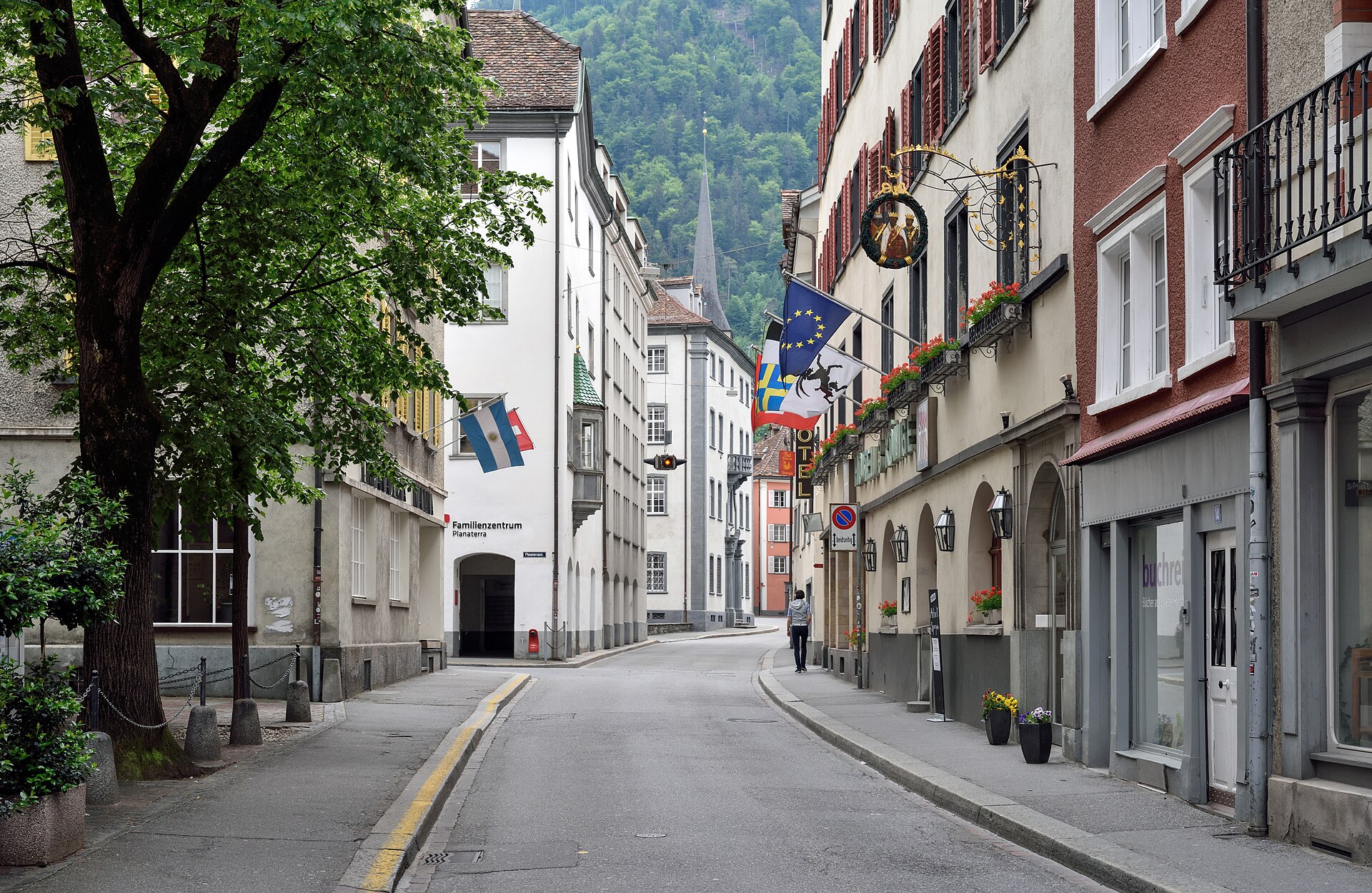
Enter through Obertor and let the street plan do the storytelling. Reichsgasse follows the logic of commerce; Arcas opens suddenly into a quieter, almost theatrical square; narrow passages reconnect them. The old town is almost entirely traffic-free, so details that disappear behind road noise elsewhere—painted façades, bay windows, shop thresholds and the slope toward the episcopal hill—become legible.
The best walk is not a checklist. Start early at Obertor, pass through Arcas, reach St. Martin's Square, then climb toward Hof and the cathedral. In roughly 90 minutes you move from civic Chur to episcopal Chur and understand why those identities sometimes cooperated and sometimes collided.
2. Cathedral of the Assumption and the Bishop's Court
The present cathedral was built from about 1154 to 1270/72 on earlier sacred sites. Its most arresting object is the late-Gothic high altar associated with Jakob Russ and dated to 1492. Look beyond individual artworks, though: the fortified position of the Hof shows how religious authority occupied its own elevated world beside the town.
Dress and behave as you would in any working church, avoid services unless attending respectfully, and check access before relying on a specific interior visit. Even when doors are closed, the climb and exterior relationship between court, cathedral and town are essential.
3. Roman excavations beneath Peter Zumthor's shelters
At Welschdörfli, remains of Roman buildings are protected by dark timber structures designed by Graubünden architect Peter Zumthor. This is not a conventional reconstruction. Slatted walls admit controlled light and air, allowing visitors to sense the footprint and fragility of what survives.
Access arrangements can be less intuitive than at a staffed museum, so verify the current key, ticket or tour procedure with Chur Tourism. The reward is conceptual: ancient fabric and late-20th-century conservation architecture explain each other.
4. Rhaetian Museum: the context-builder
If you visit only one history museum, make it this one. The Rhaetian Museum gives the wider canton a voice through archaeology, everyday objects, power, belief and social history. It turns the cathedral, Roman remains and regional food from isolated curiosities into parts of a connected Graubünden story.
Allow 90 minutes rather than trying to read every label. Prioritise the archaeological sequence and the displays that relate directly to places you will walk past later in the day.
5. St. Martin's Church and its Giacometti windows
The church was rebuilt after the 1464 fire and completed in 1492; it became Reformed in 1526. Augusto Giacometti's stained-glass windows, installed in 1919, bring radiant modern colour into a building associated with Chur's Reformation history. The juxtaposition makes St. Martin's more valuable than a quick tower photograph.
The square outside is also a civic hinge. Pause here to compare the church's position within the merchants' town with the cathedral's position above it.
6. Bündner Kunstmuseum: regional does not mean provincial
The museum combines the historic Villa Planta with a sharply contemporary extension. Its collection is especially useful for understanding how Alpine landscape, migration and regional identity entered modern art; the Giacometti family connections give many visitors an immediate point of entry.
Choose this over a second history museum when art and architecture are your priority. Temporary exhibitions change, so verify what is open and reserve up to two hours.
7. Brambrüesch: the mountain attached to the city
Few cantonal capitals let you leave a historic centre and rise directly toward mountain trails so quickly. Brambrüesch is Chur's strongest outdoors argument: hiking and biking in warmer months, snow activities in winter, and a high perspective on the Rhine valley when conditions cooperate.
Treat it as a half-day experience, not a guaranteed view. Check cableway operating dates, wind and the last descent; mountain services often pause between seasons. Shoes and layers matter more than an ambitious itinerary.
8. Cathedral Treasure Museum: sacred art and mortality
The museum adds depth to the cathedral precinct through liturgical objects and the remarkable medieval cycle of death images associated with the episcopal palace. It is a focused collection, better suited to attentive viewing than rushing.
Opening is more limited than a major city museum, so plan this first and fit the freely accessible lanes around it—not the reverse.
9. Obertor, Bärenloch and the small passages
Obertor is the ceremonial gateway; Bärenloch and the minor lanes provide the human scale. Together they show how movement was funnelled through a walled town and how later residents adapted medieval plots rather than erasing them.
This is the ideal low-cost evening walk. Return after shops close, when the façades and street geometry become easier to see, but remain considerate in residential passages.
10. H. R. Giger Bar: Chur's startling counter-image
Chur-born artist H. R. Giger is internationally associated with biomechanical surrealism and the visual universe of Alien. His bar interior replaces warm Alpine nostalgia with skeletal forms and a vaulted, otherworldly atmosphere. It will not suit every visitor, which is exactly why it belongs in a rounded portrait of the city.
This is a functioning bar rather than a museum: check age rules and opening hours, order something, ask before photographing people, and do not promise children an attraction that may be inappropriate or inaccessible to them.
What to eat in Chur: a compact Graubünden primer
| Dish | What it is | Why order it | Budget note |
|---|---|---|---|
| Capuns | Spätzle-style dough, often with cured meat, wrapped in chard leaves and served with a creamy sauce | A distinctive Graubünden comfort dish | Usually a main course; recipes vary by valley and kitchen |
| Maluns | Cooked potato grated and worked with flour, then fried into small golden crumbs | Humble mountain ingredients transformed through technique | Often good value; may appear with apple purée, cheese or meat |
| Bündner Gerstensuppe | Barley soup with vegetables and often meat | Practical, warming and historically suited to mountain life | A useful lighter lunch when restaurant mains stretch the budget |
| Bündnerfleisch | Air-dried beef sliced thinly | A classic product shaped by Alpine preservation | Price rises quickly on large platters; share an appetiser |
| Bündner Nusstorte | Caramelised walnut filling in short pastry | Portable, rich and excellent with coffee | Buy a slice before committing to a whole tart |
No single restaurant is mandatory. Read recent menus, look for a kitchen that names regional producers, and remember that “traditional” dishes have legitimate household and valley variations. For a lower-cost day, use a bakery breakfast, make lunch the main restaurant meal and keep dinner simple.
When to visit Chur
| Season | Best for | What can go wrong | Planning response |
|---|---|---|---|
| Spring (April–May) | Museums, fresh valley walks and quieter streets | Mountain paths and lifts may be between seasons | Build the trip around the city; treat Brambrüesch as weather-dependent |
| Summer (June–August) | Long days, outdoor dining, hiking and Alpine rail extensions | Heat in the valley and busy trains | Walk early, reserve key rail seats where applicable and carry water |
| Autumn (September–October) | Clearer hiking days, harvest menus and cultural visits | Shorter daylight and changing cableway schedules | Put outdoor time first, museums second |
| Winter (November–March) | Atmospheric lanes, seasonal events and snow combinations | Cold shade, holiday closures and variable lower-elevation snow | Check every opening time and keep one indoor alternative |
Two days in Chur: the slower reference itinerary
Day one—read the layers: follow the one-day route above, but choose the Rhaetian Museum as your main indoor anchor. End with a Graubünden dinner and a quiet circuit from Arcas to Obertor.
Day two—choose one clear theme: ride to Brambrüesch if the forecast and cableway schedule are sound; otherwise pair the Bündner Kunstmuseum with the Cathedral Treasure Museum and the Roman shelters. A good second day is not more crowded—it gives one layer enough time to become memorable.
The best day trips from Chur
| Trip | Typical shape | Choose it for | Do not overlook |
|---|---|---|---|
| Arosa | Direct scenic rail journey from central Chur | An easy city-to-mountain contrast | The train ride is part of the experience; check return times |
| Rhine Gorge | Rail-and-walk day with viewpoints or river-level sections | Geology, photography and hiking | Trail conditions and station-to-trail logistics need planning |
| Rhaetian Railway / Albula route | Long panoramic rail day toward the Engadin | Engineering heritage and landscape | Do not confuse regular trains, panoramic services and reservation rules |
| Lenzerheide | Bus-linked mountain resort area | Biking, hiking and winter sport | Weather and seasonal operations matter more than distance |
Do not schedule a far-reaching excursion on your only day in Chur. The city becomes a reference point for Graubünden only after you have understood its own Roman, episcopal and civic geography.
Who will enjoy Chur—and who may not?
Choose Chur if you value archaeology, regional museums, sacred architecture, rail travel and smaller cities that reveal themselves through connections. It is especially effective for curious travellers who prefer two meaningful museums and an evening walk to an endless attraction list.
Choose another base if your priority is late-night intensity, luxury shopping or a resort directly on a famous lake. In that case compare Zurich, Lugano or Montreux. For the broader national decision, return to the Swiss cities comparison hub.
Frequently asked questions about Chur
Is Chur really Switzerland's oldest city?
Chur is widely described as Switzerland's oldest city because archaeological finds show human presence in the present-day urban area from roughly 11,000 BC, followed by later prehistoric settlement and Roman Curia. The careful interpretation is that this site has an exceptionally long settlement history—not that a city in the modern civic sense existed 13,000 years ago.
How many days do you need in Chur?
One well-planned day covers the old town, cathedral precinct, one major museum and a Roman-history stop. Stay two nights if you want Brambrüesch, both principal museums, an unhurried dinner or an Alpine rail day trip.
Is Chur worth visiting if I am not taking the Bernina Express?
Yes. The old town, episcopal precinct, Roman archaeology and museums make Chur a destination in its own right. The city's small scale is a strength for travellers who want a dense cultural day without big-city logistics.
Can you visit Chur without a car?
Very easily. Intercity trains arrive at Chur station, the old town is walkable, urban buses cover outer districts and the Brambrüesch cableway starts close to the centre. A car can be useful for remote valleys, but it is unnecessary for this guide.
What is the best free thing to do in Chur?
Walk from Obertor through Arcas and Reichsgasse, continue to St. Martin's Square, then climb to the cathedral precinct. This route reveals the city's gates, trading lanes, Reformation centre and episcopal skyline without an admission fee.
What should you eat in Chur?
Start with Graubünden specialities: capuns (chard-wrapped dumplings), maluns (crumbled potato preparation), Bündner Gerstensuppe (barley soup) and Bündnerfleisch. Menus and seasonal availability vary, so treat these as regional dishes to look for rather than guaranteed items at every restaurant.
Is Chur a good base for day trips?
Yes. Direct rail links make Arosa an especially easy mountain excursion, while the Rhine Gorge, Lenzerheide area and Rhaetian Railway routes open broader Graubünden. Chur works best as a base when you reserve at least one day for the city itself.
Is Chur expensive?
It is Swiss-priced but often easier to manage than marquee lake resorts. A realistic per-person day excluding the hotel is about CHF 50 on an economy plan, CHF 100 for comfort and CHF 165 for a premium day. Use the calculator above with your exact party size.