At first glance, Zurich can feel like a city designed by a risk committee: clean trams, discreet banks, immaculate shop windows. Then you notice the bathers carrying dry bags through the financial district, the birthplace of Dada squeezed into an old-town lane and a former shipbuilding hall full of restaurants. Zurich's real talent is not tidiness. It is reinvention without erasure.
Quick answer: The strongest all-round urban break: art, design, nightlife, lake life and transport links.
Allow: 2 full days. Best window: May–September for swimming; December for atmosphere. Main trade-off: Switzerland's highest big-city prices.
Language: Swiss German; English widely understood. Car needed: No—the centre and every itinerary below work by foot and public transport.
What does Zurich cost in 2026?
Accommodation is the variable that changes the trip most. These are planning ranges in Swiss francs, not promises of availability. They were checked on 30 October 2026; festivals, fairs, weekends, views and cancellation terms can move the same room far outside the range.
| Accommodation type | Planning range per night | How to read it |
|---|---|---|
| Hostel / dorm bed | CHF 55–90 | Per person; supply varies |
| Budget private room | CHF 190–300 | Per room; usually outside the prime view |
| Typical mid-range double | CHF 320–520 | Per room; date and event sensitive |
| Upper-upscale / landmark | CHF 520–600+ | Views, major events and suites can exceed this |
Price evidence: Zurich hotels listed by Switzerland Tourism. The ranges above combine that benchmark with the city’s current accommodation mix; always price your exact dates.
Daily spending comparison, excluding the hotel
The chart is a planning model, not an average: economy assumes bakery or supermarket meals and mostly free sights; comfort includes a restaurant meal and one paid attraction; premium allows two restaurant meals, drinks and a major paid experience. Intercity trains and mountain railways are excluded.
Interactive Zurich trip-cost calculator
Formula: one room per two travellers (rounded up) × nightly room estimate, plus the daily per-person estimate above. Flights, intercity rail and major mountain excursions are not included.
Where to stay in Zurich
| Area | Best for | Trade-off |
|---|---|---|
| Old Town / Niederdorf | First visit, nightlife | Walk everywhere; liveliest and often noisiest |
| Enge | Lake access and calm | Polished, central and expensive |
| Wiedikon | Food and neighbourhood life | Better value; short tram ride |
| Zurich-West | Design, bars and modern Zurich | Industrial character; less historic |
| Oerlikon | Events and lower rates | Fast trains to the centre; not postcard Zurich |
The 10 best things to do in Zurich, ranked by meaning—not hype
Filter the reference table:
| # | Place or experience | Type | Time | Cost | Why it matters |
|---|---|---|---|---|---|
| 1 | Lindenhof | History | 45 min | Free | Roman ground and the clearest old-city view |
| 2 | Grossmünster and Fraumünster | History Art | 1–2 h | Mixed | Reformation history opposite Chagall's windows |
| 3 | Kunsthaus Zurich | Art | 2–3 h | Paid | The city's essential major collection |
| 4 | Cabaret Voltaire | History Art | 45 min | Paid | The birthplace of Dada in 1916 |
| 5 | Lake promenade and public baths | Outdoors Local | 1–3 h | Mixed | The ritual that makes the financial city human |
| 6 | Zurich-West and the Viadukt | Art Local | 2 h | Free | Reused industrial architecture and contemporary life |
| 7 | Swiss National Museum | History Family | 2 h | Paid | Best national context at the main station |
| 8 | Uetliberg | Outdoors Family | 3–4 h | Transport | Panorama only worth prioritising in clear weather |
| 9 | Botanical Garden | Outdoors Family | 1–2 h | Free | A quiet counterweight to the centre |
| 10 | Pavillon Le Corbusier | Art | 1 h | Paid | The architect's final building beside the lake |
Zurich history in five turning points
| Date | What changed |
|---|---|
| c. AD 15 | Roman Turicum develops as a customs station |
| 1351 | Zurich joins the Swiss Confederation |
| 1519 | Zwingli begins the Zurich Reformation |
| 1916 | Dada begins at Cabaret Voltaire |
| 1980s–today | Former industrial districts become cultural and technology quarters |
A one-day Zurich itinerary that avoids backtracking
| Time | Plan | Why this order works |
|---|---|---|
| 08:00 | Lindenhof and the quiet old town | Read the city's geography before crowds |
| 10:00 | Grossmünster, Fraumünster and river lanes | Connect Reformation and modern art |
| 12:30 | Lunch in Niederdorf or Wiedikon | Avoid the Bahnhofstrasse premium |
| 14:00 | Kunsthaus or Swiss National Museum | Choose art or national history |
| 17:00 | Lake bath or promenade | Join local daily life |
| 19:30 | Zurich-West | Finish in the reinvention story |
How this page is designed to stay accurate
Stable heritage facts are separated from changing prices and access rules. Costs carry a check date and methodology; official source links remain beside the claim; seasonal services are described without pretending every departure runs daily. Before travel, verify opening hours and transport in the official links at the end of this guide.
Zurich in one line: Choose Zurich when you want the widest cultural range in one compact Swiss city: medieval lanes in the morning, major art at noon, a swim after work and a converted industrial quarter after dark. It is Switzerland's largest city, but the centre still works on foot.
Best length: one full day; two nights with an excursion. Best approach: on foot, with local public transport for the longer jump.
This is not a list assembled from star ratings. It is a route with a point of view: understand why Zurich became this particular kind of Swiss city, then see its famous places in that light. For the national comparison, start with our guide to the 10 must-visit cities in Switzerland.
Why Zurich feels different
The Romans called the customs post by the Limmat Turicum. Centuries later, Huldrych Zwingli turned the Grossmuenster pulpit into an engine of the Reformation. In 1916, artists fleeing war answered that stern inheritance with Cabaret Voltaire and Dada: nonsense as protest. The same city that once regulated belief became a laboratory for breaking artistic rules.
The best things to do in Zurich in one day
Morning: begin with the story
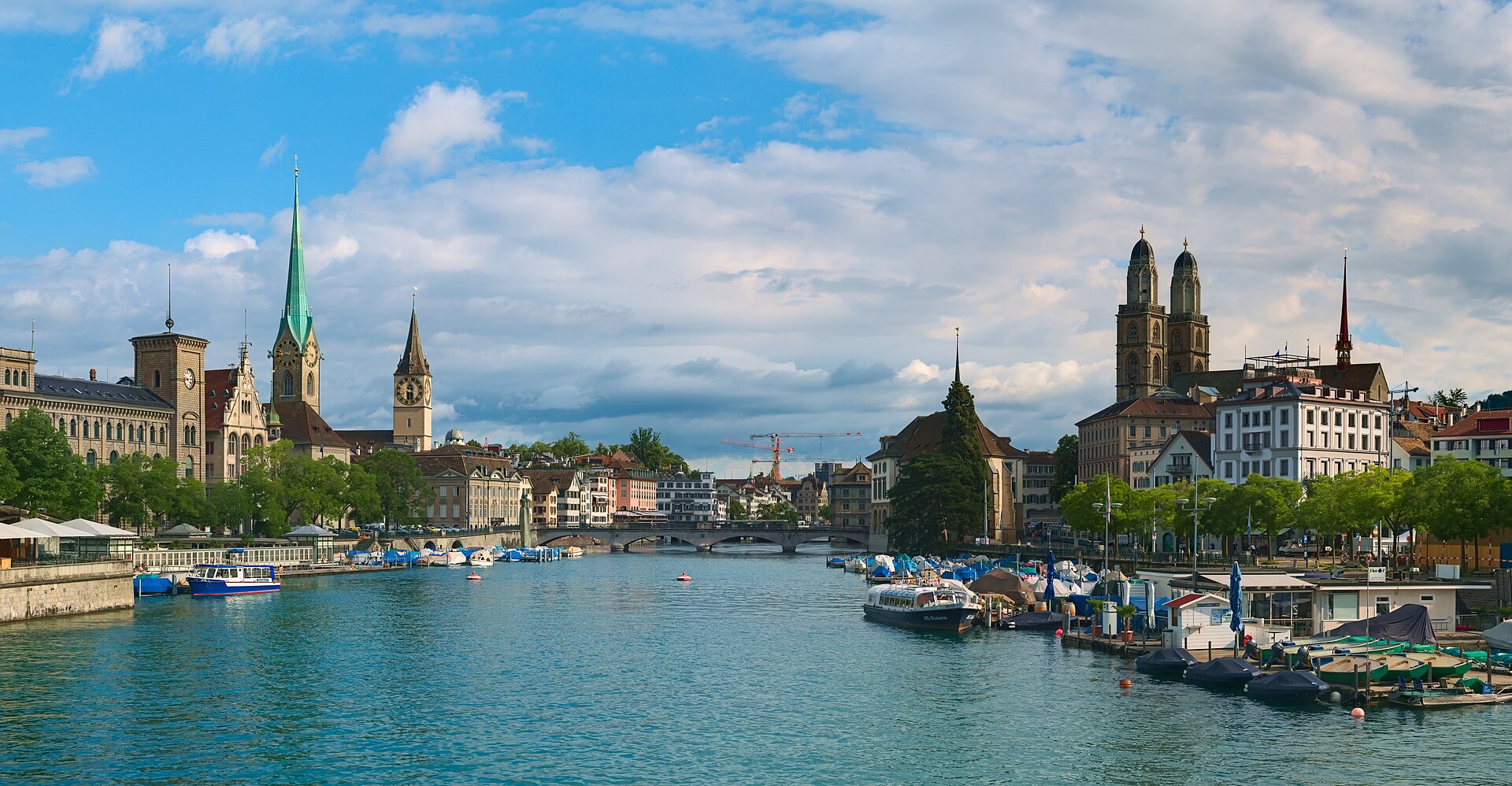
Start on Lindenhof before the shops open. The quiet terrace sits over the Roman settlement and gives the clearest reading of the old city: the Limmat below, the Grossmuenster towers opposite and guild houses lining the water. Cross to the Grossmuenster, then enter the Fraumuenster for Marc Chagall's jewel-coloured windows. Continue through the narrow Niederdorf lanes, but look up as often as you look into shopfronts; painted signs and upper storeys preserve the older city.
Afternoon: move beyond the postcard
Follow the river to the lake and choose one of Zurich's most local institutions: a public bad. In warm weather, the wooden river and lake baths turn the centre into a swimming city. If the weather fails, make the Kunsthaus your anchor. Afterwards, take tram 4 west to the arches beneath the railway viaduct and the Schiffbau, where cranes and industrial brickwork survive inside a new cultural district.
Evening: see the city become local again
Return by tram and walk the lake promenade at blue hour. For dinner, avoid treating Bahnhofstrasse as the city itself. Try Wiedikon for neighbourhood restaurants or Zurich-West for a louder evening. The contrast is the point: Zurich is best understood by moving between its polished and improvised halves.
Six places that explain Zurich
- Lindenhof: Best free overview and the city's Roman starting point.
- Grossmuenster and Fraumuenster: Reformation history opposite Chagall's modern colour.
- Cabaret Voltaire: The tiny old-town room where Dada began in 1916.
- A lake or river bath: The habit that makes Zurich feel lived-in rather than displayed.
- Kunsthaus Zurich: A serious collection for a city that is more artistic than its banking image.
- Zurich-West: Industrial architecture reused rather than scrubbed away.
What to eat in Zurich
Order Zuercher Geschnetzeltes if you want the classic: sliced veal in a creamy sauce, usually with roesti. For a less ceremonial taste of the city, try a grilled sausage at Sternen Grill or browse the food counters around the main station. Zurich is expensive; lunch menus and neighbourhood restaurants are kinder than lakefront dining rooms.
The mistake most visitors make
Do not spend the day shopping on Bahnhofstrasse and conclude that Zurich is sterile. Give equal time to the river, the baths and the western industrial quarter. Also resist adding Uetliberg in poor visibility: the ridge is worthwhile for the panorama, not for the transport ride alone.
Best day trip from Zurich
For a half-day escape, take the train to Uetliberg and walk the ridge when skies are clear. For a full day, choose Winterthur's museums or the Rhine Falls and Schaffhausen.
When to visit Zurich
May to September for swimming and long evenings; December for lights and markets; any rainy month for museums. Summer weekends are livelier, while weekday mornings reveal the old town at its calmest.
Continue through Switzerland's cities
Each city in this series represents a different Switzerland. Compare the other guides rather than collecting them all:
- Chur — Switzerland's oldest-city story
- Lucerne
- Bern
- Geneva
- Basel
- Lausanne
- Lugano
- St. Gallen
- Montreux
- Thun
Frequently asked questions about Zurich
Is Zurich worth visiting?
Yes. Zurich earns a place in a Swiss itinerary when its particular character matches your interests. This guide explains what makes it different from the other major city stops.
How long do you need in Zurich?
One full day covers the route in this guide without rushing. Stay two nights if you want a museum, a slower evening and the nearby excursion: For a half-day escape, take the train to Uetliberg and walk the ridge when skies are clear. For a full day, choose Winterthur's museums or the Rhine Falls and Schaffhausen.
When is the best time to visit Zurich?
May to September for swimming and long evenings; December for lights and markets; any rainy month for museums. Summer weekends are livelier, while weekday mornings reveal the old town at its calmest.
What should first-time visitors avoid in Zurich?
Do not spend the day shopping on Bahnhofstrasse and conclude that Zurich is sterile. Give equal time to the river, the baths and the western industrial quarter. Also resist adding Uetliberg in poor visibility: the ridge is worthwhile for the panorama, not for the transport ride alone.
Sources and further reading
Facts checked 30 October 2026. Opening times, transport and access rules change; verify them with the linked official source before travelling.