St. Gallen began, according to tradition, with an Irish monk, a wilderness and a bear. It became famous through two things that seem unrelated: manuscripts and embroidery. Look closer and they share the same civic instinct—patience, pattern and an obsession with detail.
Quick answer: A quieter heritage city joining medieval manuscripts, Baroque architecture and textile design.
Allow: 1–2 full days. Best window: Year-round; summer for Drei Weieren. Main trade-off: Many visitors leave after the abbey and miss the textile story.
Language: Swiss German; English understood in major attractions. Car needed: No—the centre and every itinerary below work by foot and public transport.
What does St. Gallen cost in 2026?
Accommodation is the variable that changes the trip most. These are planning ranges in Swiss francs, not promises of availability. They were checked on 30 October 2026; festivals, fairs, weekends, views and cancellation terms can move the same room far outside the range.
| Accommodation type | Planning range per night | How to read it |
|---|---|---|
| Hostel / dorm bed | CHF 45–75 | Per person; supply varies |
| Budget private room | CHF 80–140 | Per room; usually outside the prime view |
| Typical mid-range double | CHF 160–220 | Per room; date and event sensitive |
| Upper-upscale / landmark | CHF 270–600+ | Views, major events and suites can exceed this |
Price evidence: St. Gallen hotel averages, October 2026. The ranges above combine that benchmark with the city’s current accommodation mix; always price your exact dates.
Daily spending comparison, excluding the hotel
The chart is a planning model, not an average: economy assumes bakery or supermarket meals and mostly free sights; comfort includes a restaurant meal and one paid attraction; premium allows two restaurant meals, drinks and a major paid experience. Intercity trains and mountain railways are excluded.
Interactive St. Gallen trip-cost calculator
Formula: one room per two travellers (rounded up) × nightly room estimate, plus the daily per-person estimate above. Flights, intercity rail and major mountain excursions are not included.
Where to stay in St. Gallen
| Area | Best for | Trade-off |
|---|---|---|
| Old Town | Abbey and first visit | Compact and atmospheric |
| Station quarter | Rail trips and convenience | Easy arrival; less romantic |
| St. Fiden | Value and calm | Short bus ride east |
| Drei Weieren slopes | Views and summer swimming | Hilly, limited hotel choice |
| Abtwil | Spas and road access | Outside the historic city |
The 10 best things to do in St. Gallen, ranked by meaning—not hype
Filter the reference table:
| # | Place or experience | Type | Time | Cost | Why it matters |
|---|---|---|---|---|---|
| 1 | Abbey Library | History Art | 1–2 h | Paid | Manuscripts and the Baroque 'pharmacy of the soul' |
| 2 | Abbey Cathedral | History | 45 min | Free | The sacred half of the UNESCO ensemble |
| 3 | Old-town oriels | History Local | 1 h | Free | Merchant ambition carved into windows |
| 4 | Textile Museum | History Art | 2 h | Paid | The link from local machines to global fashion |
| 5 | Stadtlounge | Art Local | 30 min | Free | A business district turned into a red public room |
| 6 | Drei Weieren | Outdoors Local | 2–3 h | Free | Industrial reservoirs transformed into swimming ponds |
| 7 | Natural History Museum | Family | 2 h | Paid | Strong regional nature displays |
| 8 | Art Museum | Art | 1–2 h | Paid | A manageable collection in the museum quarter |
| 9 | Mühlegg railway | Local Family | 20 min | Transport | The short climb that reveals the city's terrain |
| 10 | Appenzell excursion | Outdoors History | Half/full day | Transport | Painted houses and a second eastern-Swiss identity |
St. Gallen history in five turning points
| Date | What changed |
|---|---|
| c. 612 | Tradition places the monk Gallus's hermitage here |
| 719 | The Abbey of St Gall is formally founded |
| 1803 | The canton of St. Gallen is created |
| 19th century | Embroidery turns St. Gallen into a global textile centre |
| 1983 | The Abbey District enters the UNESCO list |
A one-day St. Gallen itinerary that avoids backtracking
| Time | Plan | Why this order works |
|---|---|---|
| 09:00 | Abbey Library | Give the rarest material your freshest attention |
| 10:45 | Cathedral and Abbey District | Read the ensemble as one institution |
| 12:00 | Bratwurst lunch in the old town | Taste the local ritual—without mustard |
| 13:30 | Oriel walk and Textile Museum | Follow wealth from facade to fabric |
| 16:00 | Stadtlounge | See contemporary civic play |
| 17:00 | Mühlegg to Drei Weieren | End where industry became recreation |
How this page is designed to stay accurate
Stable heritage facts are separated from changing prices and access rules. Costs carry a check date and methodology; official source links remain beside the claim; seasonal services are described without pretending every departure runs daily. Before travel, verify opening hours and transport in the official links at the end of this guide.
St. Gallen in one line: Choose St. Gallen when you want a quieter Swiss city with one world-class heritage site and a story that connects medieval scholarship to global fashion. It is compact, uncrowded and easy to combine with Appenzell.
Best length: one full day; two nights with an excursion. Best approach: on foot, with local public transport for the longer jump.
This is not a list assembled from star ratings. It is a route with a point of view: understand why St. Gallen became this particular kind of Swiss city, then see its famous places in that light. For the national comparison, start with our guide to the 10 must-visit cities in Switzerland.
Why St. Gallen feels different
The Abbey of St Gall grew from the community associated with the missionary Gallus. Its library preserves manuscripts that made the monastery one of medieval Europe's great centres of learning. Centuries later, St. Gallen embroidery travelled through international fashion houses, bringing industrial wealth to the city while keeping pattern-making at the heart of its identity.
The best things to do in St. Gallen in one day
Morning: begin with the story
Go first to the Abbey District and enter the library before groups build. Felt slippers protect the elaborate floor, but the room's real treasure is intellectual: manuscripts, plans and centuries of accumulated memory. Give the cathedral time as well; the baroque ensemble is designed as a whole.
Afternoon: move beyond the postcard
Walk the old town and count the carved oriel windows projecting from merchant houses. Then visit the Textile Museum to understand how designs moved from drawing to machine and from eastern Switzerland to couture. Step into the bright red Stadtlounge, a contemporary urban artwork that carpets a business district in colour.
Evening: see the city become local again
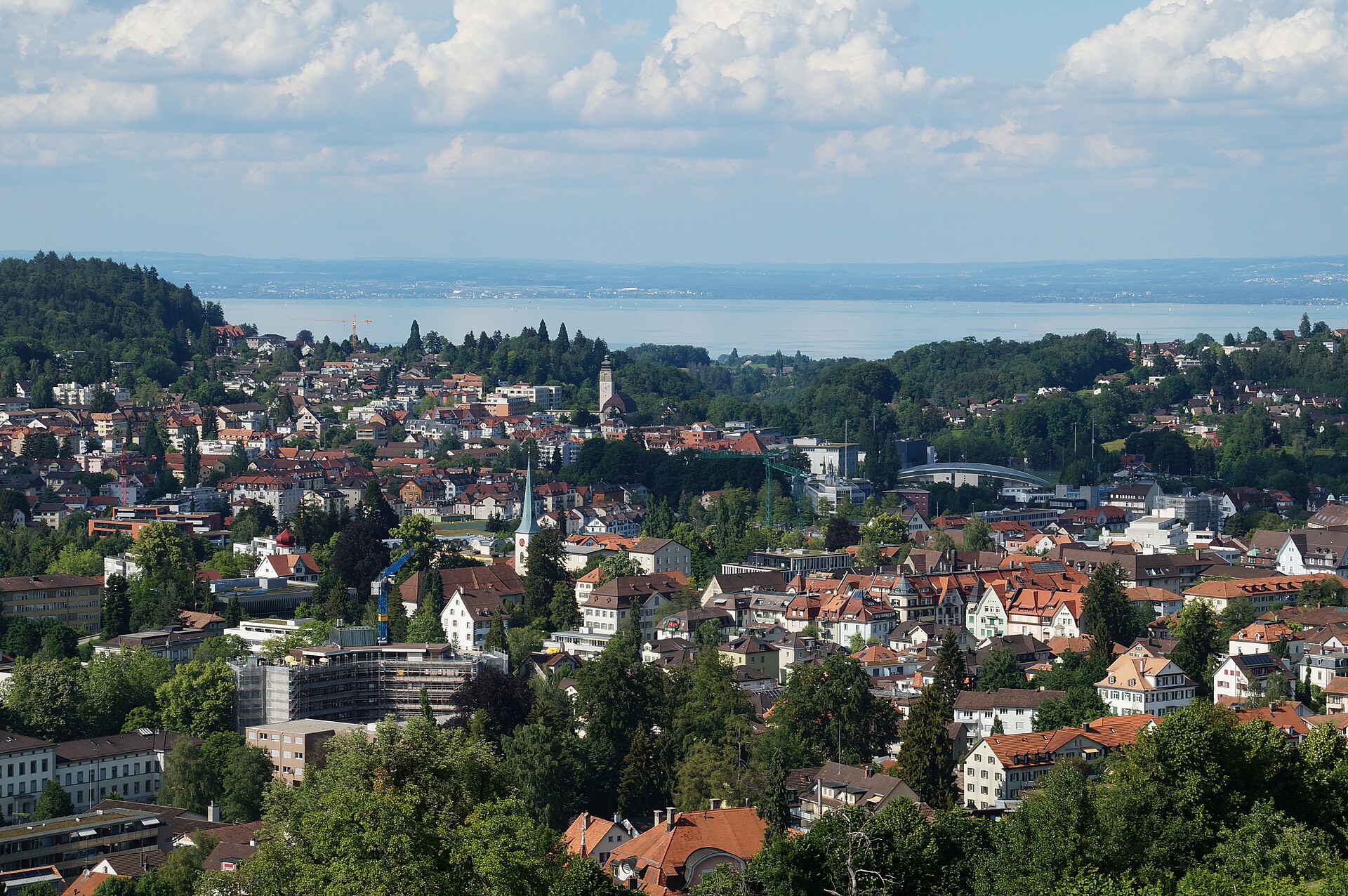
Climb or take the Muehlegg railway toward Drei Weieren, the hillside ponds above town. They began as water reservoirs for textile production and later became swimming places. From here, St. Gallen sits below with Lake Constance beyond on a clear evening—the industrial and recreational city in one view.
Six places that explain St. Gallen
- Abbey Library: The 'pharmacy of the soul' and the reason to cross Switzerland for St. Gallen.
- Abbey Cathedral: Baroque architecture experienced as part of a complete district.
- Old-town oriels: Merchant ambition carved into projecting windows.
- Textile Museum: The missing link between local machines and international fashion.
- Stadtlounge: A playful modern room laid over actual city streets.
- Drei Weieren: Former industrial reservoirs turned hillside swimming ponds.
What to eat in St. Gallen
Eat a St. Galler Bratwurst without mustard if you want to follow local custom; residents argue that the sausage should stand on its own. Pair it with a crunchy Buerli roll. The regional Biber is a spiced pastry filled with almond paste.
The mistake most visitors make
Do not photograph the library's manuscripts as if they were props; follow its current rules and slow down enough to notice what is displayed. Many visitors leave after the abbey and miss the textile story that explains modern St. Gallen.
Best day trip from St. Gallen
Appenzell is the natural day trip for painted houses and Alpstein access. Lake Constance, the car-free village of Werdenberg and the Bregenz lakeshore broaden a longer eastern-Switzerland stay.
When to visit St. Gallen
The museums make St. Gallen reliable year-round. Summer suits Drei Weieren and Appenzell walks; December brings one of the country's prettiest star-lit Christmas settings.
Continue through Switzerland's cities
Each city in this series represents a different Switzerland. Compare the other guides rather than collecting them all:
- Chur — Switzerland's oldest-city story
- Zurich
- Lucerne
- Bern
- Geneva
- Basel
- Lausanne
- Lugano
- Montreux
- Thun
Frequently asked questions about St. Gallen
Is St. Gallen worth visiting?
Yes. St. Gallen earns a place in a Swiss itinerary when its particular character matches your interests. This guide explains what makes it different from the other major city stops.
How long do you need in St. Gallen?
One full day covers the route in this guide without rushing. Stay two nights if you want a museum, a slower evening and the nearby excursion: Appenzell is the natural day trip for painted houses and Alpstein access. Lake Constance, the car-free village of Werdenberg and the Bregenz lakeshore broaden a longer eastern-Switzerland stay.
When is the best time to visit St. Gallen?
The museums make St. Gallen reliable year-round. Summer suits Drei Weieren and Appenzell walks; December brings one of the country's prettiest star-lit Christmas settings.
What should first-time visitors avoid in St. Gallen?
Do not photograph the library's manuscripts as if they were props; follow its current rules and slow down enough to notice what is displayed. Many visitors leave after the abbey and miss the textile story that explains modern St. Gallen.
Sources and further reading
Facts checked 30 October 2026. Opening times, transport and access rules change; verify them with the linked official source before travelling.