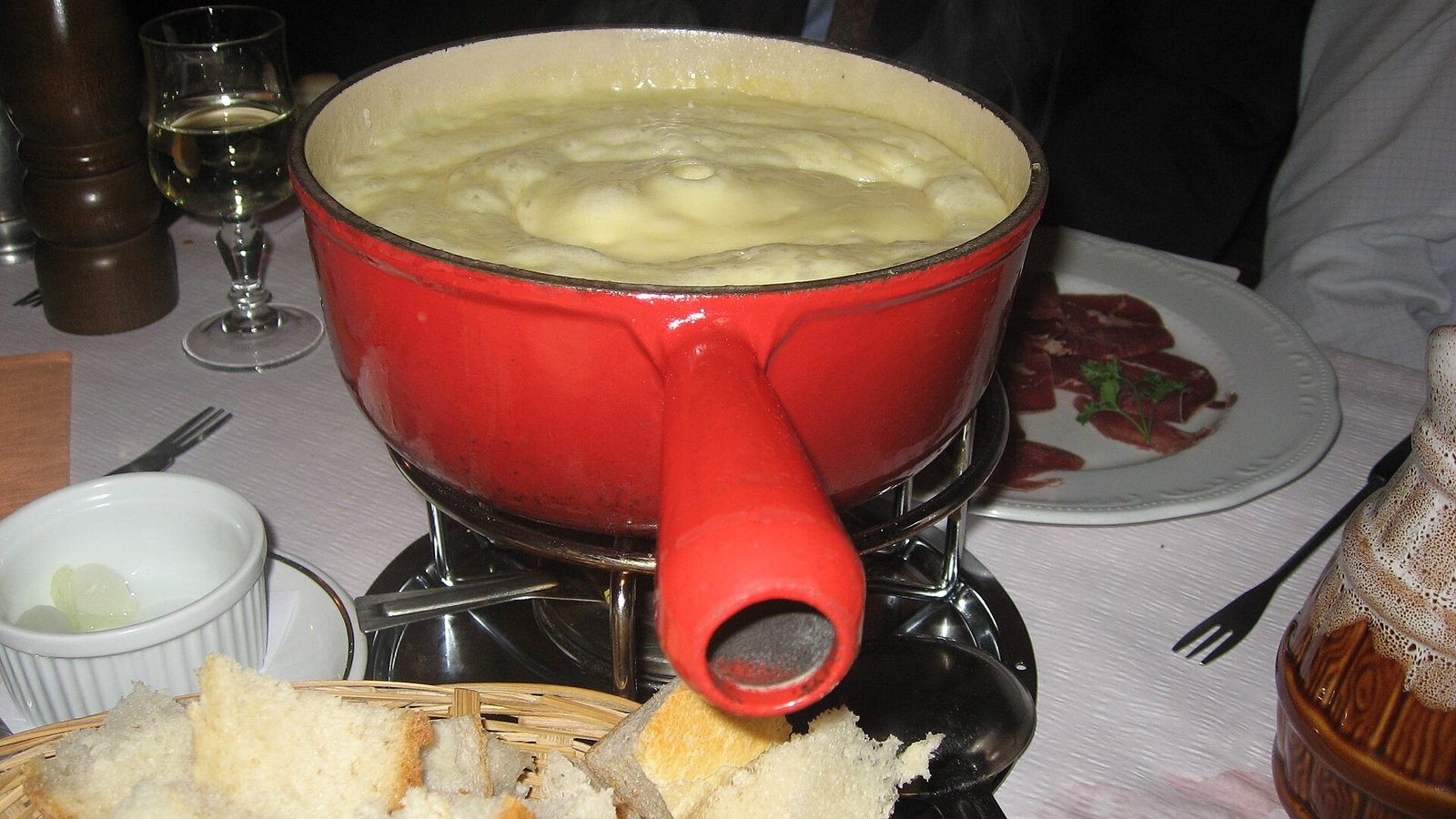
Picture a farmhouse kitchen in the canton of Bern in the 1920s. There’s bread on the table, a wheel of cheese in the cellar and soup on the stove. What you won’t find is a fondue pot. Fondue history has a twist that surprises even many Swiss people: until World War II, the dish we now call the Swiss national dish was largely unknown outside French-speaking western Switzerland.
So how did a regional speciality become the symbol of an entire nation? The answer involves a government-backed cheese cartel, a long marketing campaign, the Swiss Army, two World’s Fairs in New York and a slogan the Swiss still quote today.
None of this makes fondue fake. It’s still one of the most joyful meals on earth. But the story of how it got onto every Swiss table is far stranger than the cosy Alpine legend. Let’s open the pot.
Was fondue invented in Switzerland?
Here’s the short answer, before we dig into the fondue history. Largely, yes, but Switzerland doesn’t own the idea alone, and the national dish is a much younger invention than most people think.
- The oldest recipe is Swiss. A cookbook printed in Zurich in 1699 explains how to cook cheese with wine.
- The word is French. “Fondue” simply means “melted”, and it first appeared in a French cookbook in 1735, for a dish of cheese and eggs.
- The neighbours have their own versions. Savoy in France and the Aosta Valley in Italy have long fondue traditions too.
- The modern dish grew up in Romandy, the French-speaking west of Switzerland, in the 19th century. Our guide to the Swiss languages explains the country’s language regions.
- The national dish is a 20th-century creation, promoted by the Swiss Cheese Union from the 1930s onwards.
Sources: Swiss National Museum, Historical Dictionary of Switzerland, swissinfo.ch.
Early fondue history: before it was famous
Fondue history starts long before Switzerland existed. The idea of mixing cheese with wine is ancient. In Homer's Iliad, a woman named Hecamede mixes a drink from wine, grated goat's cheese and barley. But the direct ancestor of Swiss fondue appears much later, and in a surprising place.
The oldest recipe: Zurich, 1699
In 1699, a cookbook published in Zurich included a recipe called Käss mit Wein zu kochen, "to cook cheese with wine". The method is familiar: cheese melted in wine, with bread for dipping. That's remarkable, because Zurich lies in German-speaking Switzerland, where people would later regard fondue as a foreign, French-Swiss habit.
When fondue meant scrambled eggs
For the next 150 years, the word "fondue" meant something else entirely. In 1735, the French chef Vincent La Chapelle used it for a dish of cheese and eggs. Later, the famous French gastronome Jean Anthelme Brillat-Savarin published his own "fondue" in The Physiology of Taste. Brillat-Savarin had spent part of his exile during the French Revolution in Switzerland. He declared that fondue came from Switzerland and credited his recipe to the papers of a bailiff in Moudon, in Vaud. Yet his version was closer to scrambled eggs with cheese than to the bubbling pot we know.

A dish of the lowlands, not the herdsmen
Then there's the cosy image of herders melting cheese in a mountain hut. It's lovely, but it's mostly myth. According to the ethnologist Isabelle Raboud-Schüle, fondue wasn't a herders' dish at all. It was a meal for the better-off families of the lowlands, who could afford good cheese. For poor mountain farmers, cheese was something to sell, not to melt. For a long time, many cooks even made fondue with milk rather than wine.
According to Raboud-Schüle, a cookbook published in Neuchâtel in 1875 already presented fondue without eggs as a Swiss national dish. That claim, however, was more ambition than reality. Most Swiss had still never tasted it.
1914: the birth of the cheese cartel
The real turning point in fondue history wasn't a recipe. It was an organisation. In 1914, at the start of World War I, the federal government pressed cheese exporters, milk producers and cheesemakers into a single body: the Swiss Cheese Union, or Schweizerische Käseunion.
What the cartel controlled
At first, the union received the monopoly on cheese exports at fixed prices and set the prices of milk and cheese inside Switzerland. After the war, agreements between farmers, cheesemakers and exporters replaced those emergency rules, but the union stayed at the centre of the trade. In practice, it shaped Swiss cheese for the next 85 years, from how much cheese dairies made to which varieties they could produce. The system favoured a few big, export-friendly cheeses, such as Emmentaler and Gruyère.
Not everyone was happy. As NPR reported, for decades the union "set the price of milk, limited production, restricted the kind of cheeses you could make in Switzerland". One small cheesemaker, Sep Barmettler, asked for permission to make Sbrinz, a hard cheese. According to his family, he waited about eight years for an answer. It was no.
A problem of too much cheese
A cartel that guarantees prices has one big weakness: it tends to produce too much. Cheese was a major Swiss export at the time, part of the story of why Switzerland is so rich, so the stakes were high. When the Great Depression hit and exports collapsed, Switzerland sat on a growing pile of unsold cheese. The union needed the Swiss themselves to eat far more of it. And what better way than a dish that uses a whole pot of cheese at once?
Selling a national dish
So the Cheese Union went to work, and fondue history took a commercial turn. From the 1930s, it promoted fondue, sending out recipes and running campaigns that linked cheese with health, tradition and Swiss identity. After World War II, it turned the dish into a national brand. As the food historian Dominik Flammer told NPR, the union could sell fondue "with a traditional story behind it to show that cheese was a very healthy food from the Alps".
Fondue joins the army
Its cleverest move targeted the army. Around 1930, the union launched a fondue programme aimed at Swiss soldiers. Later, in the 1950s, it sent fondue sets to army regiments across the country. Young men from Zurich, Basel and St. Gallen ate fondue together during their service, then went home and asked for it in their own kitchens. In a country where almost every man served in the militia, few marketing channels could beat that. It's fitting, really. The same army gave the world the Swiss Army knife.
Crossing the Röstigraben
After World War II, fondue finally crossed the language border into German-speaking Switzerland. Cheese was plentiful again, and the dish was easy to make. A historian writing for the Swiss National Museum also points out that fondue was easy to make. Men, who now had more leisure time, often prepared it themselves and earned their guests' admiration. Not everyone liked it, though. One farmer, Ernst Därendinger, wrote in his memoir that he found the smell of melted cheese repulsive.
Still, the tide had turned. A dish from French-speaking Switzerland became a favourite on both sides of the Röstigraben, the cultural line between the country's German and French regions.
"Fondue isch guet und git e gueti Luune"
Later, a slogan cemented the habit. FIGUGEGL, pronounced roughly "fee-goo-geh-gel", stands for Fondue isch guet und git e gueti Luune: fondue is good and puts you in a good mood. Many Swiss still say it with a grin as the pot arrives. In the 1970s, glossy ads showed tanned skiers laughing around the caquelon, the fondue pot. Fondue had become cool.
Fondue conquers the world
Meanwhile, fondue history went international, as Switzerland exported the dish as a symbol of the whole country. In 1939, Swiss promoters brought it to the New York World's Fair. A few years later, in 1948, a chef in Lausanne created fondue bourguignonne, with beef cooked in hot oil instead of cheese.
New York became fondue's second home. In 1956, the Swiss restaurateur Konrad Egli served fondue bourguignonne at his Chalet Suisse restaurant in Manhattan. Fondue returned to the New York World's Fair in 1964. In the mid-1960s, Egli's restaurant also popularised chocolate fondue, with help from Toblerone. By the 1970s, fondue sets had become a popular gift across America and Europe, and fondue parties were the height of fashion.
The end of the cartel
The Cheese Union didn't survive the century. In its final years, scandals weakened it, including disputes in Italy over allegations of tax and customs irregularities, as did investigations into officials. Switzerland was also liberalising its farm markets. In 1999, the union went into liquidation.
The result was a cheese revolution. Freed from the cartel's rules, small dairies began making hundreds of new cheeses, from soft washed-rind cheeses to aged mountain specialities. You can explore the best of them in our guide to Swiss cheese varieties. The cartel was gone, but its most successful product, fondue, stayed exactly where it had put it: at the heart of Swiss identity.
Fondue history in one timeline
Tap through three centuries of fondue history, from a Zurich cookbook to the fall of the cartel.
Fondue history, 1699–1999
Tap a date, or use the arrow keys. Red dots mark turning points.
Cheese with wine
A Zurich cookbook prints a recipe called “Käss mit Wein zu kochen”: cheese cooked with wine.
The word appears
A cookbook by the French chef Vincent La Chapelle uses “fondue” for a dish of cheese and eggs.
Brillat-Savarin
The French gastronome publishes a “fondue” that is closer to scrambled eggs with cheese.
The modern recipe
A recipe for fondue without eggs appears, already presented as a Swiss national dish.
The cartel is born
Under pressure from the federal government, exporters, farmers and cheesemakers form the Swiss Cheese Union.
The campaign begins
With exports hit by the Depression, the union promotes fondue at home, including to soldiers.
New York, part one
Swiss promoters bring fondue to the New York World’s Fair.
Meat, not cheese
A Lausanne restaurateur creates fondue bourguignonne, beef cooked in hot oil.
Fondue joins the army
The Cheese Union sends fondue sets to army regiments. Soldiers take the habit home.
Manhattan
Konrad Egli serves fondue bourguignonne at his Chalet Suisse restaurant in New York.
New York, part two
Fondue returns to the New York World’s Fair.
Chocolate fondue
Egli’s restaurant popularises chocolate fondue, with help from Toblerone.
The fondue party
Ads show glamorous skiers around the pot, and fondue sets fill kitchens across the world.
The cartel ends
After scandals and market reforms, the Cheese Union goes into liquidation.
Fondue's civil war: every region has its recipe
Ask a Swiss person for the "right" fondue recipe and you may start a small argument. Every region, and almost every family, has its own version. Tap through the main styles below.
Fondue’s civil war: every region has its recipe
Tap a style to see where it’s from and what goes in the pot.
- Where it’s from
- What goes in
- What makes it different
- Good to know
The unwritten rules of the pot
Fondue history also left the Swiss with a set of table rules, and they take them seriously, with a smile.
Stir, don't swirl
First, you stir. Each person dips their bread on a long fork and stirs the cheese in a figure of eight or a zigzag. It keeps the cheese smooth and stops it from burning. Never double-dip with your mouth, and don't eat straight from the fondue fork, which touches the shared pot.
The bread rule
Lose your bread in the pot and you'll pay a forfeit. Depending on the table, you buy the next bottle, sing a song or kiss your neighbour. Some families make the rules up as they go along, which is half the fun.
The coup du milieu
Halfway through, some tables pause for a coup du milieu, a small glass of kirsch, to "make room" for the second half. Others dip their bread in kirsch before the cheese.
The best part comes last
At the end, a golden crust of cheese forms at the bottom of the pot. It's called la religieuse, the nun, and many Swiss consider it the best bite of the night. Someone scrapes it out and shares it around the table.

Wine, tea, or water?
Finally, there's the great drink debate. Many Swiss grandparents insist that you should drink white wine or black tea with fondue, never cold water. In 2010, researchers in Zurich put part of this to the test. Twenty volunteers ate fondue twice, once with white wine and once with black tea. With wine, their stomachs emptied more slowly, but they didn't feel any worse. In other words, drink what you like.
Quiz: fact or myth?
Now that you know the real fondue history, test yourself with six quick questions.
Fact or myth? Six claims about fondue
Score: 0 / 6The Swiss have eaten fondue all over the country for centuries.
Myth. Until World War II, it was largely unknown outside French-speaking western Switzerland.
The oldest known recipe for cheese melted in wine comes from Zurich.
Fact. A Zurich cookbook printed it in 1699.
A cheese cartel helped make fondue the national dish.
Fact. The Swiss Cheese Union promoted it for decades to sell more cheese.
Science shows white wine helps you digest fondue.
Myth. In a 2010 Zurich study, wine actually slowed digestion compared with black tea, although it caused no extra discomfort.
Chocolate fondue comes from an Alpine village.
Myth. A Swiss restaurateur popularised it in New York in the 1960s.
If you lose your bread in the pot, tradition says you pay a forfeit.
Fact. Depending on the table, you buy a round, sing a song or kiss your neighbour.
So, is fondue a fake tradition?
It would be easy to call fondue a marketing trick. After all, a cartel with too much cheese spent decades persuading the Swiss to eat it. But that's only half the story.
Nations choose their symbols, and many of them are newer than they look. The Swiss also built their identity around a crossbow hero who may never have existed, as we explore in Was William Tell real?, and around a red flag with a white cross. Fondue belongs to the same family. A cartel promoted it deliberately, yes. Yet it caught on because people loved it.
Today, fondue history matters less to the Swiss than the ritual itself: a single pot, a crowded table, a lost piece of bread and a song you'd rather not sing. That shared pot is perhaps the most Swiss thing of all. Everyone eats from the same source, and nobody gets more than their fair share.
If you'd like to explore the rest of the country's kitchen, from rösti to capuns, start with our guide to traditional Swiss food. And for the festive version without any cheese at all, see how families serve fondue chinoise in our Swiss Christmas traditions.
FAQ: fondue history
Was fondue invented in Switzerland?
Largely, yes. The oldest known recipe for cheese melted with wine appeared in a Zurich cookbook in 1699, and the modern dish developed in French-speaking western Switzerland. However, neighbouring Savoy in France and the Aosta Valley in Italy have their own long fondue traditions.
When did fondue become the Swiss national dish?
Mainly in the 20th century. From the 1930s, the Swiss Cheese Union promoted fondue as a national dish to boost cheese sales. After World War II, and with help from the army, it spread to German-speaking Switzerland and became a symbol of the whole country.
What was the Swiss Cheese Union?
The Swiss Cheese Union was a cartel that cheese exporters, milk producers and cheesemakers formed in 1914 at the request of the federal government. At first, it held the export monopoly at fixed prices and set milk and cheese prices. Later, it stayed at the centre of the trade and influenced which cheeses dairies could make. It went into liquidation in 1999.
What does FIGUGEGL mean?
FIGUGEGL is an advertising slogan for fondue. It stands for “Fondue isch guet und git e gueti Luune”, Swiss German for “fondue is good and puts you in a good mood”.
What is la religieuse in fondue?
La religieuse is the golden crust of cheese that forms at the bottom of the pot at the end of the meal. Many Swiss consider it the best part and share it out at the end.
What should you drink with cheese fondue?
Traditionally, dry white wine or black tea. A 2010 Zurich study found that wine slowed digestion compared with tea but caused no extra discomfort, so the choice is yours.
Sources and further reading
- Swiss National Museum blog: Fondue, a “natural processed product”
- Swiss National Museum blog: The cheese collective of the Swiss Cheese Union
- Historical Dictionary of Switzerland: Schweizerische Käseunion (in German)
- Swiss Armed Forces Library: A history of food in the Swiss Armed Forces
- NPR: How a Swiss cheese cartel made fondue popular (2015)
- Region of Fribourg: Fondue moitié-moitié
- The BMJ: Effect on gastric function and symptoms of drinking wine, black tea, or schnapps with a Swiss cheese fondue (2010)
- About Switzerland (FDFA): Fondue, the convivial Swiss dish par excellence
Last updated 3 October 2026. Featured photo: Brücke-Osteuropa, via Wikimedia Commons (CC0).