In 1678, the people of Fiesch, a village at the foot of the Aletsch Glacier, made a promise to God. The ice above them was growing. A lake trapped by the glacier kept bursting and flooding their valley. So they vowed to live virtuously and to pray, year after year, that the glacier would stop advancing.
More than three centuries later, their descendants went to Rome with the opposite request. They wanted to pray that the glacier would stop melting.
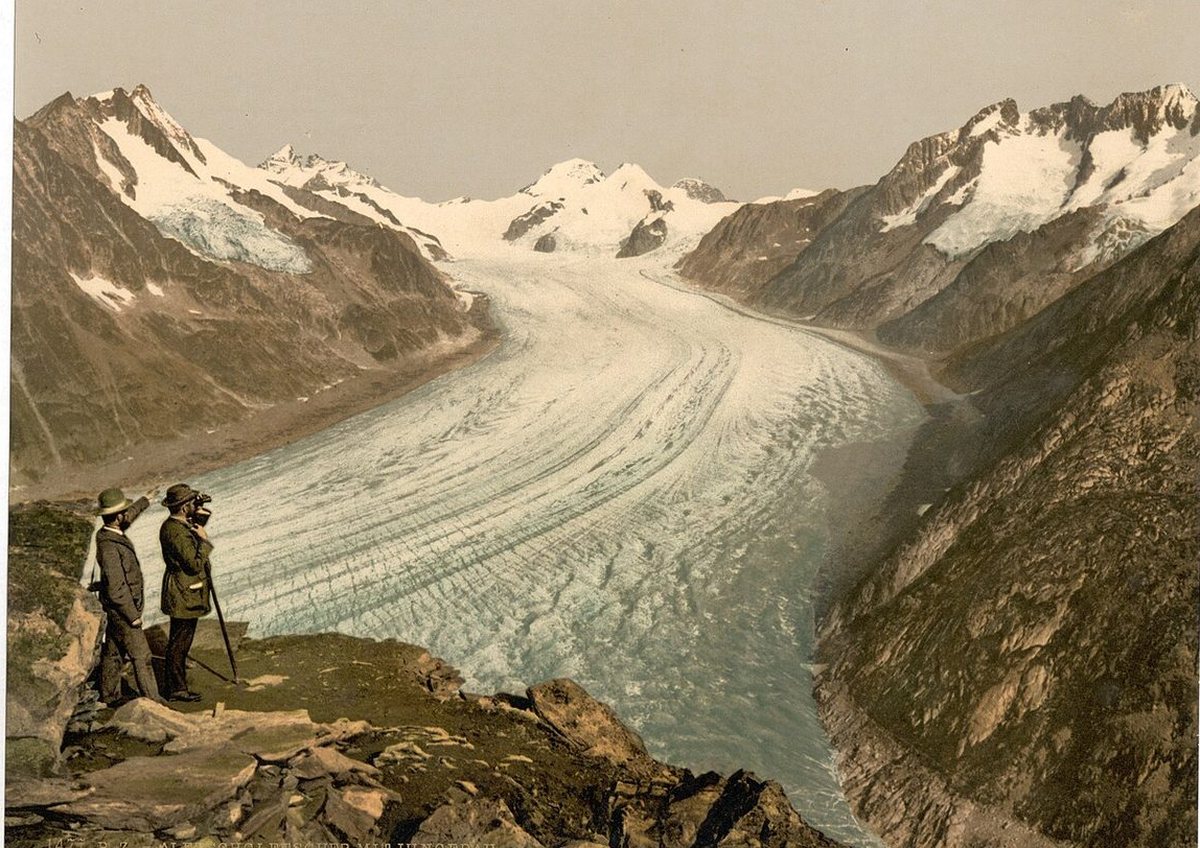
That reversal tells you almost everything about the Aletsch Glacier. It’s the largest glacier in the Alps, a river of ice about 20 kilometres long that flows from the snowfields of the Jungfrau down towards the Rhône valley. It’s also one of the best-measured glaciers on earth, and its records read like a diary of a changing climate. This guide covers both sides: the beauty you can see from the viewpoints, and the stories and data hidden in the ice.
The Aletsch Glacier at a glance
The Great Aletsch Glacier, Grosser Aletschgletscher in German, lies in the canton of Valais, on the southern side of the Bernese Alps. It begins high in the Jungfrau region, close to Jungfraujoch, and ends above the Massa gorge near Riederalp and Belalp. Along the way, it passes some of the most dramatic scenery in Switzerland.
In 2001, the glacier and its surroundings became the heart of the Swiss Alps Jungfrau-Aletsch World Heritage Site, the first natural World Heritage Site in the Alps. UNESCO extended it in 2007, and it now covers about 824 square kilometres of peaks, ice and valleys. For the country’s cultural World Heritage Sites, from Bern’s Old Town to the castles of Bellinzona, see our guide to the cultural treasures of Switzerland.
Sources: GLAMOS (Glacier Monitoring Switzerland), ETH Zurich, Jungfrau-Aletsch World Heritage.
How the Aletsch Glacier works
A glacier looks frozen in place, but it never stops moving. Think of the Aletsch Glacier as a slow conveyor belt. Snow falls high up in the mountains, gets buried and squeezed into ice, then creeps downhill under its own weight. At the bottom, it melts away.
Konkordiaplatz: where four rivers of ice meet
The engine room is Konkordiaplatz, a vast plain of ice below the Jungfrau. Here, four large ice streams flow together and form the main glacier. The ice at Konkordiaplatz is about 800 metres thick. That's roughly the height of the world's tallest skyscraper, buried under a frozen surface.
The dark stripes
From any viewpoint, you'll notice long dark stripes running down the middle of the glacier. These are medial moraines: rock debris carried along where two ice streams merge. They make the Aletsch Glacier look like a motorway with lanes, and they show you exactly where each stream came from.
A very slow journey
How slow is the conveyor belt? Researchers once calculated that ice near the upper glacier travelled about 10.5 kilometres in 86 years, at an average of around 122 metres a year. We know this because of a sad story you'll read below.
A glacier that came and went
It's tempting to think the Aletsch Glacier was always huge until recent warming. The real history is more interesting. Research summarised by the World Heritage organisation shows that in the Late Bronze Age, about 3,300 years ago, the glacier was several hundred metres shorter than today. Around 800 to 950 AD, it was roughly the size it is now.
Then the climate cooled. During the Little Ice Age, the Aletsch Glacier advanced several times: shortly after 1369, around 1678 and around 1860. Notice that middle date. The year of the Fiesch vow was a year when the ice was pushing forward.
So glaciers have always grown and shrunk. What makes today different is the speed. The Aletsch Glacier is now losing ice far faster than at any time in its long recorded history, and the cause is human-made warming.
The prayer that worked too well
Back to Fiesch. In the 17th century, life below the Aletsch Glacier was frightening. Avalanches were common, and the Märjelensee, a lake dammed by the glacier's edge, often broke through its wall of ice. Swissinfo reports that nearby glacial lakes overflowed 35 times in a hundred years, sending floods down the valley.
The vow
In 1678, the villagers of Fiesch and Fieschertal turned to faith. They promised to live virtuously and to pray against the growth of the glacier and the flooding of the lake. According to Swissinfo, an annual procession has taken place since 1862, on 31 July, the feast of Saint Ignatius. It leads to the Ernerwald chapel and lasts about five hours.
The engineers' answer
Prayer wasn't the only answer. Between 1889 and 1894, engineers drilled a drainage tunnel to stop the Märjelensee from rising too high. It worked. The tunnel carried water only once, in 1896, and the lake never rose that high again.
Reversing the vow
Then the climate turned. By the 21st century, the danger was no longer too much ice, but too little. In September 2009, Herbert Volken, a mountain guide and a descendant of the priest behind the original vow, handed Pope Benedict XVI the parish's request to change it. In 2010, the Holy See gave its approval. Today, the procession prays for the preservation of the glacier. As Volken put it: "Ice is water and water is life."
The Märjelensee itself tells the same story. Compare the two pictures below.
Then and now: the Märjelensee
The same ice-dammed lake beside the glacier, more than a century apart.
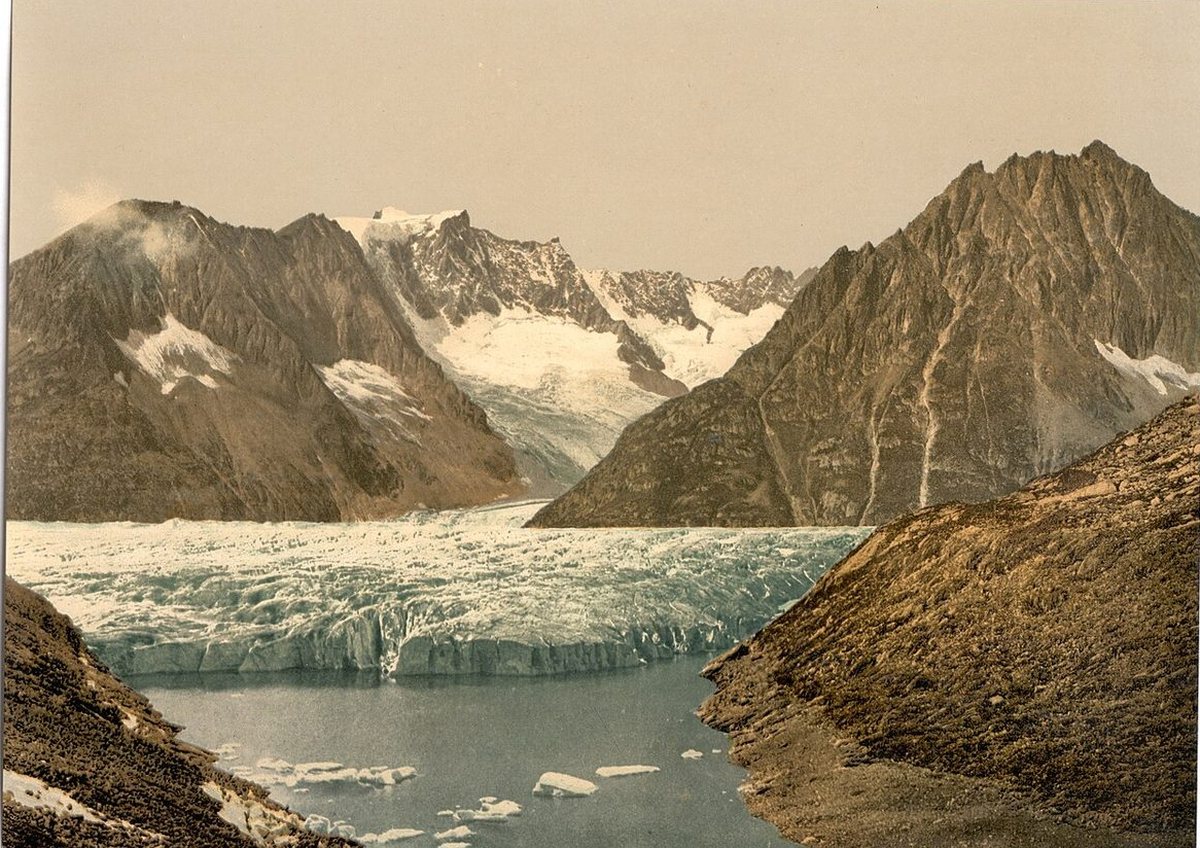
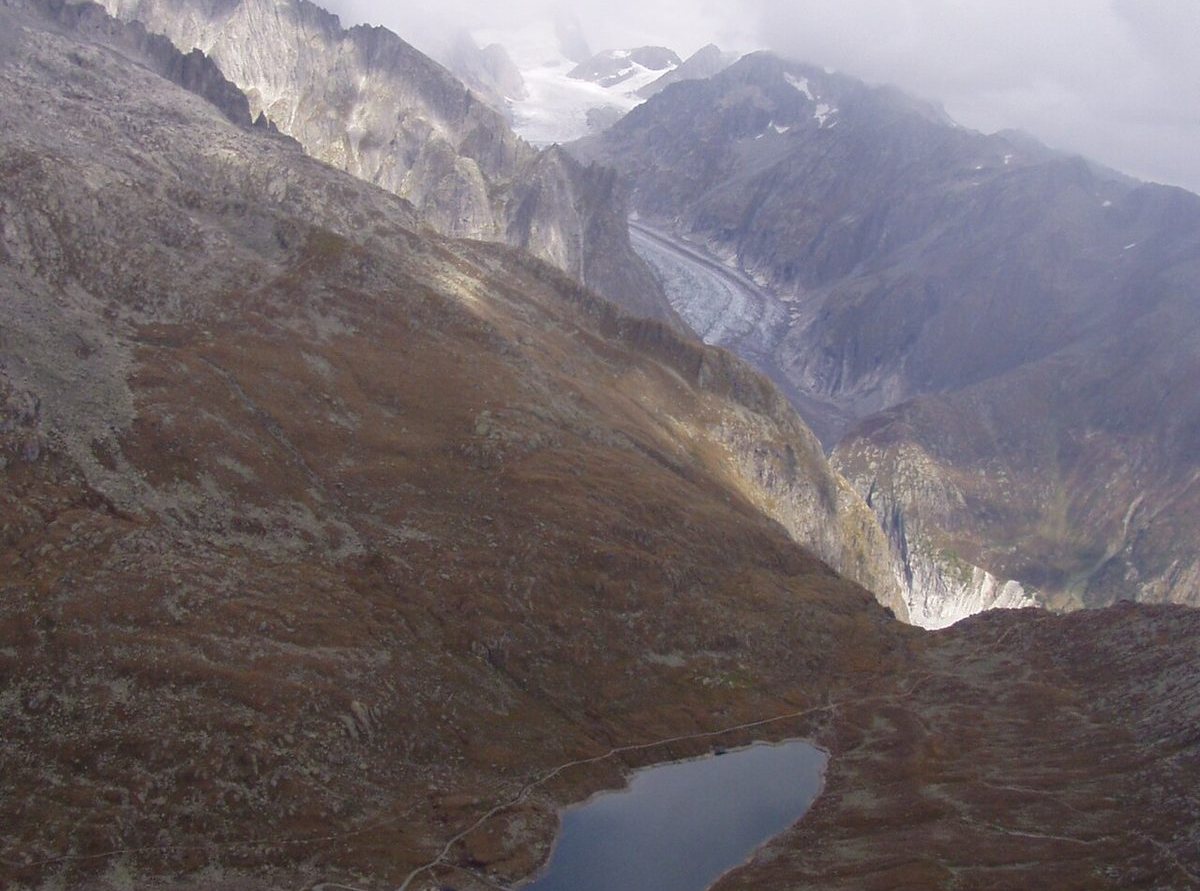
1890s: Photoglob Zürich, Photochrom Print Collection, Library of Congress (public domain). 2009: Addvisor, Wikimedia Commons (CC BY-SA 4.0). The two photos were taken from different viewpoints.
What the ice gives back
On 4 March 1926, four young men, three of them brothers, set out across the Aletsch Glacier. They were most likely caught by a storm, and they never came home. For decades, the glacier kept their story to itself.
Then, in summer 2012, mountaineers came across human bones, clothing and old equipment on the glacier. Among them were wooden ski poles, an old pair of binoculars and coins from the 1920s. They were the remains of the three brothers. The fourth man has never been found.
Scientists later used a computer model of the ice flow to reconstruct their journey. The bodies had travelled about 10.5 kilometres inside the glacier. In 1980, they were probably buried about 250 metres below the surface, under enormous pressure. Only as the ice thinned did the glacier finally give them back.
It's a haunting reminder that a glacier is also an archive. As the Aletsch Glacier melts, it returns what it has kept for decades, and sometimes for centuries.
The Aletsch Glacier in numbers: a 150-year record
Few glaciers anywhere are measured as carefully as this one. Swiss glaciologists, today organised in the GLAMOS network, have tracked the position of its tongue since 1870 and calculated its annual ice balance back to 1915. The charts below use their official data. Switch between the two records and drag the slider.
The glacier in data
Two official records from Swiss glacier monitoring. Drag the slider or tap the chart.
Data: GLAMOS, Swiss Glacier Length Change and Mass Balance, release 2025 (doi:10.18750/lengthchange.2025.r2025; doi:10.18750/massbalance.2025.r2025). Length is the sum of measured changes; some early years were not measured. GLAMOS’s preliminary figure for 2025/26, a new record loss of more than 3 m, is not yet included.
What the data shows
Three things stand out. First, the Aletsch Glacier has lost about 3.4 kilometres of length since 1870. Second, the losses have sped up. In the 2023–24 season alone, the tongue retreated by 64 metres.
Third, look at the year 1984. It was the last clear gain. Since the mid-1980s, the glacier has lost ice almost every year, and the worst years have come very recently. In 2022, after a dry winter and a hot summer, only about 11% of the glacier's area kept its winter snow, and the glacier lost the equivalent of about three metres of water across its entire surface.
Then came 2026. In September, GLAMOS reported that the 2025/26 season had been even worse for the Great Aletsch: a new record loss of more than three metres of water equivalent. The tongue was already free of snow in mid-April, and at the lowest measuring point, about 13 metres of ice melted in a single year. That figure is too new to appear in the chart above, which runs to 2025.
When the mountains start to move
A shrinking glacier doesn't just change the view. It changes the mountains around it.
The Moosfluh landslide
For thousands of years, the Aletsch Glacier pressed against the valley walls like a buttress. As the ice thinned, that support disappeared. Above the glacier, near Riederalp, a whole mountainside at the Moosfluh began to creep downhill. In autumn 2016, parts of it moved up to 80 centimetres a day. According to the monitoring firm Geopraevent, the unstable area covers about one square kilometre and at least 150 million cubic metres of rock. Several hiking trails were closed for good.
The stairs that keep growing
Further up, the Konkordia Hut tells the same story in a more personal way. When the first hut was built in 1877, it stood about 50 metres above the ice. Today, guests have to climb more than 450 steps of metal stairs from the glacier to the hut, and the staircase has to be extended every few years.
What happens next?
In 2019, the glaciologists Guillaume Jouvet and Matthias Huss at ETH Zurich modelled the future of the Aletsch Glacier. The results are sobering. Even if the world kept warming below 2 °C, as the Paris Agreement aims, the glacier would still lose more than half its volume and length by 2100. With high emissions, only small patches of ice would remain, and Konkordiaplatz, today buried under 800 metres of ice, would be completely ice-free. The record losses of 2022 and 2026 suggest the glacier is already following the darker path.
The Swiss have started to respond in their own way. In June 2023, 59% of voters approved a new climate law. Parliament had drawn it up as a counter-proposal to a popular initiative known as the Glacier Initiative, whose backers agreed to withdraw it if the law passed. It's a typical example of Swiss direct democracy, in which citizens push an issue onto the national agenda.
The Aletsch forest: an ancient forest on young ground
Right beside the glacier, above Riederalp, grows one of the most remarkable forests in the Alps. The Aletsch forest covers about 400 hectares of larches and Swiss stone pines. Some of the stone pines are around 1,000 years old. They have watched the glacier grow and shrink for a millennium.
In 1933, the forest became a nature reserve, under the protection of the conservation group now known as Pro Natura. Its centre sits in Villa Cassel on the Riederfurka, a grand summer house built in the early 1900s for the British banker Sir Ernest Cassel. Today, it runs exhibitions and guided walks about the glacier and the forest.
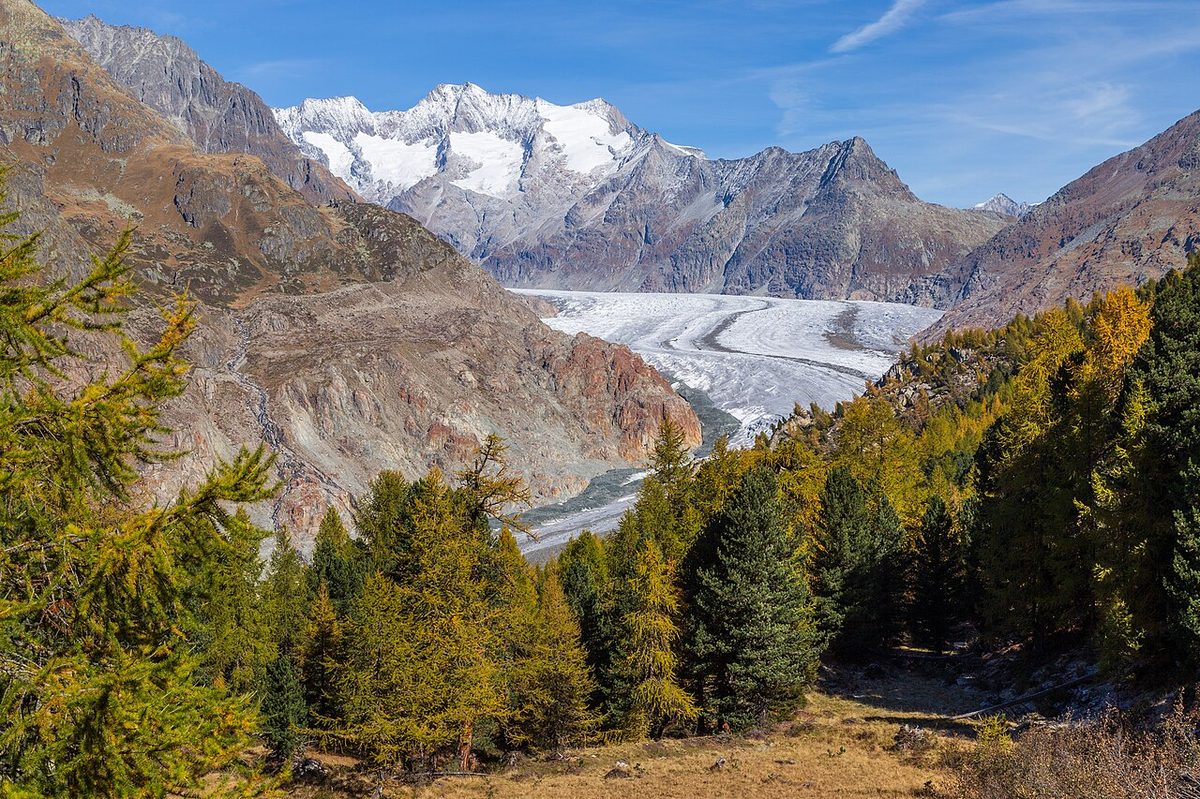
Walk through the forest in autumn, when the larches turn gold, and you'll understand why so many people fall in love with the Aletsch Glacier. You'll also see something rare: young trees and plants moving onto ground the ice left only a few decades ago.
Where to see the Aletsch Glacier
The good news is that you don't need to be a mountaineer to see the Aletsch Glacier. The easiest viewpoints are just a cable car ride away. Tap through the options below.
Where to see the Aletsch Glacier
Tap a viewpoint to see how to get there and what you’ll find.
- Getting there
- What you see
- Best for
- Good to know
Tips for your visit
- Base yourself in the Aletsch Arena. The car-free villages of Riederalp and Bettmeralp, reached by cable car from Mörel and Betten, sit right on the glacier's doorstep. Fiesch is the gateway to the Eggishorn.
- Go between June and October. Most hiking trails are open then. In winter, the viewpoints are still reachable, but many paths are not.
- Never step onto the ice alone. Hidden crevasses are deadly. Join a guided glacier hike if you want to walk on the Aletsch Glacier itself.
- Check the weather. Clouds can hide the glacier completely, so keep a flexible day in your plan.
- Combine it with Jungfraujoch. From the Bernese Oberland, the Jungfrau Railway shows you the glacier's source. It opened in 1912, a feat of Alpine engineering in the same spirit as the tunnels in our story about the Gotthard Base Tunnel.
For more ideas, see our list of the best places to visit in Switzerland. If you're driving, our guide to scenic drives in Switzerland covers the mountain passes nearby. And while you're in the Valais, try a raclette or a slice of cholera pie from our guide to traditional Swiss food.
The Aletsch Glacier through history
From the Bronze Age to the record melt of 2026, tap through the key moments in the life of the Aletsch Glacier.
The Aletsch Glacier, c. 1300 BC to 2026
Tap a date, or use the arrow keys. Red dots mark turning points.
Smaller than today
In the Late Bronze Age, the glacier was several hundred metres shorter than it is now.
The vow
Fiesch and Fieschertal promise to live virtuously and pray against the advancing ice and the Märjelensee floods.
The last maximum
The glacier reaches its last great Little Ice Age maximum.
Taming the lake
A drainage tunnel from the Märjelensee is completed after years of outburst floods.
Top of Europe
The Jungfrau Railway reaches Jungfraujoch on 1 August.
Lost in the storm
Four young men, three of them brothers, vanish on the glacier in March.
The last clear gain
The glacier gains ice for the last time in a clear way. Since then, it has lost ice almost every year.
World Heritage
UNESCO lists Jungfrau-Aletsch, the first natural World Heritage Site in the Alps.
A new prayer
Herbert Volken hands Pope Benedict XVI the parish’s request. The Holy See approves the new prayer in 2010.
The ice gives them back
Climbers find the remains of the three brothers lost in 1926.
The mountain moves
The Moosfluh slope above the glacier slides up to 80 cm a day.
A record melt
The glacier loses about 3 m of water equivalent across its whole surface.
An even worse year
GLAMOS reports the glacier’s biggest loss ever measured, beating 2022.
Quiz: true or false?
How well do you know the Aletsch Glacier now? Six quick questions will tell.
True or false? Six claims about the Aletsch Glacier
Score: 0 / 6The Aletsch is the largest glacier in the Alps.
True. It’s about 20 km long and covers roughly 76 km².
Local villagers once prayed for the glacier to shrink.
True. In 1678, Fiesch and Fieschertal vowed to pray against the advancing ice and its floods.
The glacier has had good years with a gain in ice since 1990.
False. The last clear gain was in 1984. Since then, it has lost ice almost every year.
Today, the glacier is the smallest it has been for 3,000 years.
False. In the Late Bronze Age it was several hundred metres shorter. What’s new is the speed of today’s retreat.
The remains of three men lost on the glacier in 1926 were found 86 years later.
True. Ice carried the three brothers for decades before releasing them in 2012. Nobody has ever found the fourth man.
From the viewpoints, you can safely walk out onto the ice on your own.
False. Hidden crevasses make the glacier dangerous. Go with a certified mountain guide unless you are trained and equipped for glacier travel.
Why the Aletsch Glacier matters
It's easy to see the Aletsch Glacier as a postcard: white ice, blue sky, a famous peak in the distance. But it's much more than that. It's a water tower that feeds rivers and hydropower plants, a source of electricity in a country that, as our story of why Switzerland is so rich shows, built its prosperity partly on water. It's an archive that keeps lost lives and old climates. And it's a measuring stick for the warming of the planet.
Above all, it's a place that changes how you feel about time. Stand on the Eggishorn and look down at the ice. The snow that fell on the Jungfrau when your grandparents were young may be melting below you right now.
The people of Fiesch understood the glacier's power in 1678, when they prayed for it to shrink. Their descendants understand it today, when they pray for it to stay. Go and see it while it still fills the valley.
FAQ: the Aletsch Glacier
How long is the Aletsch Glacier?
The Great Aletsch Glacier is about 20 km long and covers roughly 76 km², which makes it the largest glacier in the Alps. Its ice is about 800 m thick at Konkordiaplatz.
How fast is the Aletsch Glacier melting?
Official Swiss measurements show that the glacier has lost about 3.4 km of length since 1870. Since 2000, its tongue has retreated by about 40 m a year on average. It has lost ice almost every year since the mid-1980s, and 2025/26 was the worst year ever measured.
Will the Aletsch Glacier disappear?
Not completely by 2100 if warming is kept low, but it will shrink dramatically. An ETH Zurich study from 2019 found that even with strong climate action, it would lose more than half its volume. With high emissions, only small patches of ice would remain.
How do you get to the Aletsch Glacier?
From the Valais, take the cable cars from Mörel, Betten or Fiesch up to the car-free Aletsch Arena villages and viewpoints such as the Eggishorn, Bettmerhorn and Moosfluh. From the Bernese Oberland, take the Jungfrau Railway to Jungfraujoch.
Can you walk on the Aletsch Glacier?
Yes, but go with a certified mountain guide unless you are trained and equipped for glacier travel. Hidden crevasses make the ice dangerous. Guided glacier hikes start from the Aletsch Arena and from Jungfraujoch.
Why is the Aletsch Glacier a UNESCO World Heritage Site?
It lies at the heart of the Swiss Alps Jungfrau-Aletsch World Heritage Site, first listed in 2001 and extended in 2007. UNESCO recognised the region for its glaciers, landscapes and the way it shows how mountains form and how plants recolonise land left by retreating ice.
Sources and further reading
- GLAMOS – Glacier Monitoring Switzerland: data downloads (length change, mass balance)
- GLAMOS: Annual mass balance of Swiss glaciers in 2025/2026 (PDF, 23 September 2026)
- ETH Zurich: The future of the Aletsch Glacier (2019)
- Swiss Alps Jungfrau-Aletsch World Heritage: UNESCO leaflet on the Aletsch Glacier (PDF)
- Swissinfo: Can the Pope save Europe’s largest glacier?
- Swissinfo: Researchers shed light on accident 88 years ago
- Geopraevent: Monitoring of the Moosfluh landslide
- Aletsch Arena: The Aletsch forest
- UNESCO World Heritage Centre: Swiss Alps Jungfrau-Aletsch
- Beobachter: Um Gottes willen (on the 2009 request and 2010 approval, in German)
- Swiss Federal Council: Climate and Innovation Act, vote of 18 June 2023
Last updated 7 October 2026. Featured photo: Jo Simon, via Wikimedia Commons (CC BY 2.0).