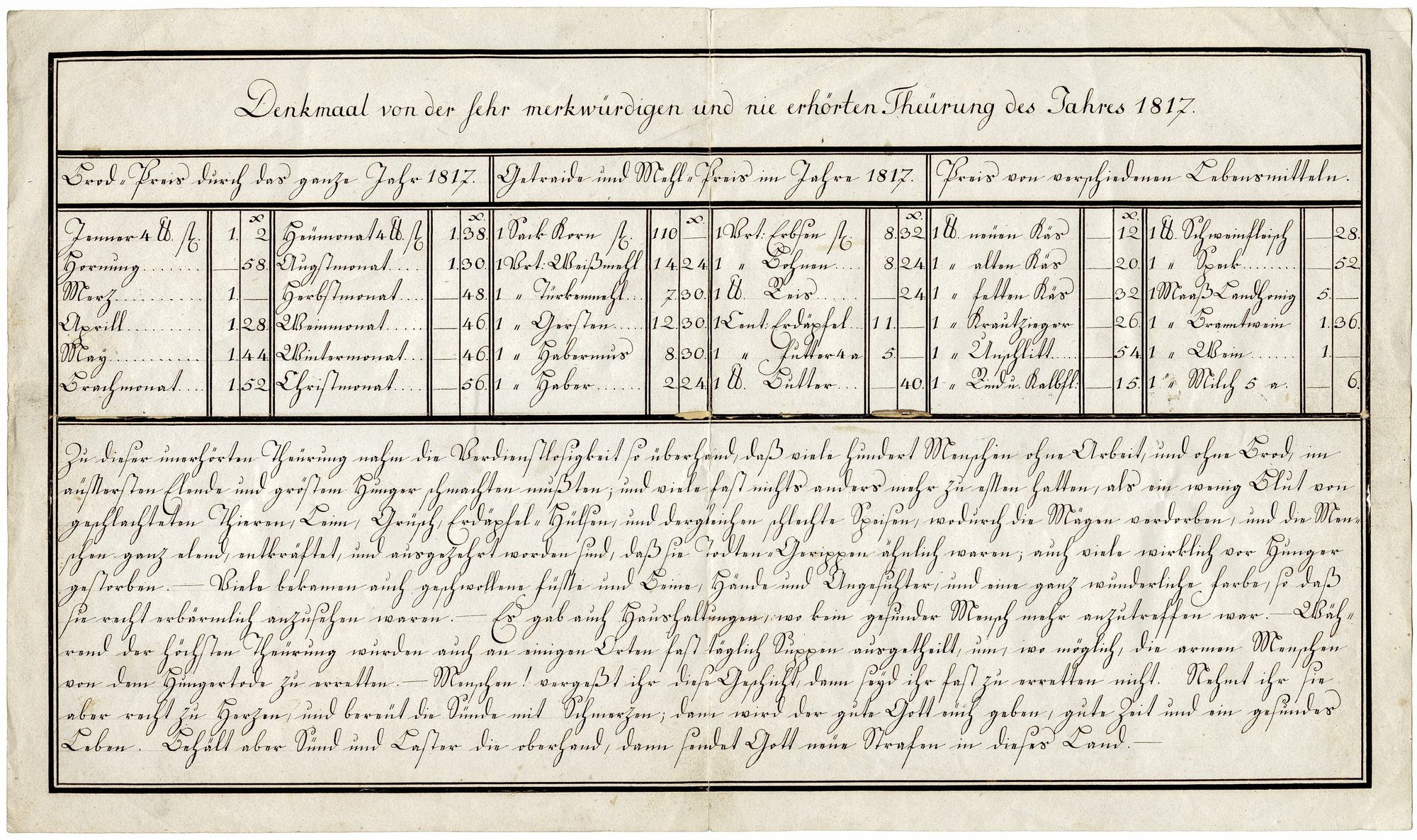
Sometime in 1817, a man named Johannes Gmünder sat down in Appenzell Ausserrhoden and made a record for people who had not yet been born. At the top of a large sheet he wrote, in careful copperplate, Denkmaal von der sehr merkwürdigen und nie erhörten Theurung des Jahres 1817: a memorial to the most remarkable and unheard-of dearness of the year 1817. Below it he ruled columns. Bread, month by month. Grain, flour, beans, butter, cheese, brandy, milk. Then, in a long paragraph, he described what the prices meant.
Hundreds of people, he wrote, were left without work and without bread. Many had almost nothing to eat but a little blood from slaughtered animals, potato peelings and similar poor food, until they looked like walking skeletons. Many developed swollen feet, legs, hands and faces, and a strange colour. There were households, he noted, where not a single healthy person could be found.
Gmünder’s sheet is one of several such memorials kept in the cantonal library of Appenzell Ausserrhoden. They are the voice of an event that most visitors to Switzerland have never heard of, and that many Swiss know only as a line in a school book: the famine of 1816 and 1817, the last true famine in the country’s history. Its trigger was a volcano on the other side of the world. Its victims, as the parish registers show, were concentrated in a handful of eastern cantons. The reasons for that geography say as much about early industrial Switzerland as about the weather.
An eruption 12,000 kilometres away
In April 1815, Mount Tambora on the Indonesian island of Sumbawa exploded in the largest volcanic eruption of the past several centuries. The blast killed tens of thousands of people on Sumbawa and the neighbouring islands. It also threw a vast cloud of sulphur into the stratosphere, where it spread around the planet and reflected part of the sunlight back into space.
Europe did not connect the two events at the time. The link was made by scientists much later, and it is still being refined. In a 2016 synthesis for the University of Bern’s Oeschger Centre, the climate historians Stefan Brönnimann and Daniel Krämer show that the cooling of summer 1816 was strongest in a band that ran through eastern France and Switzerland. Around Geneva, summer temperatures were roughly 2.5 to 3 °C below the average of 1799 to 1821. Afternoons were hit hardest: in Geneva, the afternoon readings fell by up to 3.8 °C.
There is an honest twist in the science. Climate models attribute only about 0.7 to 1 °C of the European cooling directly or indirectly to Tambora. Most of the extreme Swiss anomaly, the authors write, remains unexplained by the models. Bad luck in the weather patterns, on top of the volcanic veil, appears to have done the rest.
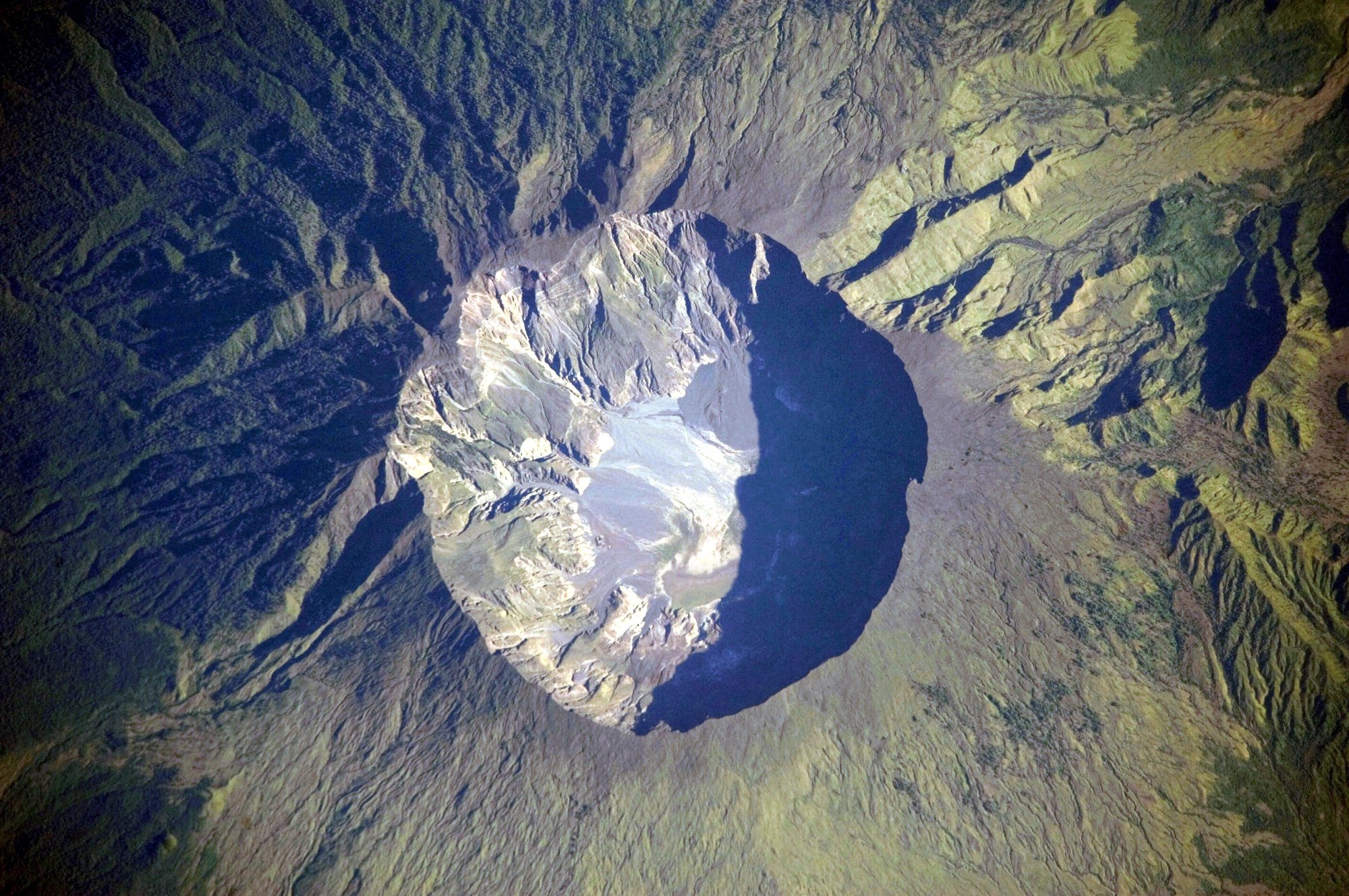
The timing is worth pausing on. In 1815, while ash was still settling on Sumbawa, the great powers were redrawing Europe at the Congress of Vienna, and in November they formally recognised Switzerland’s perpetual neutrality, a story told in our guide to Swiss neutrality. The new Confederation of 22 cantons had barely been assembled when the sky turned against it.
What the thermometers in Basel recorded
Switzerland is unusually rich in early weather records. Basel and Geneva have some of the longest instrumental temperature records in Europe, and the Historical Statistics of Switzerland publishes a summer series for Basel that begins in 1796. Plotted as a line, the series makes the anomaly visible at a glance.
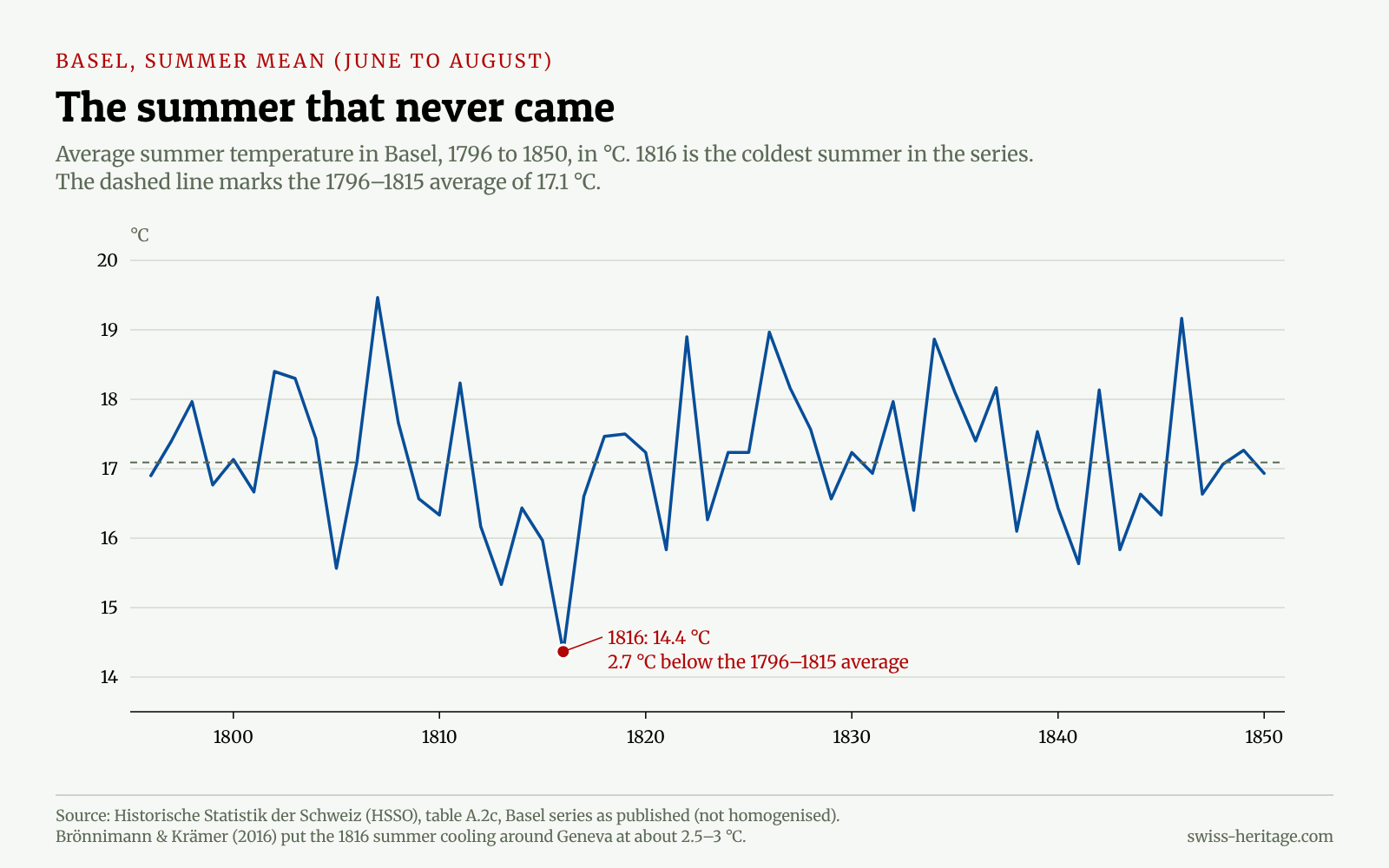
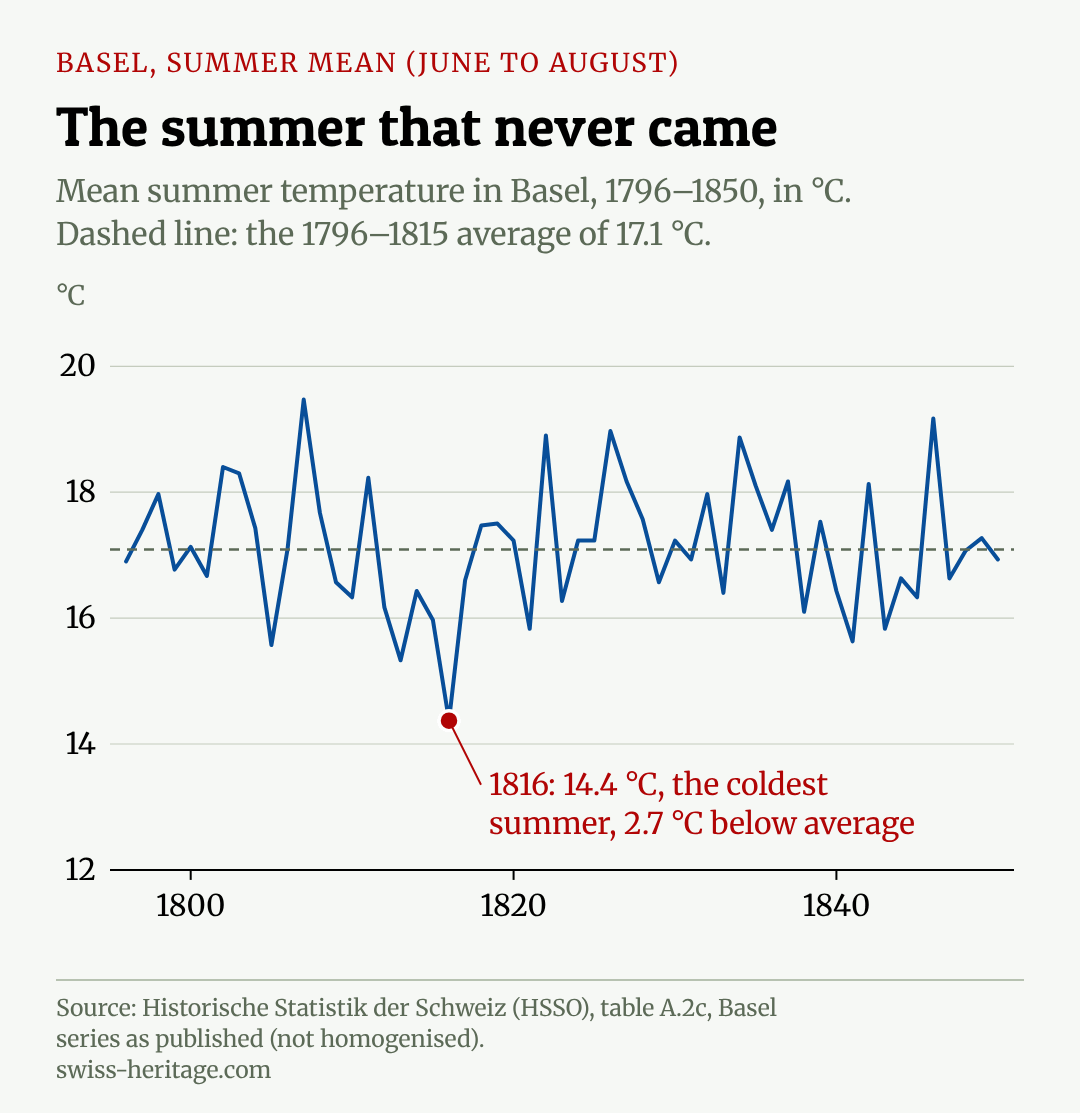
The average summer in Basel between 1796 and 1815 came to 17.1 °C. In 1816 it was 14.4 °C, the lowest value in the whole series up to 1850. The years before were no comfort either: 1813 and 1815 were also cold, so the summer of 1816 arrived on top of a run of poor seasons. Our figures use the series as published; a 2023 study in Meteorologische Zeitschrift has since revisited the early Basel and Geneva records, so individual values may shift slightly. The cold of 1816 itself is not in doubt.
Rain on 28 days out of 31
Cold was only half of it. Brönnimann and Krämer estimate that summer precipitation in Central Europe ran 20 to 80 per cent above normal. In Aarau, the writer and statesman Heinrich Zschokke recorded rain on 28 of the 31 days of July 1816; the modern July average is 11.5 rainy days. Snow fell repeatedly down to the valley floors into early summer. On 1 August, Switzerland’s later national day, a farmer in Nidwalden named Martin Obersteg noted in his diary that houses had to be heated.
Snow that fell high in the Alps during that summer did not melt. In 1817 it came down with the following winter’s snow, and the rivers north of the Alps flooded. A country that had just lost one harvest now watched water take fields that might have produced the next.
Rain, rot and the price of bread
The harvest of 1816 was poor everywhere and disastrous in places. Reported yields were 20 to 30 per cent below normal, and models suggest losses of 10 to 40 per cent for crops such as potatoes. Grain rotted in the fields and in the barns. Wine grapes were picked unripe in November.
For most households, that was not an inconvenience but a threat to life. Ordinary families spent 60 to 70 per cent of their income on food. When the harvest failed, prices did not drift upwards; they exploded. Brönnimann and Krämer report that grain prices rose by about 220 per cent in Geneva and by almost 600 per cent in Rorschach, the grain port on Lake Constance.
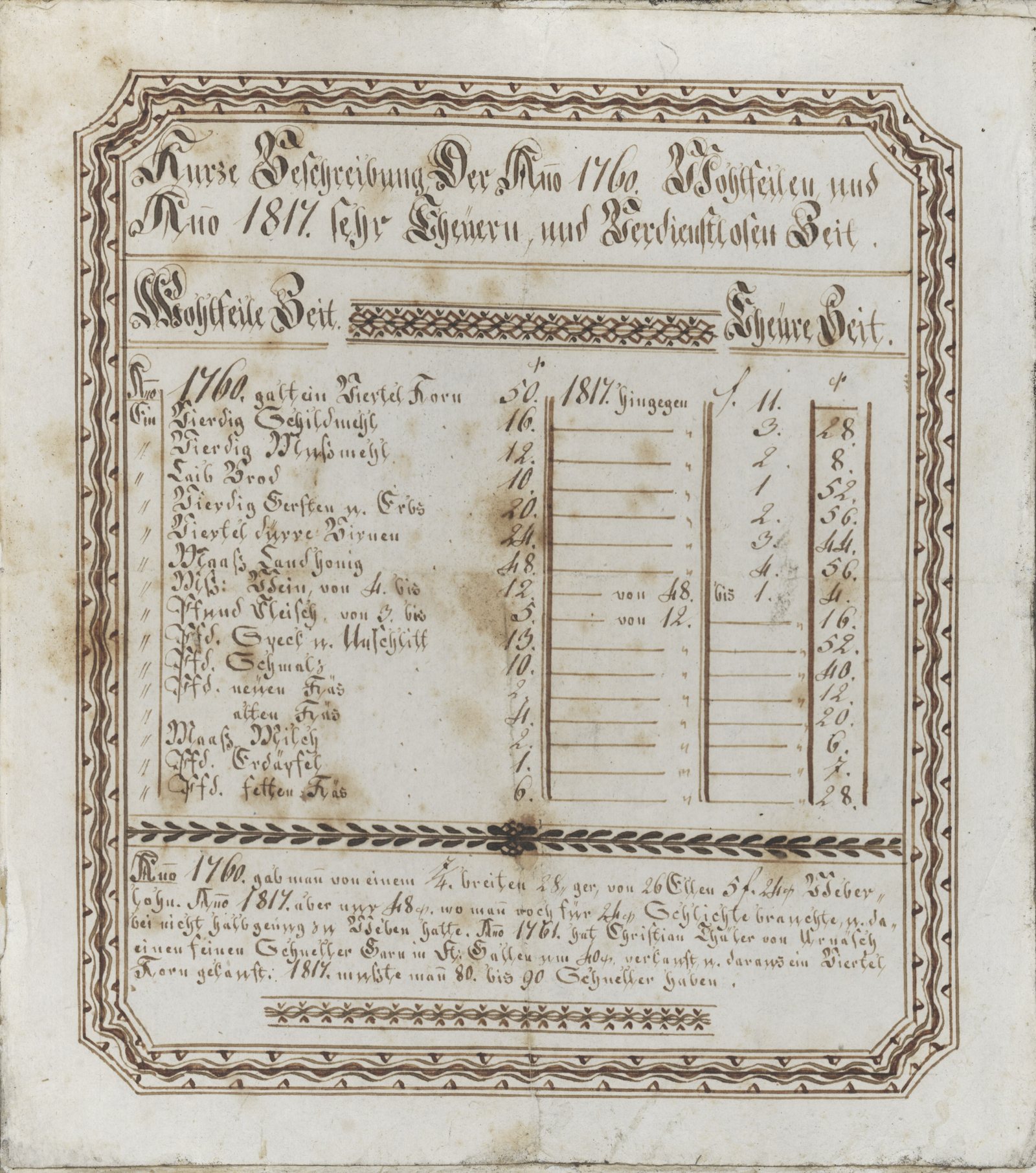
People in Appenzell were so shaken by these numbers that they turned them into objects. The so-called Hungertäfeli, small printed or hand-lettered price boards like the one from Urnäsch above, set the cost of bread, flour and other food in 1817 beside the prices of a cheap year, 1760. One painted Appenzell cupboard even carries scenes and price lists from the hunger year on its doors. Families kept the famine in their furniture.
Why the east starved and the west did not
The weather hit all of Switzerland north of the Alps. The dying did not. To see how unevenly the famine struck, we compared recorded deaths in 1817 with the average of the five years from 1811 to 1815 for every canton whose series is complete in the Historical Statistics of Switzerland.
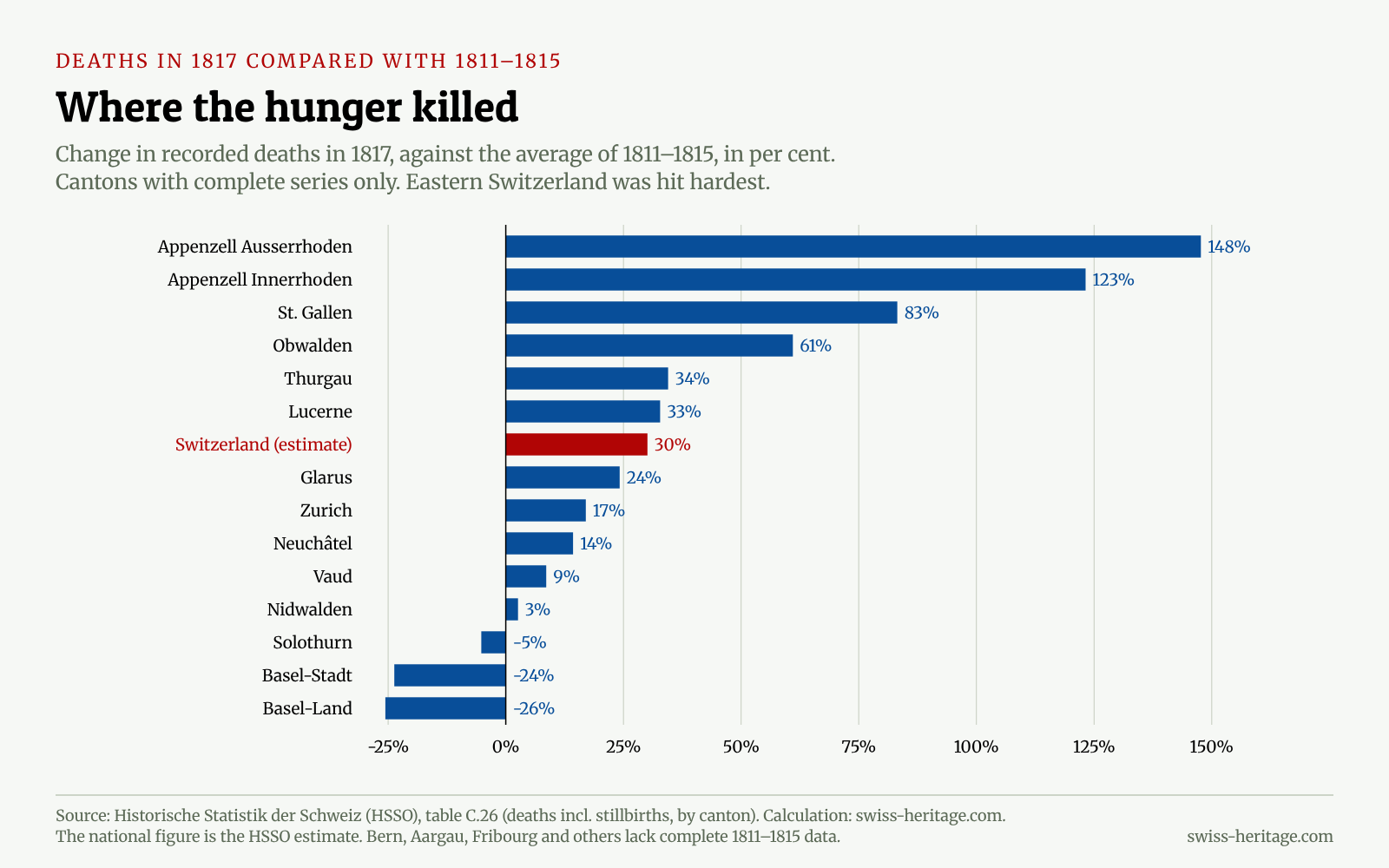
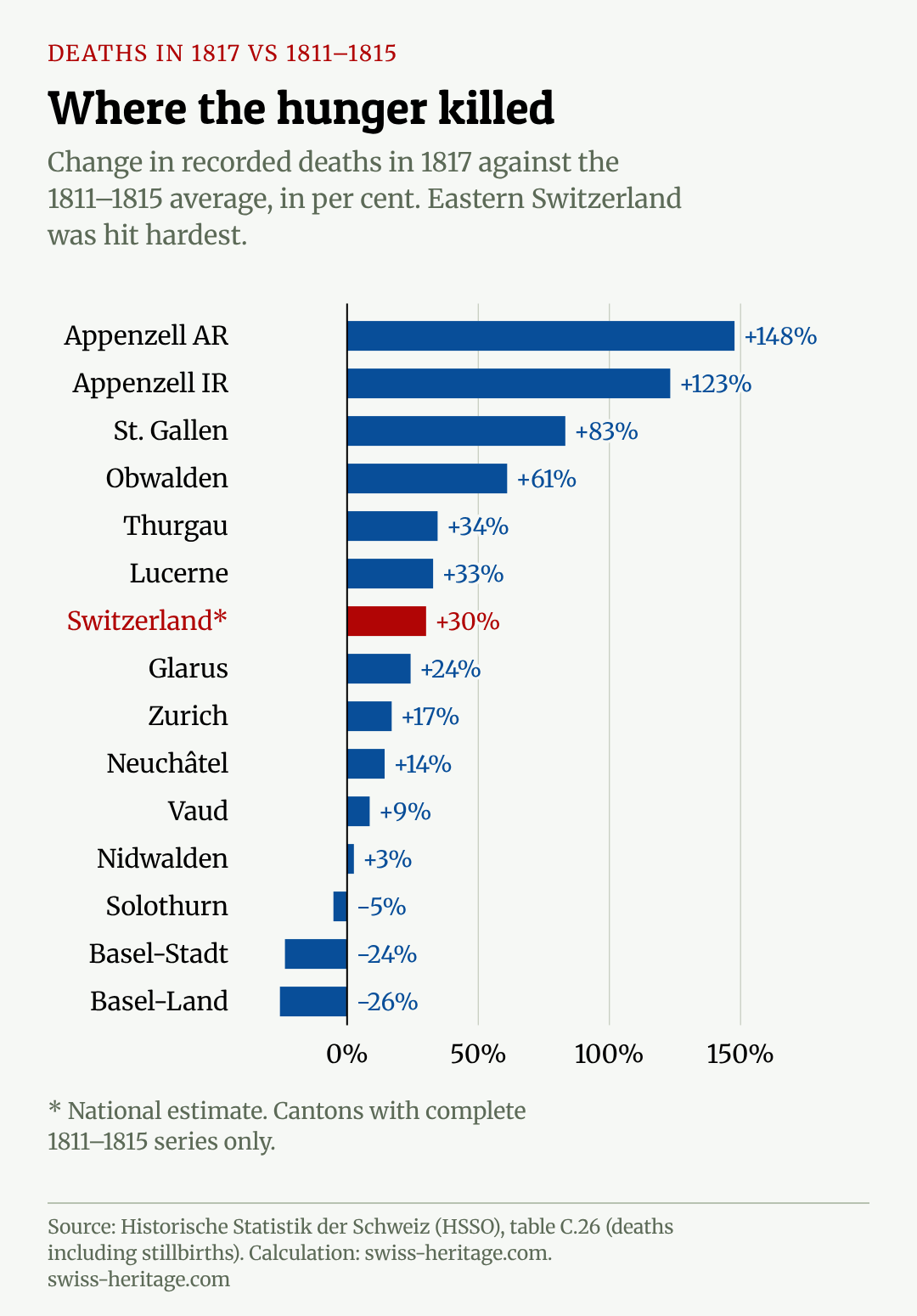
The result is stark. In Appenzell Ausserrhoden, deaths in 1817 were nearly two and a half times the normal level. In Appenzell Innerrhoden they more than doubled, and in St. Gallen they rose by 83 per cent. In Vaud the increase was 9 per cent. In both Basel cantons, deaths in 1817 were actually lower than the baseline, partly because both had recorded an unusually deadly year in 1814 that inflates their average.
Three forces explain the pattern, and only one of them is the climate.
A textile crisis already under way
Eastern Switzerland was the country’s first industrial region, but its industry lived in farmhouses. Families in Appenzell, the Toggenburg and the Zurich Oberland spun and wove cotton at home for merchants. When machine-spun yarn arrived, that work collapsed. Brönnimann and Krämer cite the loss of about 60,000 hand-spinning jobs between 1787 and 1820; canton Zurich alone counted 30,000 unemployed cotton spinners in 1817. The Historical Dictionary of Switzerland makes the same point: the famines of 1770–71 and 1816–17 were made worse by slumps in the textile trade that had nothing to do with the harvest. A hungry weaver had no wages with which to buy dear bread.
That is why the famine looks like a map of proto-industry. The densely populated hill country of the east, with little arable land and many looms, depended on buying its grain. The textile story continues in our guide to St. Gallen, whose embroidery boom later in the century grew out of the same cottage workshops.
A market that dried up
The east’s grain came largely from southern Germany, sold through markets around Lake Constance. In 1816 and 1817 southern Germany was suffering the same failed harvests. In Ravensburg, the painter Gottlob Johann Edinger recorded the arrival of the first harvest wagons after the great famine of 1816–17. When the granaries across the lake were empty, there was no easy alternative.
Governments that waited
The third factor was political. The western cantons intervened in the markets earlier and bought grain abroad in the autumn of 1816. Several eastern cantons waited longer. Brönnimann and Krämer note that Thurgau closed its 1817 accounts with a budget surplus, in the middle of the famine, and that a cantonal poor-relief commission itself criticised what it called the “aimless struggle” against the distress. There was no federal state yet to take over. The Confederation of 1815 was a loose alliance; famine policy was a cantonal matter, and each canton guarded its own grain.
The demography of hunger: fewer births, more deaths
Famine historians have long argued that hunger leaves its deepest mark not in the death registers but in the birth registers. The Historical Dictionary of Switzerland, drawing on Markus Mattmüller’s work on earlier crises, describes a typical pattern: excess deaths that last for a year or two, and a fall in births that lasts longer. The national estimates for 1814 to 1820 follow that script closely.
| Year | Births (incl. stillbirths) | Deaths (incl. stillbirths) | Births minus deaths |
|---|---|---|---|
| 1814 | 63,500 | 53,700 | +9,800 |
| 1815 | 67,600 | 43,800 | +23,800 |
| 1816 | 65,100 | 46,800 | +18,300 |
| 1817 | 53,200 | 64,100 | −10,900 |
| 1818 | 48,800 | 53,000 | −4,200 |
| 1819 | 67,600 | 49,300 | +18,300 |
| 1820 | 68,300 | 43,700 | +24,600 |
In 1817, deaths jumped to about 64,100, roughly 46 per cent more than in 1815. Births fell to 53,200 and then to 48,800 in 1818, about 28 per cent below the level of 1815. For two years in a row, Switzerland lost population through natural change. In the national estimates for the whole nineteenth century, 1817 and 1818 are the only years in which deaths outnumbered births. Then, in 1819, births bounced back to 67,600. Couples who had postponed children did not postpone them forever.
Behind the numbers lie the diseases of hunger. The Historical Dictionary lists what famished people turned to: roots, grass, nettles, hay, bark, offal, the meat of cats, dogs and horses. Such food filled stomachs without feeding bodies and spread dysentery and typhus. It also brought humiliation. People who could no longer dress for church, or pay for a funeral, lost their standing in a society that valued both.
Meanwhile, at a villa above Lake Geneva
The famous version of 1816 happened almost 300 kilometres west of Appenzell, in a rented house in Cologny on the shore of Lake Geneva. In June, Lord Byron, the poet Percy Bysshe Shelley and Mary Godwin, soon to be Mary Shelley, found themselves kept indoors by the weather at and around the Villa Diodati. Byron proposed that each of them write a ghost story. Mary’s became Frankenstein, published in 1818. Byron wrote the poem “Darkness”, a vision of a world without sun.
Years later, in the introduction to the 1831 edition of her novel, Mary Shelley remembered it simply as a “wet, ungenial summer”. The contrast with Gmünder’s memorial could hardly be sharper. In Cologny, the rain produced literature. In Appenzell, it produced empty tables and, in many homes, coffins. Both stories are true, and both belong to Swiss history, but only one of them is widely told. If you visit Geneva, the villa is private and can be seen only from outside.
What the hunger years left behind
For the poorest, the famine was a push to leave. The Historical Dictionary notes that famines regularly forced the destitute into permanent emigration, and the years after 1816 saw Swiss families set out for North America and elsewhere. Our article on why Switzerland became so rich follows that thread, including the communes that paid their poor to go.
For those who stayed, the lesson was about markets and institutions. Cantons that had stockpiled grain or bought early had done better. Poor relief, still organised commune by commune, had proved fragile. Later reforms of grain policy and the eventual federal state of 1848 did not grow out of the famine alone, but the experience of 1816 and 1817 was part of the background against which Switzerland learned to think of food security as a public task. The longer arc appears in our Swiss history timeline.
For science, the legacy is the data. The Basel and Geneva series, the diaries of people like Zschokke and Obersteg, and even the price boards of Appenzell are now inputs for climate reconstructions. They help researchers understand how a large eruption can shake the food system of a mountainous, import-dependent country. It is not an abstract question for a Switzerland that still imports a large share of its calories.
The last famine, not the last warning
The Historical Dictionary lists documented famines in Switzerland in 1438, 1530, 1571–1574, 1635–1636, 1690–1694, 1770–1771 and 1816–1817. It warns that the list is incomplete, because many famines struck single regions. But the series stops in 1817. In that sense, the year without a summer marks a border in Swiss history: the moment when weather could still starve people to death in large numbers, for the last time.
It is worth remembering the next time a cold, rainy July sends visitors indoors. In 1816, the same weather filled a villa with ghost stories and a valley with hunger. The difference lay not in the sky but in who could afford bread.
Year without a summer: questions and answers
What was the year without a summer in Switzerland?
It was the summer of 1816, when temperatures around Geneva were about 2.5 to 3 °C below normal and rain fell on most days. Harvests failed, food prices soared and a famine followed in 1816 and 1817, the last famine in Swiss history.
What caused the cold summer of 1816?
The eruption of Mount Tambora in Indonesia in April 1815 put sulphur into the stratosphere and cooled the Northern Hemisphere. Models attribute about 0.7 to 1 °C of the European cooling to the eruption; the stronger Swiss anomaly also reflects unusual weather patterns.
Which parts of Switzerland suffered most?
Eastern Switzerland. In Appenzell Ausserrhoden, recorded deaths in 1817 were almost two and a half times the 1811–1815 average, and St. Gallen saw an increase of 83 per cent. Western cantons such as Vaud were far less affected.
Did the famine have anything to do with Frankenstein?
Indirectly. Mary Shelley began Frankenstein in June 1816 at and around the Villa Diodati in Cologny near Geneva, when the bad weather kept her, Lord Byron and Percy Bysshe Shelley indoors. The famine itself unfolded mainly in the east of the country.
How many people died in Switzerland in 1816 and 1817?
There is no exact count of famine deaths. National estimates show about 64,100 deaths in 1817, against about 43,800 in 1815, and a fall in births from about 67,600 to 48,800 by 1818.
Sources and further reading
- Brönnimann, S. and Krämer, D. (2016): Tambora and the “Year Without a Summer” of 1816. Geographica Bernensia G90, University of Bern
- Historisches Lexikon der Schweiz: “Hungersnöte” (Fridolin Kurmann)
- Historische Statistik der Schweiz (HSSO), table A.2c: summer mean temperatures 1796–1995
- HSSO, table C.26: deaths by canton 1801–1995
- HSSO, table C.16: births by canton 1801–2006
- Brugnara, Y. et al. (2023): Revisiting the early instrumental temperature records of Basel and Geneva. Meteorologische Zeitschrift 32(6)
- Kantonsbibliothek Appenzell Ausserrhoden: Johannes Gmünder, “Denkmaal von der sehr merkwürdigen und nie erhörten Theurung des Jahres 1817”
- Kantonsbibliothek Appenzell Ausserrhoden: Urnäscher Hungertäfeli, 1817
- Mary Shelley: Frankenstein (1831 edition, with the author’s introduction), Project Gutenberg