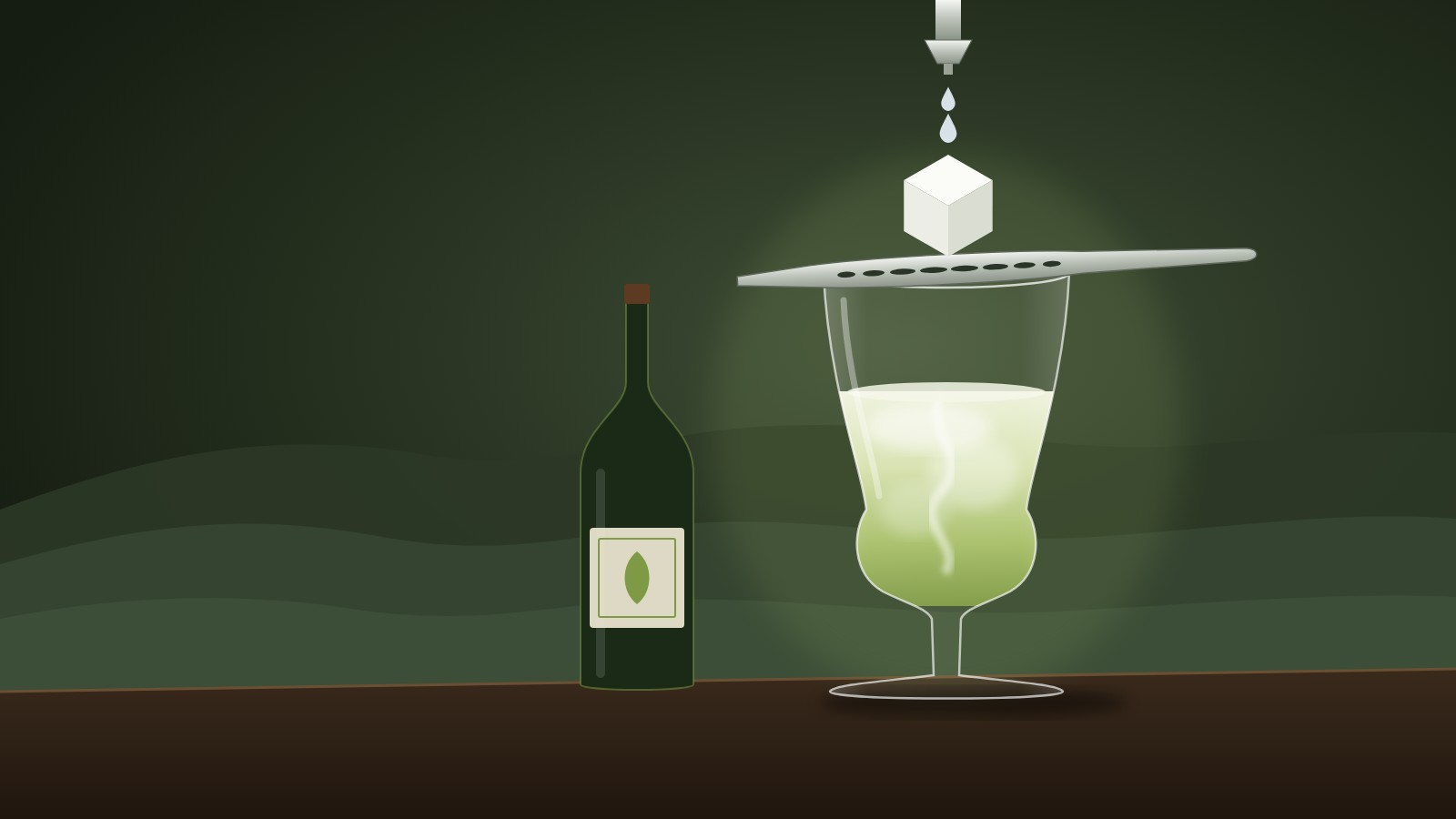
On the afternoon of 28 August 1905, in the village of Commugny near the shore of Lake Geneva, a French labourer named Jean Lanfray shot his pregnant wife and their two little daughters, Rose and Blanche, aged four and two. He then turned the gun on himself and survived. The police established what he had drunk that day: seven glasses of wine, six of cognac, a coffee laced with brandy, two crème de menthes and two glasses of absinthe.
Only the last item made the headlines. At his trial in February 1906, a psychiatrist described the killings as a classic case of absinthe madness. Lanfray was sentenced to thirty years and hanged himself in his cell three days later. Within months, a petition against absinthe had gathered tens of thousands of signatures in Vaud. Within three years, Switzerland had voted to ban the drink nationwide, written the ban into its constitution and set out to destroy an industry that had been born in one of its own valleys.
The Swiss absinthe ban is usually told as a curiosity: the country that outlawed the Green Fairy. The vote results tell a sharper story. They show a country divided by language and economy, a federal government that opposed the ban and lost, and one Jura valley that voted almost alone against everybody else.
A drink from the Val-de-Travers
Absinthe, the spirit flavoured with wormwood, anise and fennel, is Swiss before it is French. Its origins lie in Couvet in the Val-de-Travers, in the Jura mountains of canton Neuchâtel, at the end of the eighteenth century. Accounts differ on who first made it. One version credits a French doctor living in Couvet, Pierre Ordinaire, who sold it as a remedy; another credits the Henriod sisters of Couvet, who may have made it before him. The documented commercial history begins in 1797, when a certain Major Dubied acquired the formula and opened a distillery in Couvet with his son and his son-in-law, Henri-Louis Pernod. In 1805, Pernod opened a second distillery across the border in Pontarlier.
From there absinthe conquered France, and in the second half of the nineteenth century it became the drink of Parisian cafés, painters and poets. The Val-de-Travers stayed at the heart of production. Wormwood was grown in the valley and dried in special barns; one of these drying sheds, at Boveresse, is today protected as cultural property. For the valley’s farmers and distillers, the green spirit was a livelihood.


From a family tragedy to a national campaign
The temperance movement had been warning about absinthe for years before Commugny, and other crimes were linked to it in public debate. But the Lanfray murders gave the campaign a face. In Vaud a petition gathered more than 80,000 signatures, and the cantonal parliament banned absinthe, a decision that voters then upheld in a referendum. Geneva followed with its own ban. Sources differ slightly on the dates and figures of the Vaud steps, which ran through 1906 and 1907.
At the same time, anti-alcohol organisations launched a federal popular initiative. When they submitted it, it carried 167,814 signatures, according to the Swissvotes database, the highest number ever collected for a Swiss initiative up to that point. The proposal was simple: a new constitutional article banning the manufacture, import, transport and sale of absinthe, and its storage for sale.
A government that said no
The Federal Council opposed the initiative. It did not deny the danger: a medical report it had commissioned concluded that absinthe caused particularly severe mental and physical harm. But the government considered a national ban a disproportionate interference with freedom of trade and industry, for a product made and drunk almost entirely in the French-speaking cantons. It also warned that a ban would hit the Val-de-Travers hard. Federal Councillor Marc-Emile Ruchet defended that position in parliament.
Parliament did not follow him. A majority recommended that voters accept the initiative, against the Federal Council’s advice, a constellation that Swissvotes describes as very rare in the history of Swiss popular votes. The Free Democrats were split: the radicals of Geneva and Neuchâtel opposed the ban, other cantonal parties abstained. The Social Democrats, the Grütli association and the Catholic Conservatives supported it, as did the bishops and the Protestant church conference. The campaign, Swissvotes notes, only made big waves in French-speaking Switzerland.
5 July 1908: how Switzerland voted
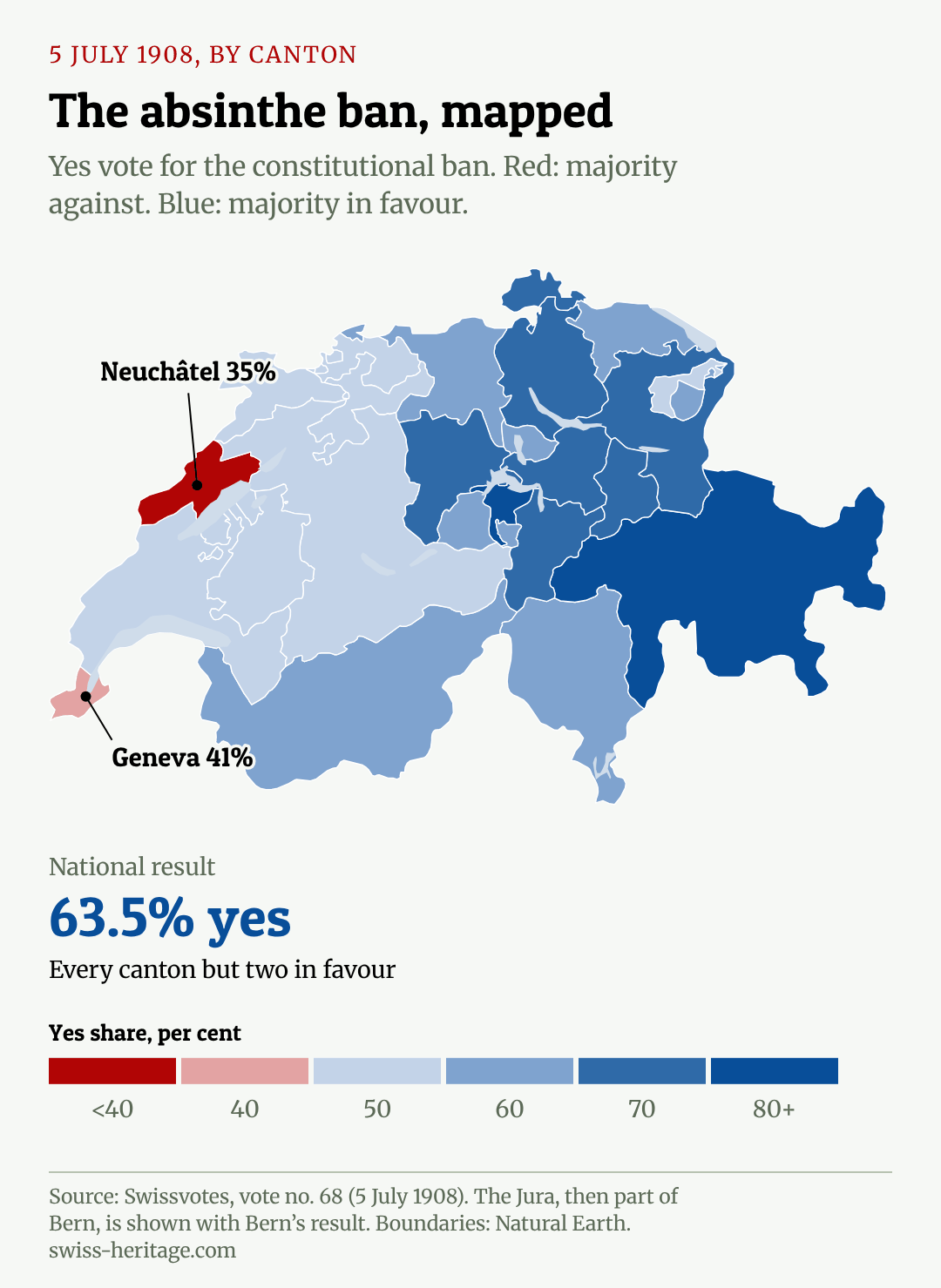
On 5 July 1908, voters accepted the initiative with 63.5 per cent of the vote, on a turnout of 49.3 per cent. Twenty of the twenty-two cantons said yes. The breakdown by canton, published by the Federal Chancellery and compiled by Swissvotes, is the clearest picture we have of what the country thought.


Only Geneva, with 40.8 per cent yes, and Neuchâtel, with 35.3 per cent, rejected the ban. Support was highest in central and eastern Switzerland, where absinthe was barely drunk: 83 per cent in Graubünden and 82 per cent in Nidwalden. Vaud, where the campaign had started, accepted the national ban with a modest 56 per cent. Within Vaud, the Lausanne district actually voted no, with 49.1 per cent yes.

The valley that voted almost alone
The most striking number is hidden one level down. In the Val-de-Travers district, the home of the distilleries and the wormwood fields, only 17.3 per cent of voters supported the ban; 2,537 voted no and 529 yes. Few places in Switzerland have ever been outvoted so heavily on a question that concerned them so directly. The district results also show how unevenly the rest of Neuchâtel felt: in La Chaux-de-Fonds, 45.8 per cent voted yes.
| Area | Yes | No | Yes share |
|---|---|---|---|
| Switzerland | 241,078 | 138,669 | 63.5% |
| Zurich (canton) | 44,104 | 13,978 | 75.9% |
| Vaud (canton) | 17,848 | 13,949 | 56.1% |
| Geneva (canton) | 5,974 | 8,686 | 40.8% |
| Neuchâtel (canton) | 6,337 | 11,634 | 35.3% |
| Lausanne (district) | 3,208 | 3,328 | 49.1% |
| La Chaux-de-Fonds (district) | 2,373 | 2,811 | 45.8% |
| Val-de-Travers (district) | 529 | 2,537 | 17.3% |
The geography fits a pattern that runs through Swiss history: a majority in German-speaking Switzerland imposing a rule on a product, or a habit, that belonged mostly to the French-speaking west. The language border at work in this vote is the subject of our guide to the Röstigraben.
Language or something else? Testing the split
The idea that German-speaking Switzerland outvoted the French-speaking west can be tested with the cantonal results. Added together, the three French-speaking cantons of Geneva, Neuchâtel and Vaud voted 46.8 per cent yes. The eighteen cantons and half-cantons where German was the majority language, counting trilingual Graubünden among them, voted 69.6 per cent yes. The bilingual cantons of Bern, Fribourg and Valais landed in between, at 57.1 per cent, and Italian-speaking Ticino voted 68.4 per cent yes, on a turnout of just 18.6 per cent. The map of the Swiss languages is visible in the result.
So the split was real, but it was not the whole story. Vaud, a French-speaking canton, voted for the ban, and so did Fribourg and Valais, both with French-speaking majorities. A simple calculation shows how little the west mattered to the outcome. Remove Geneva, Neuchâtel and Vaud from the national count altogether, and the yes share rises only from 63.5 to 66.9 per cent. The ban did not need the west to pass, and the west could not have stopped it. That is the arithmetic of a federal majority, and it is why the Val-de-Travers, with its 17 per cent, never stood a chance.
Switzerland was not alone: the absinthe bans of the early twentieth century
Switzerland is often described as the country that banned absinthe, but it was one of several. Belgium and the Netherlands also banned the drink in the years before the First World War. The United States followed in 1912, and France, the biggest market by far, in 1915, in the middle of the war. By then the Green Fairy had been driven out of most of the places where it had been drunk.
What set Switzerland apart was the method. Elsewhere, absinthe was banned by governments, parliaments or official decrees. In Switzerland, voters wrote the ban into the federal constitution against the advice of their own government, which is one reason it lasted so long. The return came in a similar cluster. The Netherlands lifted its ban in 2004, and Belgium and Switzerland in 2005. The United States allowed absinthe back onto shelves in 2007. France formally repealed its 1915 law only in 2011, although spirits made with wormwood had been sold there again since 1988, under other names.
The ban in practice: 1910 to 2005
The constitutional ban took effect on 7 October 1910. Legal production in the Val-de-Travers ended, but the drink did not disappear. Clandestine home distillers produced a colourless version that was harder for inspectors to recognise, known as la Bleue. For almost a century the valley kept a quiet tradition of illegal distilling, and the name la Bleue came to stand for Swiss-style absinthe in general.
Did the ban make the Swiss drink less?
This is the question the 1908 campaign was really about, and the national consumption estimates allow a rough answer. The Historical Statistics of Switzerland publish estimates of how much distilled spirit the Swiss consumed, averaged over periods of several years. Divided by the population, they give a picture of drinking habits across a century.


In the early 1880s, the Swiss drank the equivalent of about 11.6 litres of 40 per cent spirits per person per year. The big fall came long before the absinthe ban. In 1885 voters gave the federal government power to regulate spirits, and in 1887 they approved a federal spirits law with 65.9 per cent yes, creating a state monopoly. By 1893 to 1902, consumption had dropped to about 7.1 litres. Across the absinthe ban, the curve barely moves: about 6.4 litres in 1903 to 1912 and 6.2 in 1913 to 1922. The next big drop followed another reform, the reorganisation of alcohol policy approved by voters on 6 April 1930, which brought fruit brandies under federal control.
The opponents of the ban had predicted exactly this. Drinkers, they argued, would switch to another spirit or buy illegally; only a comprehensive alcohol policy would make a difference. On the evidence of the consumption estimates, they were right. The absinthe ban changed what the Swiss drank more than how much. These figures are estimates and period averages, but no version of them shows the ban as a turning point.
Was absinthe really dangerous? What the chemistry shows
The case against absinthe rested on one compound: thujone, a substance found in wormwood and believed to cause hallucinations, convulsions and the condition doctors called absinthism. For a century, the toxicity of historical absinthe was assumed, not measured.
In 2008 a team led by the food chemist Dirk Lachenmeier, from the official food-control laboratory in Karlsruhe, analysed 13 samples of pre-ban absinthe from sealed bottles and published the results in the Journal of Agricultural and Food Chemistry. They found relatively small amounts of thujone, much lower than earlier estimates and about the same as in absinthe produced since its rehabilitation. As Lachenmeier put it, nothing besides ethanol was found that could explain the syndrome of absinthism. Absinthism, in other words, was most probably alcoholism, in a drink that was typically bottled at a very high strength.
That fits the details of the Commugny case. Jean Lanfray had drunk large quantities of wine, cognac and brandy that day. The prosecution at the time pointed out that the absinthe was minor compared with everything else. The court of public opinion was not interested in the distinction.
The return of the Green Fairy
The ban outlived the reasons for it. When Switzerland adopted a new Federal Constitution, which entered into force in 2000, the absinthe article was left out, although the prohibition remained in ordinary law. Legislators then lifted that too, and absinthe became legal again on 1 March 2005. Distillers in the Val-de-Travers, some of them former clandestine producers, went legal.
The valley then tried to secure its heritage. In 2010, a decision allowed only absinthe made in the Val-de-Travers region to be labelled “absinthe” in Switzerland. In 2014 the Federal Administrative Court overturned it, ruling that absinthe is a type of product, not a geographic origin. Switzerland also remains, according to the reference literature, the only country with a formal legal definition of absinthe, which must be distilled, free of certain additives and naturally coloured or colourless.
Visiting absinthe country
The Val-de-Travers lies west of Neuchâtel, close to the French border. Môtiers, Couvet and Boveresse are the places to start, and the drying shed at Boveresse shows how wormwood was once prepared. The valley is a short trip from the lake towns covered in our guide to the best places to visit in Switzerland. For the wider story of how Swiss food and drink were shaped by regulation and cartels, our history of the cheese union and fondue makes a natural companion, and our overview of traditional Swiss food covers the rest of the table.
The absinthe ban is a reminder that direct democracy does not only produce wise or tolerant results. It produced a law that most of its targets rejected, that the government opposed and that, by the best available evidence, did little to reduce drinking. It also produced one of the most precise records of public opinion anywhere in Europe in 1908, down to a single valley that said no. For more on how Swiss voters shape their own laws, see our guide to Swiss direct democracy.
Absinthe ban in Switzerland: questions and answers
When was absinthe banned in Switzerland?
Voters approved a constitutional ban on 5 July 1908, with 63.5 per cent yes. The ban took effect on 7 October 1910 and lasted until 1 March 2005.
Why did Switzerland ban absinthe?
A temperance campaign gained momentum after the Lanfray murders in Commugny in 1905, which were blamed on absinthe although the killer had drunk large amounts of other alcohol. A federal initiative with 167,814 signatures led to the 1908 vote.
Which cantons voted against the absinthe ban?
Only Geneva (40.8 per cent yes) and Neuchâtel (35.3 per cent yes). In the Val-de-Travers district, where absinthe was produced, only 17.3 per cent voted yes.
Is absinthe legal in Switzerland today?
Yes. The constitutional ban was dropped with the new Federal Constitution in 2000, and the remaining legal prohibition was lifted on 1 March 2005.
Did absinthe really cause madness?
The evidence says no. A 2008 analysis of 13 pre-ban absinthes found only small amounts of thujone, similar to modern absinthe, and concluded that nothing besides alcohol explained the symptoms attributed to absinthism.
Sources and further reading
- Swissvotes: Initiative «für ein Absinthverbot», vote no. 68 of 5 July 1908, with results by canton and district
- Bolliger, C. (2010): “Trotz Widerstand in der Westschweiz: Die ‹grüne Fee› wird verbannt”, in Handbuch der eidgenössischen Volksabstimmungen 1848–2007
- Historische Statistik der Schweiz (HSSO), table T.9a: estimated consumption of alcoholic beverages 1880–1984
- Wikipedia: “Jean Lanfray”
- Wikipedia: “Absinthe”
- Lachenmeier, D. W. et al. (2008): Chemical composition of vintage preban absinthe. Journal of Agricultural and Food Chemistry
- Swissvotes: federal votes on alcohol policy (1885, 1887, 1923, 1930)