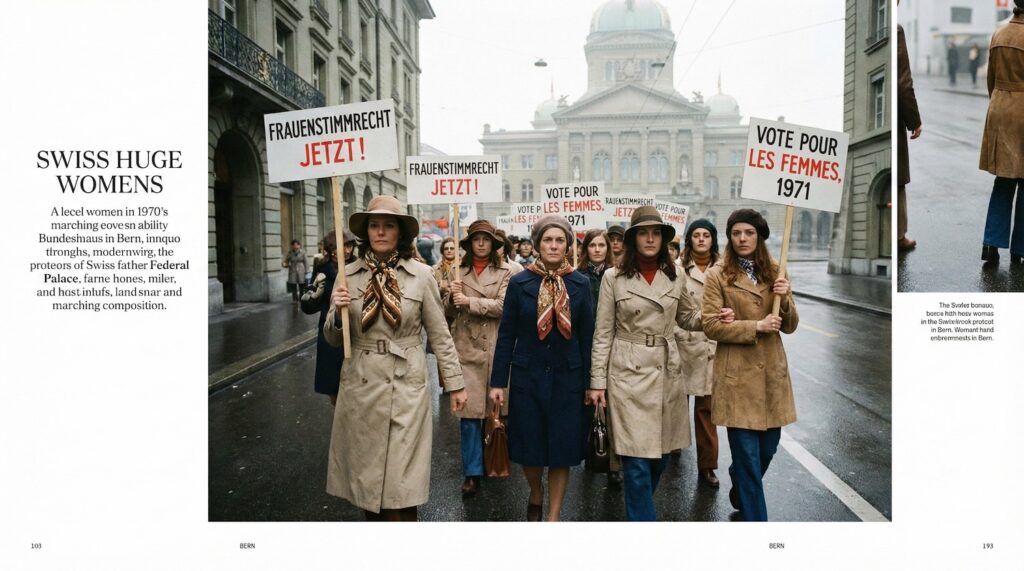
On 9 November 1918, cavalry sealed off Paradeplatz and the banking district in Zurich, while the city around them argued about whether Switzerland was on the edge of revolution. The same day, the German Empire collapsed and the Kaiser’s abdication was announced. Two days later, the guns fell silent on the Western Front.
Switzerland had not fought in the war, yet it ended the war with the most serious internal crisis in the history of its federal state. Between 12 and 14 November 1918, roughly 250,000 workers stopped work across the country in the Landesstreik, the national general strike. Troops occupied cities. Three strikers were shot dead in Grenchen. And all the while, a second enemy was moving through barracks and tenements: the influenza pandemic, which reached its deadliest month in Switzerland that same November.
The strike lasted three days and ended in capitulation. That is why it was long remembered as a defeat for the left, or, by the right, as a failed Bolshevik coup. The records tell a more interesting story. Of the nine demands the strikers made, most eventually became law. Some took a year. One took 53. Here is what happened, what the numbers show and why the three days still shape Swiss politics.
A neutral country at war with itself
Neutrality kept Switzerland out of the trenches, but not out of the war economy. Prices rose year after year while wages lagged far behind. The Historical Statistics of Switzerland publish a real wage index, which measures what pay could actually buy. It stood at 63.7 in 1914. By 1917 it had fallen to 49.8, a loss of more than a fifth of purchasing power in three years. Nominal wages rose by about two thirds between 1914 and 1918; prices rose faster.
At the same time, some employers made enormous war profits, and many farmers enjoyed a boom of high food prices. The historian Bernard Degen, writing in the Historical Dictionary of Switzerland, describes a deep gulf between those groups and a working class sinking into poverty. Because the army had called up so many men, labour was scarce, and strikes became more likely to succeed. From 1917 onwards they multiplied.
In February 1918, the Social Democrat Robert Grimm brought together a new generation of trade union and party leaders in what became known as the Olten Action Committee. Several times that year the committee pressed demands on the Federal Council, backed by the threat of a strike. For the first time, the government had to negotiate at least in part. Switzerland’s neutrality had protected it from invasion. It had not protected it from inflation.
How a protest became a national strike
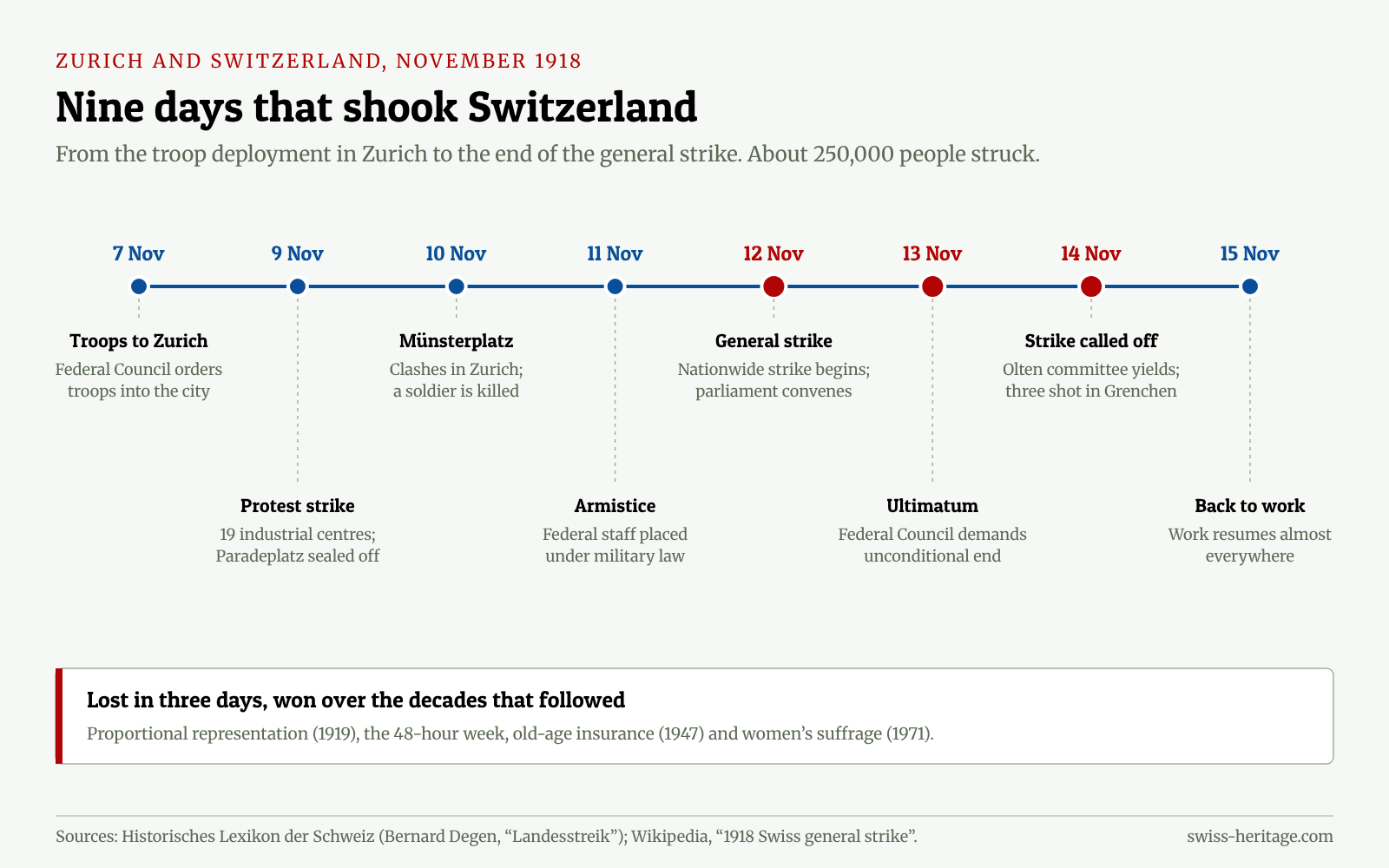
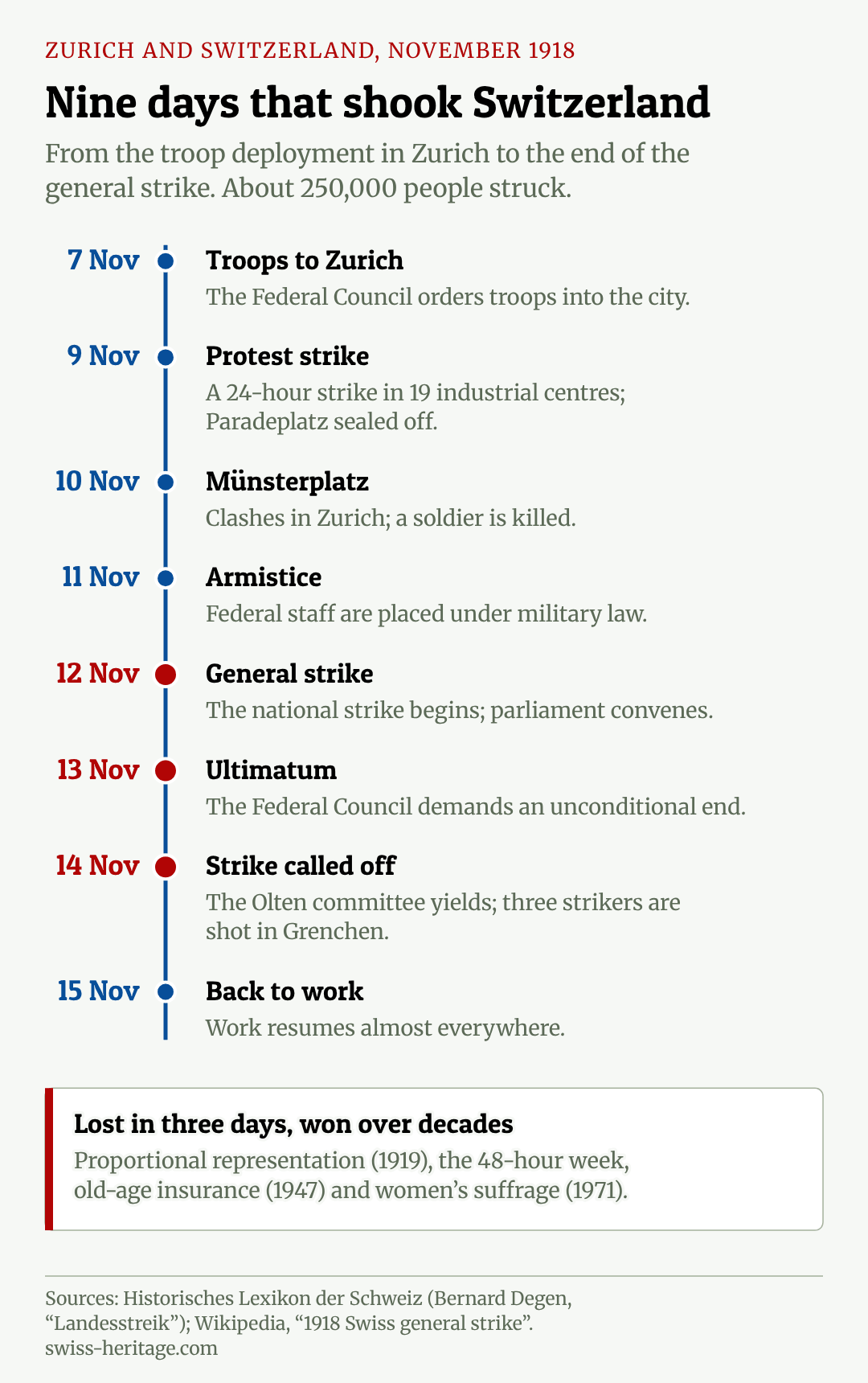
The trigger came in the autumn. On 30 September and 1 October, Zurich’s bank employees went on strike, supported by a local general strike. Parts of the bourgeois camp saw it as a dress rehearsal for revolution. Others, as Degen puts it, wanted to teach the restless workers a lesson before the army was demobilised. On 7 November, after the Federal Council decided on an armed federal intervention, the army marched troops into Zurich in a deliberate show of force.
The Olten committee called a 24-hour protest strike in 19 industrial centres for Saturday 9 November. It passed calmly. In Zurich, however, the workers’ union decided to continue until the troops withdrew, and on 10 November soldiers and demonstrators clashed on Münsterplatz; a soldier was killed. The committee now faced a choice between following Zurich or losing control of the movement. It called an indefinite national general strike to begin on Tuesday 12 November.
About 250,000 strikers, and the railways stopped
A survey by the Swiss Federation of Trade Unions counted around 250,000 strikers. The participation of railway workers made the deepest impression, because it carried the strike into rural areas that it would otherwise never have touched. The strike was weaker in French-speaking Switzerland and Ticino. Overall it was remarkably calm. Strike committees even imposed alcohol bans in some places. In Basel, where the liberal National-Zeitung printed the strike call without comment, the cantonal government and the strike leaders worked together to keep order.
The Federal Council did not see it that way. On 11 November it placed federal staff under military law, so that striking railway and postal workers faced military justice. In the same days it expelled the Soviet mission from Bern. The Federal Assembly convened on 12 November and backed the government. On 13 November the Federal Council demanded the unconditional end of the strike. Fearing that the army would crush the movement, the Olten committee gave in during the early hours of 14 November. Work resumed almost everywhere on Friday 15 November.
The worst violence came after the decision to stop. On 14 November in Grenchen, in canton Solothurn, soldiers fired on strikers and three were killed.


How big was it, and why did it fold so quickly?
Numbers help put the three days in proportion. The census of 1920 counted 3,880,320 residents in Switzerland. If the trade unions’ figure of 250,000 strikers is right, roughly one resident in fifteen stopped work, children and pensioners included. That is a larger share of the population than took part in the British general strike of 1926, when about 1.7 million workers walked out in a country of more than 40 million. The North American general strikes of 1919, in Seattle in February and in Winnipeg from May to June, were city-wide stoppages of tens of thousands. The Swiss strike was national, and it reached the railways that held the country together.
Yet it collapsed within three days. The sources point to several reasons, and they are worth separating. The first was force: the army was on the streets before the strike began, and the most careful count of the records found about 50,000 people on duty. The second was geography. The strike was weaker in French-speaking Switzerland and Ticino, so the country did not stop evenly; the language divide explored in our guide to the Röstigraben ran through this crisis too. The third was the pandemic, which was killing thousands of people a month that autumn. The fourth was the character of the movement itself. Its leaders were trade unionists and members of parliament, not insurrectionists, and voters had approved one of their central demands, proportional representation, only a month earlier. Faced with an ultimatum and the prospect of bloodshed, they chose to keep their organisations intact.
Basel showed that another approach was possible: there, the cantonal government worked with the strike leaders to keep order, a story that fits the city described in our Basel guide. The ultimatum that ended the strike came from Bern, where the Federal Council and parliament sat.
The nine demands
The strike proclamation was not a programme for revolution. It contained nine concrete demands, partly political and partly social. Reading them a century later, what stands out is how many of them now look like ordinary features of Swiss life.
| Demand of November 1918 | What happened | When |
|---|---|---|
| Immediate re-election of the National Council by proportional representation | Voters had already approved proportional representation on 13 October 1918 (66.8% yes). A vote on 10 August 1919 (71.6% yes) cleared the way for early elections | 1918–1919 |
| Votes and eligibility for women | Rejected for decades; introduced at federal level after the vote of 7 February 1971 | 1971 |
| A general duty to work | Never introduced | Never |
| The 48-hour week in all public and private enterprises | Working hours cut sharply; the 48-hour week became law for factories | 1919 |
| Reorganisation of the army into a people’s army | Not implemented in the form demanded | Never |
| Securing the food supply with the farmers | No specific reform followed from the strike | n/a |
| Old-age and disability insurance | A first law was rejected in 1931 (39.7% yes). Old-age and survivors’ insurance (AHV) was approved with 80.0% yes on 6 July 1947; disability insurance followed in 1960 | 1947 / 1960 |
| A state monopoly on foreign trade | Never introduced | Never |
| Paying off the public debt through the propertied classes | A one-off wealth levy initiative was rejected on 3 December 1922 with only 13.0% yes | Rejected 1922 |
Four of the nine demands were eventually met in full: proportional representation, the 48-hour week, women’s suffrage and old-age insurance. Disability insurance followed too. The more radical ideas, a duty to work, a foreign trade monopoly and a wealth levy, were rejected by voters or never put forward. The pattern is very Swiss. What survived was what a majority could eventually accept at the ballot box. Proportional representation itself arrived through a popular initiative, the third attempt after defeats in 1900 and 1910, the mechanism explained in our guide to Swiss direct democracy. Our guide to women’s suffrage in 1971 tells the story of the demand that took longest.
The second enemy: influenza
The strike unfolded in the middle of the deadliest epidemic in modern Swiss history. Monthly death statistics, published in the Statistical Yearbook and reproduced by the Historical Statistics of Switzerland, show its shape with brutal clarity.


A first wave struck in July and August 1918, with 2,264 and 2,270 influenza deaths. After a lull in September, the second wave exploded: 5,501 deaths in October and 5,991 in November, the month of the strike, then 4,089 in December. In 1918 as a whole, influenza killed 21,491 people in Switzerland, and another 3,486 in 1919. Almost 25,000 deaths in two years is far more than any war-related loss the country suffered.
The soldiers who fell ill on strike duty
The army was hit hard. The medical historian Walter Nussbaum, who went through the army’s records for a 1982 study in the journal Gesnerus, counted 1,805 soldiers who died of influenza in 1918 and 1919. Of these, 926 belonged to the troops called up to keep order during the general strike. The number of sick soldiers peaked at 14,023 on 21 November 1918, exactly when the strike troops had been deployed. In November alone, 807 soldiers died.
The deaths quickly became political. Left-wing papers attacked the army’s chief medical officer, Carl Hauser. On the other side, a claim circulated for decades that the strike deployment alone had cost 3,000 soldiers their lives. Nussbaum called that figure a fairy tale with no basis in the sources. Even the size of the deployment is uncertain: a figure of more than 90,000 troops appears in a 1920 note without supporting evidence, while a 1926 count of the records found about 50,000 people on duty. Other accounts give still higher numbers.
Defeat in November, victory at the ballot box
The immediate aftermath was harsh. Military justice opened proceedings against more than 3,500 people, most of them railway workers, which led to 147 convictions. In the main trial, from 12 March to 9 April 1919, a military court sentenced Robert Grimm, Friedrich Schneider and Fritz Platten of the Olten committee to six months in prison and the editor Ernst Nobs to four weeks. Citizens’ militias founded during the strike formed lasting organisations. For decades, the strike was presented as an attempted revolution and used to stigmatise the left.
Yet the political map changed within a year, and the numbers show by how much. The 1917 election had been the last under the old majority system, which had given the Free Democrats an absolute majority in the National Council ever since 1848. In October 1919, under proportional representation, they lost it.

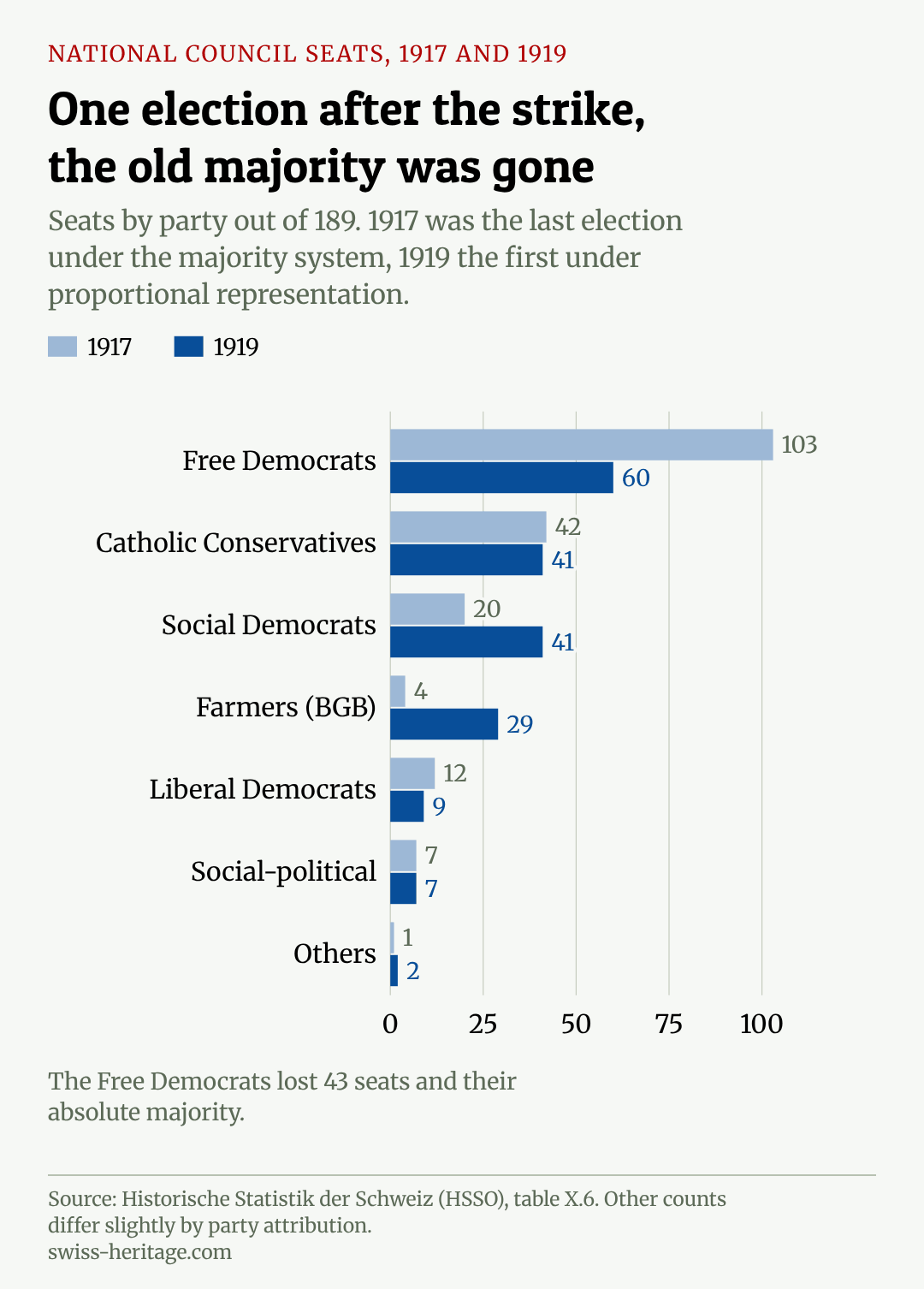
According to the Historical Statistics of Switzerland, the Free Democrats fell from 103 seats to 60 out of 189. The Social Democrats doubled from 20 to 41 seats, and the new farmers’ party, today’s Swiss People’s Party, rose from 4 to 29. Other sources attribute a few seats differently, but every count shows the same thing: the age of single-party dominance was over. Measured as a share of the seats, the Free Democrats fell from 54.5 to 31.7 per cent, and no party has held a majority in the National Council since. From then on, Swiss governments had to be built on compromise between several large parties, the foundation of the consensus system described in our guide to the seven-member Federal Council.
The long road to social partnership
Degen also points to quieter consequences. Export industries that had refused to negotiate with unions became willing to sign agreements. Federal authorities began involving union representatives in decisions. When the Second World War came, the government was determined not to repeat the mistakes of 1914 to 1918: it involved the labour movement in the war economy from the start, gave high priority to fair distribution and laid the groundwork for collective agreements and for the old-age insurance approved in 1947. The fear of another November 1918 helped create the Swiss model of social peace.
The best-known milestone came in 1937, when employers and unions in the machine and metal industry signed the so-called peace agreement, committing both sides to settle disputes by negotiation rather than by strikes and lockouts. Historians often draw a line from November 1918 to that agreement. The employers had seen what a general strike could do; the unions had seen how quickly the state could break one. Both learned that a contract was cheaper than a confrontation.
Revolution or reform? How historians see it now
For half a century the dominant reading was simple: an attempted Bolshevik coup, defeated by a loyal army and a determined government. Research published from the 1950s onwards, which reached a wide audience after the fiftieth anniversary in 1968, largely cleared the strike leaders of revolutionary intent. Degen notes that the left, embarrassed by the capitulation, also undervalued the strike’s successes for a long time.
The most persuasive view today is that the general strike was a pressure campaign by an organised labour movement, triggered by a provocative deployment of troops and conducted, for the most part, with discipline. It failed as a strike and succeeded as politics. A 2022 swissinfo article by the political scientist Claude Longchamp sums up the consensus: historians agree that 1918 and 1919 were the biggest period of change in Switzerland’s political history.
Traces you can still find
In Zurich, Paradeplatz and Münsterplatz, where cavalry and demonstrators faced each other, are a short walk apart in the old town covered by our Zurich guide. The Swiss National Museum devoted a major exhibition to the strike for its centenary in 2018, and the railway archive SBB Historic keeps the leaflets that both sides addressed to railway staff during the three days. The broader sequence of crises and compromises that runs from 1847 to 1918 is traced in our Swiss history timeline.
Swiss general strike 1918: questions and answers
When was the Swiss general strike?
The national general strike, known as the Landesstreik, ran from 12 to 14 November 1918. It was preceded by a protest strike on 9 November and clashes in Zurich on 10 November.
How many people took part?
A survey by the Swiss Federation of Trade Unions counted around 250,000 strikers. The participation of railway workers was decisive.
How many people died?
Three strikers were shot dead by soldiers in Grenchen on 14 November, and a soldier died in Zurich on 10 November. Influenza killed far more: 926 soldiers among the troops called up for the strike died of the disease, according to Walter Nussbaum.
What were the strikers’ demands?
Nine: early National Council elections by proportional representation, women’s suffrage, a general duty to work, the 48-hour week, army reform, food security, old-age and disability insurance, a state foreign-trade monopoly and debt repayment by the propertied.
Was the strike an attempted revolution?
Most historians now say no. It was long portrayed as a Bolshevik coup attempt, but research since the 1950s has largely cleared the leaders of revolutionary intent. Most of the demands were later achieved through the ballot box.
Sources and further reading
- Historisches Lexikon der Schweiz: “Landesstreik” (Bernard Degen)
- Wikipedia: “1918 Swiss general strike” (with references to Degen, Gautschi and others)
- Nussbaum, W. (1982): Die Grippe-Epidemie 1918/1919 in der schweizerischen Armee. Gesnerus 39(2), 243–259
- Historische Statistik der Schweiz (HSSO), table D.48a: influenza deaths by month, 1918–1938
- HSSO, table X.6: party seats in the National Council and Council of States, 1848–1995
- HSSO, table G.18: nominal and real wage index, 1890–2005
- swissinfo.ch: “How a strike threat reshaped Swiss democracy” (Claude Longchamp, 2022)
- Swissvotes: popular votes on proportional representation (1900, 1910, 1918)
- HSSO, table B.18a: resident population at the federal censuses, including 1920
- Zanetti, B.: Das Abkommen über den Arbeitsfrieden von 1937 in der schweizerischen Maschinen- und Metallindustrie (library record)
- Wikipedia: “1926 United Kingdom general strike”
- Wikipedia: “Seattle General Strike”
- Wikipedia: “Winnipeg general strike”