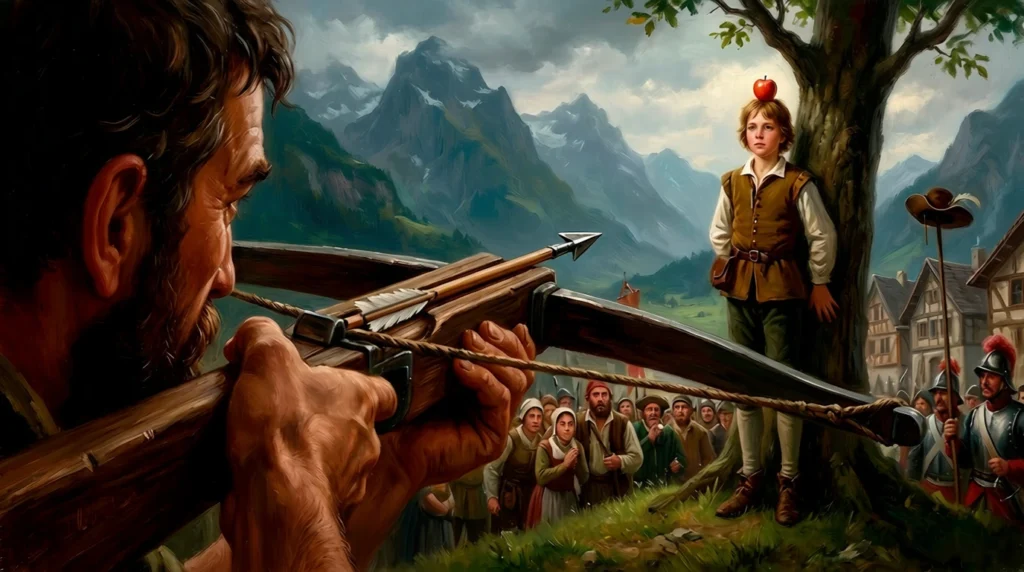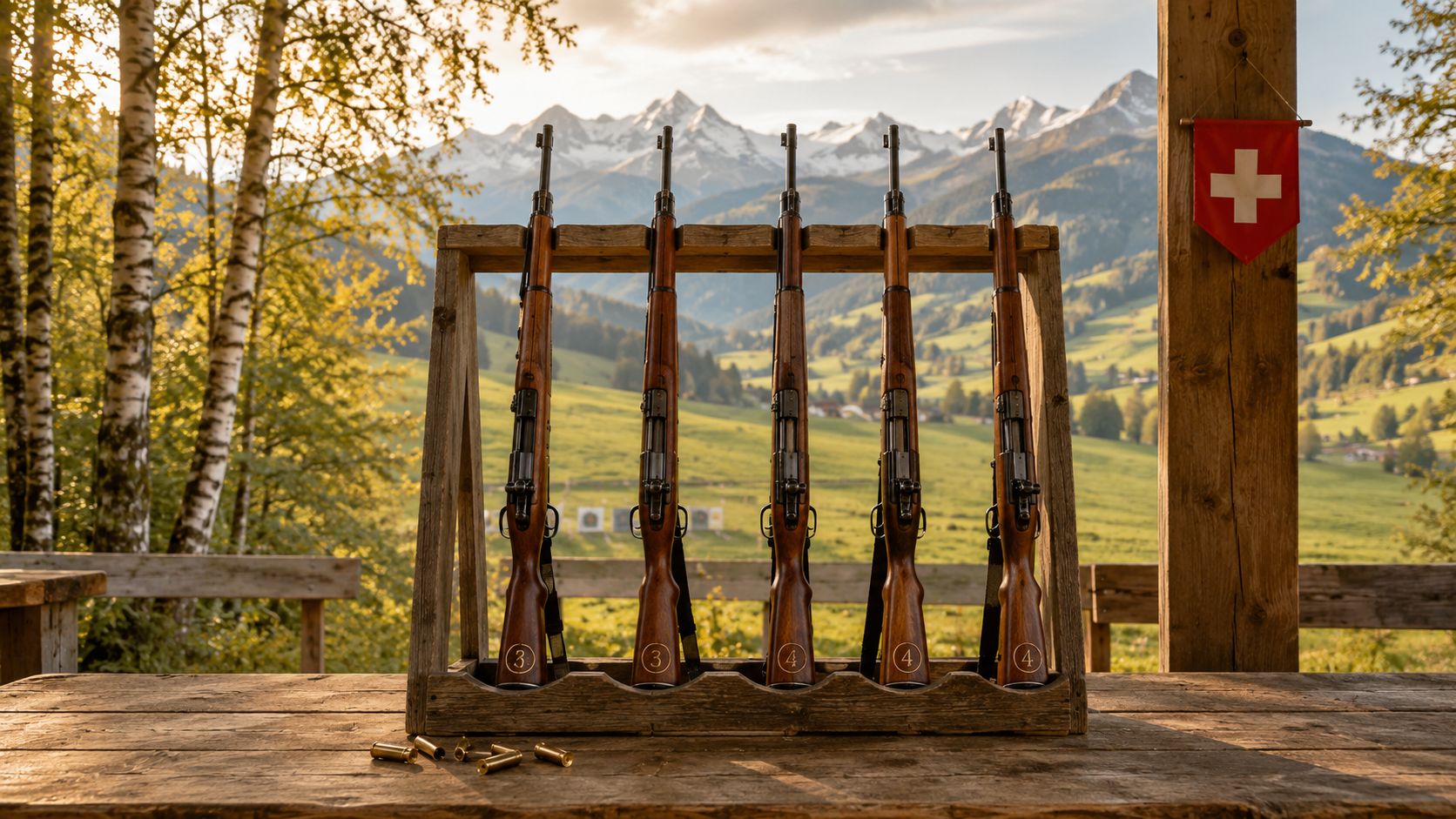
Every May, something happens in Switzerland that would cause a national panic in most countries. Around 130,000 people — including teenagers as young as thirteen — gather at 3,000 shooting ranges across the country and fire live ammunition at paper targets for three days straight. Parents bring their children. Grandparents come to watch. Nobody calls the police. Nobody posts alarmed tweets. The local mayor sometimes drops by to hand out prizes.
This event is the Feldschiessen — the world’s largest annual shooting competition. And it tells you almost everything you need to know about why Swiss gun laws produce a different outcome than what most people expect.
Switzerland has approximately 2.3 million firearms in civilian hands, according to the Small Arms Survey. That works out to roughly 28 guns per 100 residents — one of the highest rates in Europe, and among the highest in the world outside the United States and Yemen. Nearly 48% of Swiss households contain at least one firearm.
Yet in 2024, Switzerland recorded just 10 firearm homicides. Ten. In a country of 9 million people. That is a gun homicide rate of 0.11 per 100,000 — roughly 45 times lower than the United States.
Those two facts — high ownership, almost no violence — break the model that most people use to think about guns. So how does Switzerland make it work?
The militia: where Swiss gun culture actually begins
You cannot understand Swiss gun laws without understanding the militia. Everything flows from it.
Switzerland has mandatory military service for all male citizens. At age 19, Swiss men enter recruit school — roughly 18 weeks of training — and then serve refresher courses throughout their twenties and into their mid-thirties. The total active service period runs until age 34 for soldiers and 50 for officers. Women may volunteer but are not required to serve.
The gun comes home
When a conscript completes recruit school, something happens that would be unthinkable in most countries: he takes his service weapon home. The SIG SG 550 assault rifle — or the SIG Sauer P220 pistol for officers — goes into his wardrobe, his attic, or a locked cabinet. It stays there throughout his years of service, ready for the annual refresher training and, in theory, for national mobilisation.
This is the origin of Switzerland’s high gun ownership numbers. A large proportion of civilian firearms are current or former military-issue weapons. After completing service, soldiers can purchase their weapon from the army at a subsidised price. Many do. The rifle is converted from selective-fire to semi-automatic only, and it becomes private property.
Here’s the detail that changes everything, though. Since 2007, soldiers no longer store military ammunition at home. The army recalled its distributed ammunition stocks, and by March 2011, more than 99% had been returned. Only around 2,000 specialist militia members — those protecting airports and other sensitive sites — still keep military ammunition at home. Everyone else has the weapon. Nobody has the rounds.
What this means culturally
The militia system means that Swiss men are trained on firearms before they can legally drink. They learn marksmanship, weapon safety, and cleaning procedures under military supervision. By the time they leave the army, they have handled a rifle for thousands of hours across hundreds of training sessions. The weapon is neither exotic nor frightening. It is a tool they understand, the way a carpenter understands a saw.
And critically, the cultural framing is collective rather than individual. The militia exists to defend Switzerland. The gun in the wardrobe represents a civic obligation — part of the same national contract that includes shared government, direct democracy, and compulsory civil defence. The gun is not a symbol of personal empowerment. It is a symbol of belonging.
What Swiss gun laws actually require (the parts everyone gets wrong)
People who cite Switzerland in gun debates tend to make one of two errors. American gun-rights advocates claim Swiss laws are minimal. European gun-control advocates claim Swiss laws prove that regulation works. Both sides get it partially right and significantly wrong.
What you need to buy a gun in Switzerland
| Category | Examples | What you need |
|---|---|---|
| Standard firearms | Bolt-action rifles, break-action shotguns | Written acquisition permit from cantonal police. Background check against criminal and psychiatric databases. Must be 18+, no criminal record, no court-ordered guardianship. |
| Semi-automatic weapons | Semi-auto rifles, handguns | Same permit as above. Additional requirement since 2019: proof of regular sport-shooting activity or membership in a shooting club for certain semi-automatics. |
| Prohibited weapons | Fully automatic firearms, silencers, laser sights, disguised weapons | Banned for civilian ownership. Cantonal exception permits exist for collectors but are rare and strictly controlled. |
| Former military weapons | SIG SG 550 (converted to semi-auto) | Standard acquisition permit plus proof of completion of military service. Weapon is converted before transfer. |
What surprises people
Several features of Swiss gun laws catch international observers off guard. First, there is no centralised national gun registry. Cantons maintain their own records, and private sales between individuals do not always require registration — though the 2019 reforms tightened this significantly. Second, carrying a concealed weapon in public requires a separate permit that is genuinely difficult to obtain and rarely issued. Third, ammunition purchased at a shooting range must technically be used at that range — though enforcement of this rule has historically been lax.
But the biggest surprise is what Switzerland does not have: a culture of guns for self-defence. When researchers survey Swiss gun owners, the answers cluster around sport, tradition, and military service. The Pew Research Center found in 2017 that 67% of American gun owners cited personal protection as a major reason for owning firearms. In Switzerland, self-defence barely registers as a motivation. The gun is for the range, for the Feldschiessen, for the annual refresher. It is not for the nightstand.
“Regulatory structure and social context matter more than ownership levels.”
— Action on Armed Violence (AOAV), 2024
The numbers that break the narrative: Switzerland vs the United States
This is the comparison everyone wants to make. So let’s make it properly, with verified numbers.
The visual tells the story. But the numbers alone don’t explain it. A 2024 study published in Aggression and Violent Behavior by Wolfgang Stroebe and colleagues at the University of Maryland identified three structural differences that account for the gap.
| United States | Switzerland |
|---|---|
| Gun laws vary wildly by state. Many states require no permit, no background check for private sales, no registration. | Federal law applies uniformly. Background checks mandatory. Cantonal police issue permits. Fully automatic weapons banned. |
| Gun culture centres on individual self-defence and personal empowerment. 67% of owners cite protection as a major motive. | Gun culture centres on collective national service, sport, and tradition. Self-defence is a marginal motivation. |
| Poverty rate: 17.8% (OECD relative measure). Highest among wealthy nations. Strong correlation with homicide rates. | Poverty rate: 9.1% (same OECD measure). Strong social safety net. Universal healthcare. Low economic deprivation. |
| No mandatory military service. No universal firearms training. Anyone can buy with minimal gatekeeping in many states. | Mandatory military service with supervised firearms training. Gun ownership is embedded in institutional discipline. |
| Mass shootings: multiple per year. Over 600 in 2023 alone (Gun Violence Archive definition). | Last mass shooting: 2001, Zug cantonal parliament. 14 killed. One event in 25 years. |
The poverty factor most people miss
Here’s the finding that changes the conversation. Stroebe’s team found that poverty is the single strongest predictor of homicide rates — both within the US and across countries. The United States has a relative poverty rate nearly twice Switzerland’s. It also has dramatically weaker social safety nets: no universal healthcare, limited public housing, minimal paid parental leave, and an incarceration system that cycles people through poverty rather than out of it.
In other words, the question is not just “why does Switzerland have low gun violence despite high ownership?” The question is also “why does Switzerland have low poverty, universal healthcare, strong social cohesion, and institutional trust?” Because those factors do more work than the gun laws themselves.
The 2001 Zug massacre: the one event that still haunts
On 27 September 2001, a man named Friedrich Leibacher entered the cantonal parliament building in Zug carrying a military-style assault rifle, a pump-action shotgun, and a handgun. He opened fire on the parliament in session. Fourteen people died. Eighteen more were wounded. Leibacher then killed himself.
The Zug massacre remains Switzerland’s only mass shooting in modern history. It happened twenty-five years ago. Nothing comparable has happened since.
What changed after Zug
The attack prompted reforms. The government tightened background checks and improved information-sharing between cantonal police databases. Parliament debated whether to remove army weapons from homes entirely — a proposal that was ultimately rejected in a 2011 referendum (56.3% voted against). However, the separate decision to recall military ammunition in 2007 did pass and was fully implemented.
Quick observation: in the US, a single mass shooting rarely produces lasting policy change. In Switzerland, one event in 2001 triggered two decades of incremental reform that continues to this day. The 2019 referendum — where 63.7% of voters approved alignment with EU firearms rules — was partly downstream of the post-Zug reform trajectory. The Swiss system processes trauma slowly but persistently.
The 2019 referendum: when Switzerland chose Europe over its guns
In May 2019, Switzerland faced a genuine choice. The European Union had adopted stricter firearms rules after the 2015 Paris attacks. As a Schengen member (though not an EU member), Switzerland was expected to align its laws. Refusal could have meant ejection from Schengen — and with it, the end of passport-free travel to 26 European countries.
The campaign
The pro-gun lobby framed the vote as an attack on Swiss sovereignty and tradition. The government and most political parties argued that Schengen membership was worth the modest tightening of rules. The debate cut across usual political lines — many conservative rural voters who cherished their shooting traditions also valued passport-free European travel.
The result
On 19 May 2019, Swiss voters approved the new rules with 63.7% support. The reforms required registration of previously unregistered weapons within three years, added tracking requirements for key weapon components, and mandated proof of regular sport-shooting activity for certain semi-automatic weapon purchases.
The vote was revealing. When forced to choose between their guns and their European integration, the Swiss chose integration — but by a margin that showed genuine reluctance. The result preserved the gun culture while accepting greater regulation. That balance — not absolutism on either side — is the Swiss model in one vote.
The ammunition question: the reform nobody noticed
If you want to understand why Swiss gun violence dropped significantly in the 2000s, look at ammunition rather than weapons.
Before 2007, Swiss soldiers stored a sealed tin of military ammunition alongside their service weapon at home — enough for an initial combat engagement. The rationale was Cold War readiness: if the Soviets crossed the border, every soldier needed to be able to fight immediately, before reaching a military depot.
After the Cold War ended and the Zug attack raised fresh questions, the government ordered the recall. Distribution of military ammunition to soldiers’ homes stopped in 2007. By March 2011, more than 99% had been returned. The result was striking: firearm suicides — which had been running at roughly 400 per year — dropped to approximately 200. The weapon was still in the house. The ammunition was not. The lethality gap was immediate and measurable.
This single data point — same guns, removed ammo, halved suicides — is perhaps the most important finding in the entire Swiss gun debate. It suggests that access to ammunition, not access to weapons, is the binding constraint on impulsive gun violence. A locked rifle with no rounds is a piece of metal. Add 20 rounds and it becomes a lethal weapon. Switzerland tested this inadvertently, and the evidence is hard to argue with.
What the Swiss model actually proves (and what it doesn’t)
Both sides of the international gun debate misuse Switzerland. So let me be direct about what the evidence supports and what it does not.
What the Swiss model proves
High gun ownership is compatible with very low gun violence — but only when accompanied by universal firearms training, uniform federal regulation, strong social safety nets, low poverty, cultural attitudes that frame guns as collective responsibility rather than individual empowerment, and restrictions on ammunition access. Remove any of those conditions and the Swiss outcome becomes unlikely.
What the Swiss model does not prove
It does not prove that more guns make a country safer. It does not prove that gun regulation is unnecessary. And it does not prove that the American model would work if Americans simply had more training. The Swiss model works because of a web of interconnected conditions — military culture, economic equality, institutional trust, direct democracy, and a political system where no single leader can dominate. Cherry-picking one variable from that web and transplanting it into a different society is not analysis. It is wishful thinking.
The honest conclusion is uncomfortable for both sides. The data says: guns plus poverty plus individualism plus weak regulation equals violence. Guns plus training plus equality plus collective responsibility plus strong regulation equals Switzerland. The variable that matters most isn’t the gun. It’s everything around it.
Frequently asked questions about Swiss gun laws
How many guns does Switzerland have?
What is Switzerland’s gun homicide rate?
Can Swiss citizens own guns for self-defence?
Military service and the Feldschiessen
Do Swiss soldiers keep their guns at home?
What is the Feldschiessen?
Has Switzerland ever had a mass shooting?
Sources and further reading
- Switzerland Gun Laws: Complete Guide by Experts. Goldblum (2026) (opens in new tab)
- Stroebe, W. et al. Gun Ownership and Gun Violence: US vs Switzerland. Aggression and Violent Behavior (2024) (opens in new tab)
- Switzerland’s gun culture takes different path from US. Christian Science Monitor (2018) (opens in new tab)
- Switzerland to Vote on Stricter Gun Controls. TIME (2019) (opens in new tab)
- Gun Ownership and Gun Violence: Swiss Experience. START, University of Maryland (2024) (opens in new tab)
- Switzerland gun control: Voters back EU regulations. BBC News (2019) (opens in new tab)