It is 1971. In the US, astronauts are driving moon buggies across the lunar surface. In London, crowds are queuing for David Bowie concerts and The Rolling Stones are in their prime. But in Switzerland—wealthy, orderly, famously democratic Switzerland—half the population is still legally barred from voting.
The date is February 7, 1971. On this ordinary winter morning, 2.8 million Swiss men cast ballots on a question that should have seemed absurd by then: Should women be allowed to vote? By a margin of 65.7%, they say yes. It is one of the strangest moments in Western democracy: men, alone, deciding to share their political power with women. Switzerland, which prides itself as a beacon of direct democracy, has just become one of the last Western nations to enfranchise women—more than 50 years after Germany, Austria, and the US did so.
What makes this delay even more unsettling? Many Swiss grandmothers alive today were not allowed to vote until they were in their 30s or 40s. The activists who fought for this right had already grown old. And in one remote Alpine canton, the battle was far from over.
Why Did It Take So Long? The Direct Democracy Paradox
Here’s the paradox that stunned historians: Switzerland’s most celebrated strength—its system of direct democracy—became the biggest obstacle to women’s suffrage.
Unlike representative democracies where parliaments can pass laws, Switzerland requires the people to vote on major changes. This sounds democratic in theory. In practice, it meant that men had to voluntarily agree to share their voting power with women. And for over a century, they refused.
When the Federal Council first proposed women’s suffrage in 1959, the result was crushing: 67% of male voters said no. The cantons followed: only 3 out of 22 approved it. The message was clear—voters weren’t ready.
Conservative rural cantons offered bizarre defenses against women’s voting rights. Some argued that women couldn’t possibly walk the distances to polling stations without abandoning their households and children. (This objection persisted even after women had been driving cars for decades.) In Appenzell Innerrhoden and Glarus—where the ancient Landsgemeinde system still held sway—officials made an even stranger claim: the public squares where men gathered outdoors to vote by raising their hands were simply too small to accommodate women as well.
Even more troubling was that women’s own organizations split on the issue. Some female associations opposed suffrage outright, fearing it would undermine traditional family structures. The feminist movement, in other words, had to fight both men and its own side.
What finally broke the deadlock was not logic or justice, but embarrassment. In 1968, Switzerland prepared to ratify the European Convention on Human Rights—a commitment to universal human equality. Yet the nation still denied half its population the vote. The contradiction became impossible to ignore. By 1969, public pressure erupted onto the streets.
The “Illegal” Vote of Unterbäch: A Village of Rebels
Fourteen years before the 1971 federal victory, something extraordinary happened in an obscure village.
Unterbäch is a hamlet of 400 people in the Upper Valais, a region of steep mountains and tight communities where everyone knew everyone else’s business. On March 5, 1957, the local council made a decision that would echo across the nation: they would allow women to vote on a federal referendum about military service requirements—something that affected only women.
The canton’s government was horrified. This was illegal, they said. Unconstitutional. But the village’s mayor, Paul Zenhäusern, had made up his mind. So had the teacher and local leaders who supported him. And behind them, though initially unseen, was a woman—Iris von Roten, a trained lawyer married to one of the officials. She had convinced the men that denying women a vote on a law affecting them was absurd. Years later, her husband admitted: “Iris was the driving force. Without her influence, I would never have fought so vehemently.”
When voting day arrived, snow lay on the streets. A woman in a beige coat with a herringbone pattern made her way to the polling station. Her name was Katharina Zenhäusern—the mayor’s wife. She was 37 years old, and she was about to become the first woman in Switzerland to cast a vote that counted (or tried to).
As she climbed the steps to the voting booth, camera flashes exploded. Her heart was pounding. On the roof above, stones from angry male protesters clattered against the tiles. Inside the booth, she slid her ballot into the slot—a small, quiet act of enormous consequence.
The ballots cast by Katharina and 32 other women were immediately declared void. Never counted. Vanished into the official record as if they had never happened. Yet the world noticed. The New York Times sent journalists to cover the story of this tiny Swiss village. Thirty-three women had dared to vote against the will of the authorities, the canton, and many of their own neighbors.
“Someone had to be first,” Katharina would later reflect. She died in 2014 at age 94, having lived to see women’s suffrage finally arrive—though she waited 57 years for her vote to be legally recognized.
Unterbäch was never the same. It became known as the “Rütli of the Swiss Woman“—a reference to the meadow where Switzerland’s ancient founders swore their oath of freedom. The village issued honorary citizenship to Elisabeth Kopp when she became Switzerland’s first female Federal Councillor in 1984, making visible the connection between Unterbäch’s rebellion and later victories.
The 1969 March on Bern: “Democracy Waits for No One”
By 1969, patience had worn thin.
The first referendum had failed a decade earlier. Women were still excluded from voting. Even worse, the Federal Council was preparing to sign the European Human Rights Convention—with a reservation exempting Switzerland from its gender equality clause. The message was insulting: Switzerland was so committed to excluding women from politics that it would carve out an official exception to a human rights treaty rather than grant them the vote.
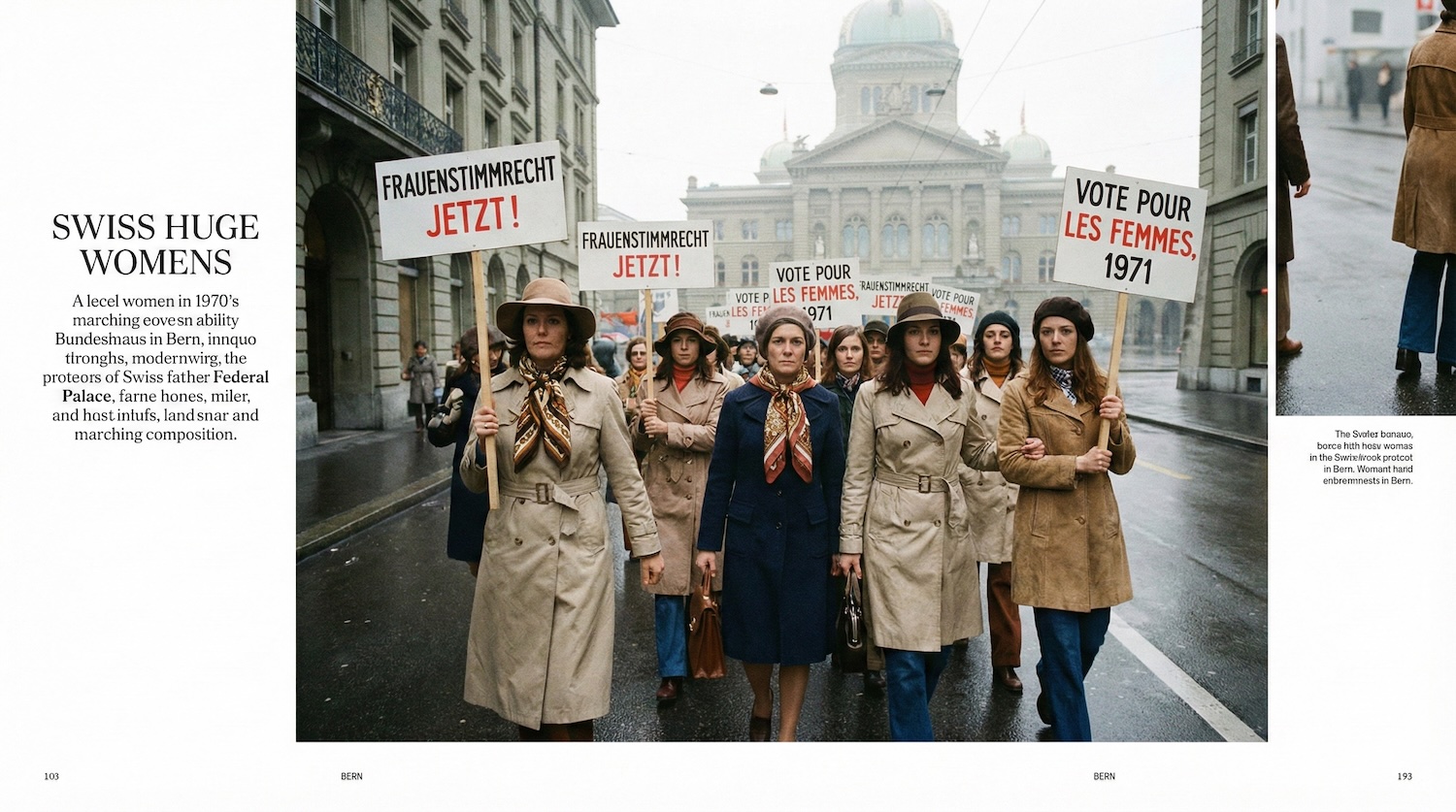
On March 1, 1969, thousands of women converged on the Bundesplatz in Bern. Official estimates put the crowd at 5,000; the feeling was of a nation’s conscience breaking open. The march was technically unauthorized—the government hadn’t granted permission—but the women came anyway.
At the center of the crowd stood a woman in a striking red coat, standing on a wooden platform. Her name was Emilie Lieberherr, an economist and activist in her early 40s. She had masterminded the march and would become one of Switzerland’s most uncompromising feminists.
Lieberherr’s words cut through the noise: “We Swiss women here on the Bundesplatz demand full voting and election rights at the federal and cantonal level.” The crowd roared. She demanded that the government sign the human rights convention without a gender exemption. “Democracy,” she declared, “waits for no one.”
What happened next became legend. The Federal Council, embarrassed and angry, refused to send a representative to meet the demonstrators. A government official appeared at an upper window—and then hastily withdrew. So the women did something unforgettable: they raised whistles—thousands of them—and blew a deafening, scornful chorus.
The pfeifkonzert (whistling concert) was Lieberherr’s masterstroke. The government had brought it on itself. She had even funded the whistles by selling them to raise money for the sound system. It was organized, disciplined, and devastating—a reminder that women could not be ignored.
The march worked. Within months, the Federal Council reversed course. It prepared a new referendum on women’s suffrage for 1971. Lieberherr, now a household name, would later become Zurich’s first female city councillor and serve 24 years leading the social department. She outlived most of her opponents, dying in 2011 at age 86, her legacy secure.
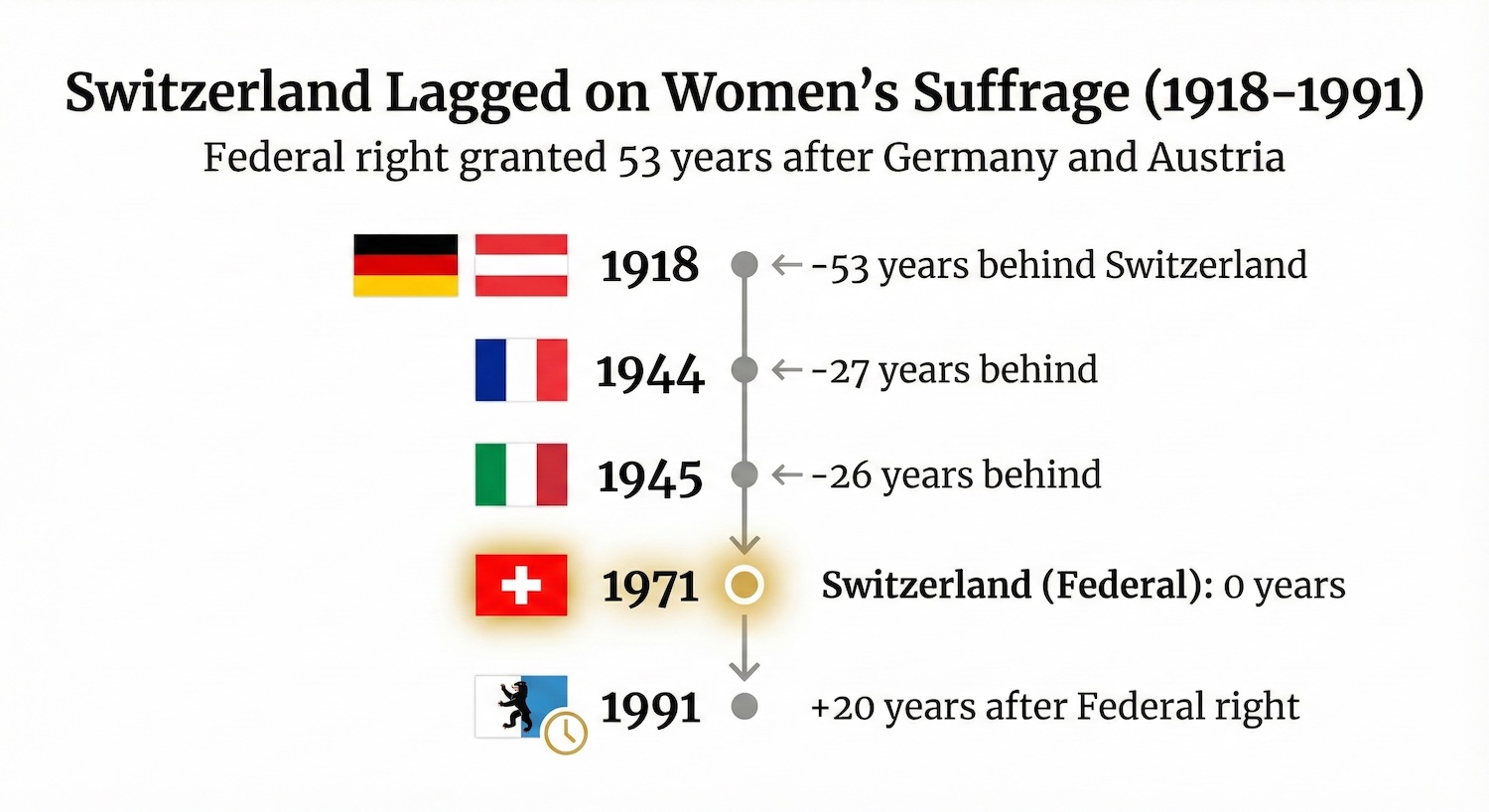
Women’s Suffrage Timeline: Switzerland vs. Western Europe
The Appenzell Exception: Denied Until 1991
If the 1971 referendum was supposed to end the saga, it didn’t. The Swiss Constitution allowed cantons to set their own voting rules for cantonal and local elections. And one canton—Appenzell Innerrhoden—simply refused.
Appenzell Innerrhoden is Switzerland’s most traditional canton, home to 16,000 people who cling fiercely to their customs. Men wear traditional leather breeches and embroidered jackets. They still use the Landsgemeinde—an ancient open-air assembly where voters gather in the town square and decide issues by raising their hands. Historically, carrying a ceremonial sword proved you were a (male) citizen entitled to vote.
In the 1971 federal referendum, only 28.7% of Appenzellers supported women’s suffrage—the lowest support of any canton. When the canton held its own vote in 1973, men voted down women’s suffrage. They did it again in 1982. Each time, the message was the same: no.
By the late 1980s, two cantons were holding out: Appenzell Ausserrhoden and Appenzell Innerrhoden. Appenzell Ausserrhoden finally buckled in April 1989—by a razor-thin majority. That left Appenzell Innerrhoden alone, stubbornly resistant, almost defiantly so.
In April 1989, a woman named Theresia Rohner had had enough. In her mid-30s, running a pottery shop, mother of two, she filed a formal complaint with the cantonal government: she wanted to participate in the upcoming Landsgemeinde, to vote like the men did. The government rejected her outright, citing the cantonal constitution. Women, they said, were not mentioned—and therefore not included.
So Rohner took them to court.
Immediately, she became a pariah. Locals called her an anarchist. No one wanted to be seen supporting her. But she persisted. She appealed to the Federal Court in Lausanne—Switzerland’s highest court—arguing that a modern nation couldn’t constitutionally deny women the vote based on their sex.
On November 27, 1990, the Federal Court delivered a one-line verdict: “Whoever denies women the right to vote violates the Federal Constitution.” The decision was unanimous and definitive. Appenzell Innerrhoden had no legal ground to stand on.
The canton’s response was vicious. After the ruling, as Appenzell prepared for the first Landsgemeinde in which women could vote on April 28, 1991, Theresia Rohner’s pottery shop was attacked. Stones were hurled through the windows. She and her family received police protection. When the historic April assembly finally took place, armed officers were present to keep the peace—a surreal precaution for a voting ritual that hadn’t changed in 600 years.
The April 1991 Landsgemeinde was peaceful in the end. An estimated 3,000 voters gathered in the square. For the first time, women could raise their hands alongside men. But the bitterness lingered. Appenzell Innerrhoden had become a global symbol of how even modern democracies could resist equality—and how court intervention, not consent, had been needed to enforce it.
The Legacy: From 1971 to the Women’s Strikes of 1991 and 2019
The 1971 referendum was supposed to be a victory—and in a sense, it was. Women could finally vote. Eleven women were elected to parliament in October 1971, each receiving a rose as they took their seats for the first time.
But the delayed enfranchisement had real costs. While women were fighting for basic political rights, Switzerland was quietly fortifying itself with camouflaged bunkers disguised as houses—military infrastructure that would have been designed and approved entirely by men in the decades before women gained the vote. The gap between political voice and national defense planning was stark. Women had lost decades of political voice. Laws that affected them—family law, tax law, social security, workplace protections—had been written without their input. Gender equality, once assumed to flow automatically from the right to vote, proved far more elusive.
Twenty years after the 1971 referendum, it became clear that voting rights alone were not enough. On June 14, 1991—exactly 10 years after Appenzell’s forced surrender—approximately 500,000 Swiss women (and many supporting men) went on strike. It was the largest protest in Switzerland since 1918.
Their banner: “Wenn Frau will, steht alles still” (“If women will it, everything stops”). Their demands: equal pay, recognition of unpaid domestic work, access to childcare, and real enforcement of the equality article that had been added to the Constitution 10 years earlier. The 1991 strike wasn’t just about politics. It was about economic justice, social recognition, and the daily realities that formal voting rights had failed to address.
Yet even this massive mobilization didn’t settle things. In 2019—exactly 28 years after the first strike—500,000 women marched again. The wage gap remained. Unpaid care work still fell disproportionately on women. Representation in parliament had grown but remained far from parity.
What had changed was consciousness. Switzerland’s silence on women’s suffrage had been broken. The history was no longer hidden. Marthe Gosteli, an archivist who lived through the entire suffrage struggle (1917-2017), had spent decades preserving documents, letters, and testimonies from the women’s movement. The Gosteli Archive, established in 1982, now holds approximately one kilometer of files on women’s history in Switzerland—a physical monument to what had been nearly erased.
Frequently Asked Questions about Swiss Suffrage
The shock of 1971 was not that women finally got the vote. It was that they had been denied it for so long. Switzerland’s late enfranchisement exposes the gap between the myth of democracy and its practice. But it also reveals something else: the power of ordinary women who refused to accept that their exclusion was inevitable. Katharina Zenhäusern’s trembling heart at the ballot box, Emilie Lieberherr’s red coat on the Bundesplatz, and Theresia Rohner’s defiance against a hostile village—these acts did not create democracy. They demanded that democracy finally mean what it claimed to mean.
Sources & References
- Wikipedia: 1971 Swiss Women’s Suffrage Referendum
https://en.wikipedia.org/wiki/1971_Swiss_women’s_suffrage_referendum - Wikipedia: Katharina Zenhäusern
https://de.wikipedia.org/wiki/Katharina_Zenh%C3%A4usern - WOZ (Wochenzeitung): “Nach hundert Jahren des Wartens” (After 100 Years of Waiting)
https://www.woz.ch/1909/marsch-nach-bern/nach-hundert-jahren-des-wartens - Swiss Community: “It Was No Accident That Women’s Suffrage Came Late to Switzerland”
https://www.swisscommunity.org/en/news-media/swiss-revue/article/it-was-no-accident-that-womens-suffrage-came-late-to-switzerlan - Swiss National Museum Blog: “Schweizer Geschichte – Der lange Weg zum Frauenstimmrecht”
https://blog.nationalmuseum.ch/2020/06/frauenstimmrecht/ - CH2021: “Emilie Lieberherr (1924-2011)”
https://ch2021.ch/emilie-lieberherrr-1924-2011/ - Wikipedia: Marthe Gosteli
https://en.wikipedia.org/wiki/Marthe_Gosteli - Unterbäch Tourism: “Das Rütli der Schweizer Frau” (The Rütli of the Swiss Woman)
https://unterbaech.ch/unterbaech/kultur/das-ruetli-der-schweizer-frau/ - Unterbäch Tourism (English): “The Swiss Woman’s Rütli”
https://unterbaech.ch/en/discover-experience/culture/the-swiss-womans-ruetli/ - CH2021: “Katharina Zenhäusern (1919-2014)”
https://ch2021.ch/katharina-zenhaeusern-1919-2014/ - Swiss Parliament: “Women’s Suffrage in Switzerland: 100 Years of Struggle”
https://www.parlament.ch/en/%C3%BCber-das-parlament/political-women/conquest-of-equal-rights/women-suffrage - Library of Congress: “50 Years of Women’s Suffrage in Switzerland”
https://blogs.loc.gov/law/2021/04/50-years-of-womens-suffrage-in-switzerland/ - Swiss National Museum Blog: “Schweizer Geschichte – Menschenrechte ja, aber…” (Human Rights Yes, But…)
https://blog.nationalmuseum.ch/2021/03/frauen-und-das-menschenrecht/ - Swiss National Museum Blog: “Swiss History – The Women’s Strike Day of 1991”
https://blog.nationalmuseum.ch/en/2019/06/womens-strike-day-in-switzerland/ - Wikipedia: 2019 Swiss Women’s Strike
https://en.wikipedia.org/wiki/2019_Swiss_women’s_strike - House of Switzerland: “Women’s Strikes in Switzerland: From One 14 June to Another”
https://houseofswitzerland.org/swissstories/society/womens-strikes-switzerland-one-14-june-another - Gosteli Archive (Gosteli-Archiv)
https://www.gosteli-archiv.ch/en