A top-down view of a Swiss meal split in half to represent the Röstigraben. The left side features Rösti and beer representing German Switzerland, while the right side features wine and fondue representing French Switzerland.

The Röstigraben: Crossing the Invisible Wall Dividing Switzerland

Can you cross a national border without actually leaving the country? In Switzerland, the answer is yes. You don’t need a passport, and there are no guards. But if you drive ten minutes west from Bern, the world tilts on its axis. As you cross the river Saane (or Sarine, depending on who you ask), […]

The Röstigraben: Crossing the Invisible Wall Dividing Switzerland Read More »

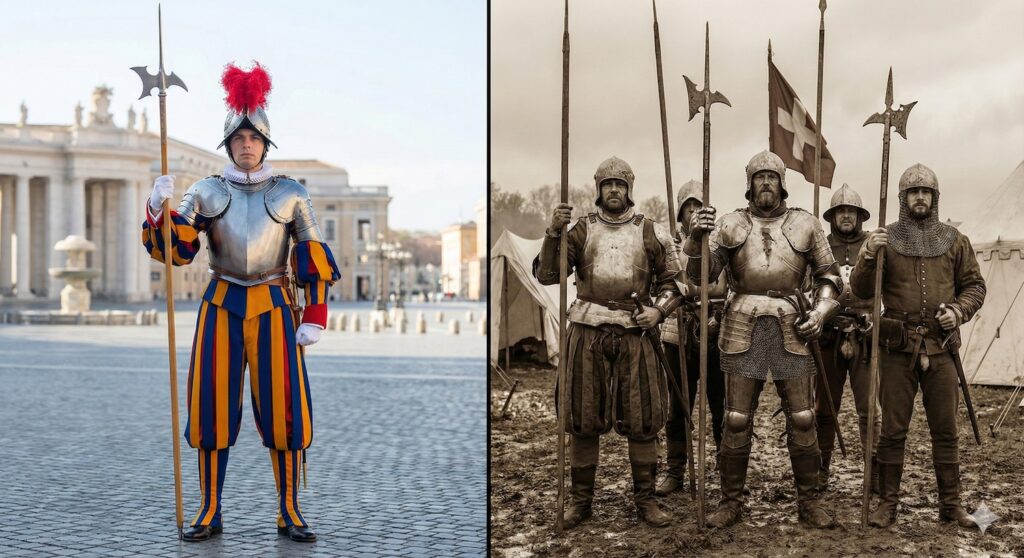
A split-screen comparison illustrating the evolution of Swiss mercenaries history. The left side shows a modern Pontifical Swiss Guard in a colorful ceremonial uniform, while the right side depicts a gritty, sepia-toned medieval Swiss mercenary with a pike, representing the bloody reality of the 1515 Battle of Marignano.

From Killers to Peacekeepers: The Bloody History of Swiss Mercenaries

Every day, tourists crowd the Vatican courtyards snapping photographs of the Pontifical Swiss Guard. The guards stand motionless in their ridiculous uniforms—blue, red, and orange striped hose, white gloves, helmets that look like they belong in a Renaissance fair. They look ceremonial. Decorative. Like Swiss heritage theme park employees rather than soldiers. But those uniforms

From Killers to Peacekeepers: The Bloody History of Swiss Mercenaries Read More »

A close-up photograph of the Villa Rose, one of the most famous Swiss camouflage bunkers disguised as a residential home. The image reveals a concrete structure painted pink with fake windows, designed to hide an anti-tank cannon.

The House That Shoots Back: Switzerland’s Camouflaged Bunkers

You’re hiking near Lake Geneva on a beautiful afternoon. The Alps shimmer in the distance. Everything is Switzerland-postcard perfect. Then you spot it: a charming pink house, nestled against the green hillside. The windows have white-trimmed shutters. Terracotta roof tiles. A mailbox by the front door. It looks exactly like the kind of chalet a

The House That Shoots Back: Switzerland’s Camouflaged Bunkers Read More »

High-end architectural photography of a modern Swiss residence featuring a reinforced steel blast door seamlessly integrated into a luxury wine cellar. The image illustrates how design adapts to the Swiss nuclear bunker law, blending mandatory civil defense infrastructure with sophisticated interior design.

Why Every Swiss House Must Have a Nuclear Bunker (The Law Explained)

Switzerland is famous for peace, precision, and mountains. But beneath those idyllic Alpine meadows lies something nobody expects: the world’s most extensive network of nuclear bunkers. Not in some secret military zone, but under your neighbor’s house. Under your ski chalet. Under the local grocery store. This isn’t paranoia. It’s law. For more than 60

Why Every Swiss House Must Have a Nuclear Bunker (The Law Explained) Read More »

Historical composite illustration serving as a visual Sonderbund War summary. On the left, a 19th-century map shows Switzerland sharply divided between the Catholic rebel cantons and the Federal Diet. On the right is a portrait of General Guillaume-Henri Dufour, the commander who ended the civil war in 1847 with minimal bloodshed.

7 Days in 1847: The Short Civil War That Created Modern Switzerland

Switzerland is famous for three things: chocolate, banking, and peace. But in November 1847, Switzerland was a war zone. It sounds impossible. A civil war in a country the world thinks of as eternally neutral? Yes—and it lasted only 26 days. Fewer than 100 people died. Yet this short, strange war changed everything. It killed

7 Days in 1847: The Short Civil War That Created Modern Switzerland Read More »

Historic reenactment of the 1969 March on Bern, showing Swiss women in 1970s fashion holding placards demanding voting rights in front of the Federal Palace

1971: The Shocking Year Swiss Women Finally Got the Vote

It is 1971. In the US, astronauts are driving moon buggies across the lunar surface. In London, crowds are queuing for David Bowie concerts and The Rolling Stones are in their prime. But in Switzerland—wealthy, orderly, famously democratic Switzerland—half the population is still legally barred from voting. The date is February 7, 1971. On this ordinary

1971: The Shocking Year Swiss Women Finally Got the Vote Read More »