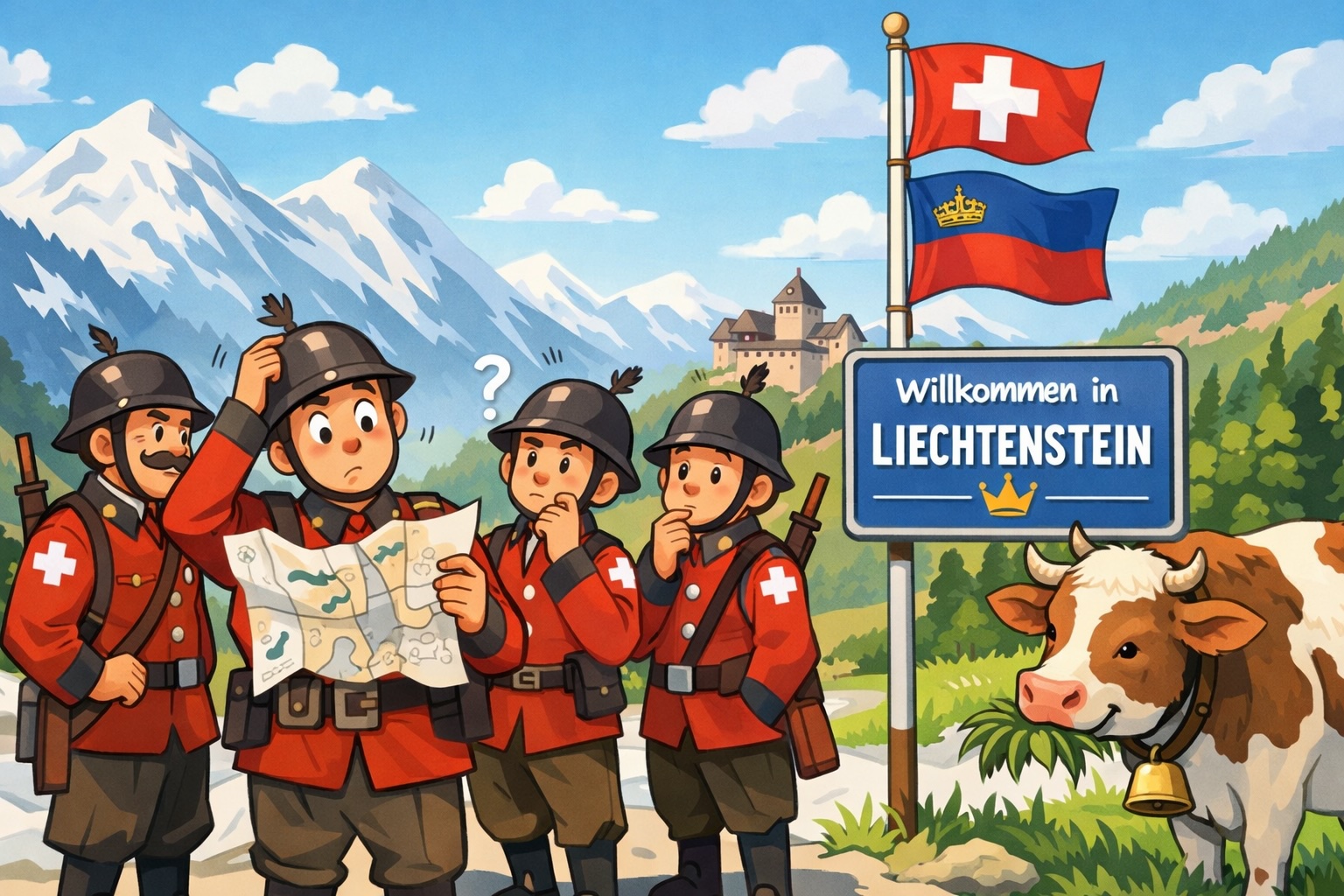
If you ever feel terrible at directions, remember this: Switzerland invaded Liechtenstein by accident. Not once. Not twice. Five times.
Nobody went to war. Nobody even shouted. Instead, “Switzerland invaded Liechtenstein” turned into one of Europe’s most low-stakes running jokes.
Tiny stage, big comedy
Liechtenstein is a small mountain principality between Switzerland and Austria, with about 40,000 residents, one royal family, and valleys that look hand‑picked for postcards.
Switzerland is the famously neutral neighbor. People associate it with precision, chocolate, and the word “no” whenever war comes up. So the idea that Switzerland invaded Liechtenstein multiple times already sounds like a punchline.
It gets even better when you know that Switzerland also helps guarantee Liechtenstein’s defense. The protector keeps tripping over the line it’s supposed to watch.
Let’s walk through the five accidental “invasions,” with exact dates and what actually happened.
1. 14 October 1968 – Shells hit Malbun
The first big mishap happened on 14 October 1968. During a Swiss artillery exercise, five shells landed in Malbun, Liechtenstein’s only ski resort.
The shells hit near the ski area and damaged a few chairs that belonged to an outdoor restaurant close to the Friedenskapelle (Peace Chapel). No one suffered injuries, but in a country that tiny, stray artillery feels very personal.
Liechtenstein filed a protest. Switzerland admitted the mistake and promised more care. Inside Switzerland, critics asked how a “routine exercise” had managed to hit a friendly neighbor at all.
2. 26 August 1976 – 75 soldiers and some packhorses
Late on the night of 26 August 1976, just before midnight, about 75 Swiss militia soldiers and several packhorses took a wrong turn during maneuvers.
They wandered roughly 500 meters into Liechtenstein, near Iradug in the municipality of Balzers. Locals noticed the unexpected visitors. Instead of panicking, people reportedly offered the soldiers drinks. The soldiers declined, realized their mistake, and headed straight back over the border.
It was less “invasion,” more “confused hiking group with rifles and horses.” Still, on paper, Switzerland invaded Liechtenstein again.
3. 5 December 1985 – Rockets and a forest fire
The incident on 5 December 1985 caused the most damage. During an anti‑aircraft exercise in a winter storm, Swiss rockets drifted off course into Liechtenstein.
They hit a protected forest area near Balzers and started a serious fire that destroyed part of the Bannwald. That forest didn’t just look pretty; it also acted as an avalanche barrier. Firefighters from both countries fought the blaze together.
Afterwards, Switzerland paid several million Swiss francs in compensation. Liechtenstein’s leaders warned that “good neighbor” status required better control of military exercises. Even then, both sides kept the tone practical rather than hostile.
4. 13 October 1992 – An observation post in the wrong country
On 13 October 1992, a much smaller Swiss group caused a very awkward moment. Swiss army recruits received written orders to set up an observation post in Triesenberg.
They followed the instructions exactly. They even asked a local resident if they could use her garage as part of their perimeter. She agreed but grew uneasy at the sight of heavily equipped soldiers in gas masks, so she called the police.
Here’s the twist: Triesenberg is not in Switzerland. It is a village in Liechtenstein. The officers who wrote the orders had simply overlooked that detail.
Once Liechtenstein pointed it out, Switzerland apologized and pulled the recruits back. No confrontation, no drama — just a very Swiss version of “wrong address.”
5. 1 March 2007 – 171 soldiers wander in at night
The most famous event took place on the rainy night of 1 March 2007. A company of about 170–171 Swiss infantry soldiers was on a training exercise near the border.
It was dark, visibility was poor, and the border in that area had no obvious markings. The soldiers marched more than 1.5–2 kilometers into Liechtenstein before anyone realized they had left Switzerland. They carried rifles but no live ammunition. As soon as they discovered the mistake, they turned around and went home.
The best part: Liechtenstein didn’t notice at the time. The principality only learned about the “invasion” when Switzerland phoned later to explain and apologize. A Liechtenstein spokesman joked, “It’s not like they invaded with attack helicopters,” and the matter ended there.
Why these “invasions” went viral
Look at the pattern and it becomes obvious why the internet loves this story.
- Every case came from routine Swiss military training, not hostility.
- No one died or suffered injuries, even in the serious 1985 fire.
- Switzerland apologized and, when needed, paid for the damage. Liechtenstein stayed calm and often treated it with humor.
We live in a world full of real conflicts. That makes a story like “Switzerland invaded Liechtenstein and they solved it with apologies, compensation, and dry jokes” feel almost unreal in the best possible way.
It is also a reminder that even countries with a reputation for precision still mess up. The difference lies in what happens afterwards.
What the border actually feels like
On the map, the Swiss–Liechtenstein border looks like a crisp line. On the ground, it often feels like scenery: a mountain ridge, a forest trail, or a quiet stretch of the Rhine.
In many places, no fence or wall marks the exact line. You might see a small sign, a boundary stone, or nothing obvious at all. Walk a little loop and you can go from one country to the other without noticing.
For locals, this is normal life. For young soldiers on night exercises with old‑school maps and bad weather, it becomes a recipe for “Wait… are we still in Switzerland?” Many people who trained near the border later admitted online that small, unnoticed crossings probably happened more often than anyone wrote down.
So when you hear “Switzerland invaded Liechtenstein,” imagine less Hollywood and more “we missed the invisible line by 2 kilometers.”
Quirky border moments and local stories
Beyond the five big incidents, border communities remember smaller, very human details.
Residents of Balzers still tell the story of that 1976 night when a column of Swiss soldiers and packhorses appeared out of the dark. People spoke with them, offered drinks, and then watched them clop politely back toward Switzerland.
In Triesenberg, the 1992 event lives on as “the evening with the soldiers in the garage.” From the local point of view, the sight of armed recruits with gas masks looked alarming at first. Once the mix‑up came to light, it shifted into an anecdote about paperwork and geography rather than aggression.
On social media, people from both countries often talk about how normal the relationship feels: daily cross‑border commuting, business links, and an open border that works quietly in the background. In that context, the idea that your only regular “security scare” is a Swiss training unit that lost its way becomes part of the region’s shared humor.
How Swiss neutrality and training fit in
Neutrality does not mean “no army.” Switzerland’s permanent neutrality became formal in 1815 at the Congress of Vienna and later entered international law through agreements like the Hague Conventions.
At the same time, Switzerland keeps universal male conscription and runs a fairly active army focused on territorial defense and crisis response. During the Second World War, the country mobilized heavily and developed plans such as the Alpine “Réduit” to defend itself if larger powers attacked.
All that requires constant training. Many of those exercises take place in the Alps or near borders, because that terrain matches real‑world scenarios. Combine that with poor visibility, complex maps, and young recruits, and you get the occasional international “oops.”
The key point: when mistakes happen, the system leans on diplomacy, compensation, and communication, not escalation. That is neutrality in practice, not just on paper.
Why Liechtenstein stays relaxed
Liechtenstein abolished its army long ago and now relies on diplomacy, partnerships, and economic strength. It coordinates closely with Switzerland on customs, border matters, and aspects of security.
So when “Switzerland invaded Liechtenstein” in each of these episodes, the invader was also the main security partner that guards the region. That does not make the mistakes harmless, especially in 1968 and 1985, but it changes the emotional temperature.
Liechtenstein protested after the shelling and the forest fire. It also insisted on better safety standards. Yet once Switzerland apologized and offered compensation, both sides had strong reasons to move forward without drama.
In a way, Liechtenstein responded like a calm neighbor saying, “We like living next to you. Please stop accidentally shelling our hillsides.”
Where this story fits in Swiss Heritage
At Swiss Heritage, we love stories that show Switzerland as more than a postcard. The saga of how Switzerland invaded Liechtenstein five times is a perfect example. It mixes human error, mountains, and the kind of diplomacy that relies on trust instead of threats.
If this mix of humor and history speaks to you, you may also enjoy our broader look at how Swiss neutrality actually works, from the defeat at Marignano in 1515 to the neutrality vote of 2026.
And if quirky Swiss stories are your thing, two more are worth your time. Our guide to the 26 Swiss cantons shows how the town of Moutier changed canton after a popular vote, and our investigation into whether Swiss bridges were rigged to blow reveals what the army really planned for its own borders.
Quick checklist: what to remember
- Five main incidents: 1968, 1976, 1985, 1992, 2007.
- All came from Swiss training exercises, not planned attacks.
- 1968: shells hit Malbun’s ski area.
- 1976: 75 soldiers and packhorses wandered into Balzers.
- 1985: rockets started a forest fire in a protected Liechtenstein forest.
- 1992: recruits set up an observation post in Triesenberg.
- 2007: 170+ troops marched around 2 km into Liechtenstein during a rainy night.
- Nobody died. Damage hit forests, infrastructure, and some pride, not people.
- Switzerland apologized and paid; Liechtenstein stayed friendly and even joked about it.
FAQs
How many times did Switzerland invade Liechtenstein by accident?
Sources list five notable cases: 14 October 1968, 26 August 1976, 5 December 1985, 13 October 1992, and 1 March 2007.
Did anyone get hurt during these incidents?
No injuries or deaths are reported for these five events. The most serious damage came from the 1985 forest fire in the Bannwald.
Which incident caused the worst damage?
The 5 December 1985 incident did. Swiss rockets started a forest fire in a protected area, and Switzerland later paid several million Swiss francs in compensation.
Why does this keep happening on that border?
The Swiss–Liechtenstein border runs through mountains and forests with few clear physical markers. Night training, bad weather, and human error make wrong turns surprisingly easy.
Is Switzerland still neutral if it runs so many exercises?
Yes. Neutrality means Switzerland does not join other countries’ wars or military alliances. It still maintains a conscript army and trains to defend its own territory.
Does Liechtenstein have its own army?
No. Liechtenstein abolished its army in the 19th century. It relies on diplomacy, police, and cooperation with partners such as Switzerland.
How did Liechtenstein react to the 2007 incident?
Officials downplayed it. A spokesman joked that it was not like the Swiss arrived with attack helicopters. They accepted the Swiss apology, and the story mostly lived on as a curiosity.
References
- Liechtenstein–Switzerland relations (incidents involving the Swiss military) – overview of all five accidental incursions with dates and locations.
https://en.wikipedia.org/wiki/Liechtenstein%E2%80%93Switzerland_relations - CBC – “Not-so-precise Swiss army unit mistakenly invades Liechtenstein” (2007) – coverage of the 2007 nighttime march into Liechtenstein.
https://www.cbc.ca/news/world/not-so-precise-swiss-army-unit-mistakenly-invades-liechtenstein-1.658642 - ABC News – “Whoops! Swiss Accidentally Invade Liechtenstein” (2007) – another report on the 2007 incident and Liechtenstein’s relaxed response.
https://abcnews.com/International/story?id=2921407&page=1 - Los Angeles Times archive – coverage of Swiss rockets causing a forest fire in Liechtenstein (1985) – details on the Bannwald fire and compensation.
https://www.latimes.com/archives/la-xpm-1985-12-08-me-15149-story.html - Liechtenstein-Institut – “Das Schweizer Militär beschiesst das Malbun – versehentlich!” – German article on the 1968 Malbun shelling.
https://liechtenstein-institut.li/news/das-schweizer-militar-beschiesst-das-malbun-versehentlich - We Are The Mighty – “3 times Switzerland accidentally invaded its neighbor” – popular summary of the 1985, 1992, and 2007 events.
https://www.wearethemighty.com/mighty-history/3-times-switzerland-accidentally-invaded-its-neighbor/