Switzerland is small on the map but enormous once you’re behind the wheel. You round a corner and suddenly there’s a turquoise lake below, a cluster of timber chalets above, and somewhere in the background, a mountain that doesn’t quite look real. That’s the thing about scenic drives in Switzerland — the beauty doesn’t wait to be found. It just appears.
This guide is for international tourists who want to experience Switzerland the way it deserves: slowly, with windows down and no fixed agenda. Whether you’re planning a full Swiss Alps road trip or fitting in a single-day loop between cities, these roads will change how you see this country entirely.
Why Switzerland Is Made for Road Trips
Most visitors assume Switzerland is best seen by train. The trains are extraordinary, no question. But the roads take you somewhere trains simply can’t — into the folds of the Alps, along cliff edges, through valleys that feel genuinely untouched.
Swiss roads are also exceptionally well-maintained. Mountain passes stay smooth throughout the summer months, road signs are clear, distances are short, and petrol stations appear exactly when you need them. For an international tourist picking up a rental car for the first time, it’s one of the most welcoming driving countries in Europe.
One practical thing to sort before you go: the Swiss motorway vignette. It’s a small sticker (around CHF 40) required for motorway driving, available at the border, petrol stations, or post offices. Get it sorted early — the fines for not having one aren’t worth the risk.
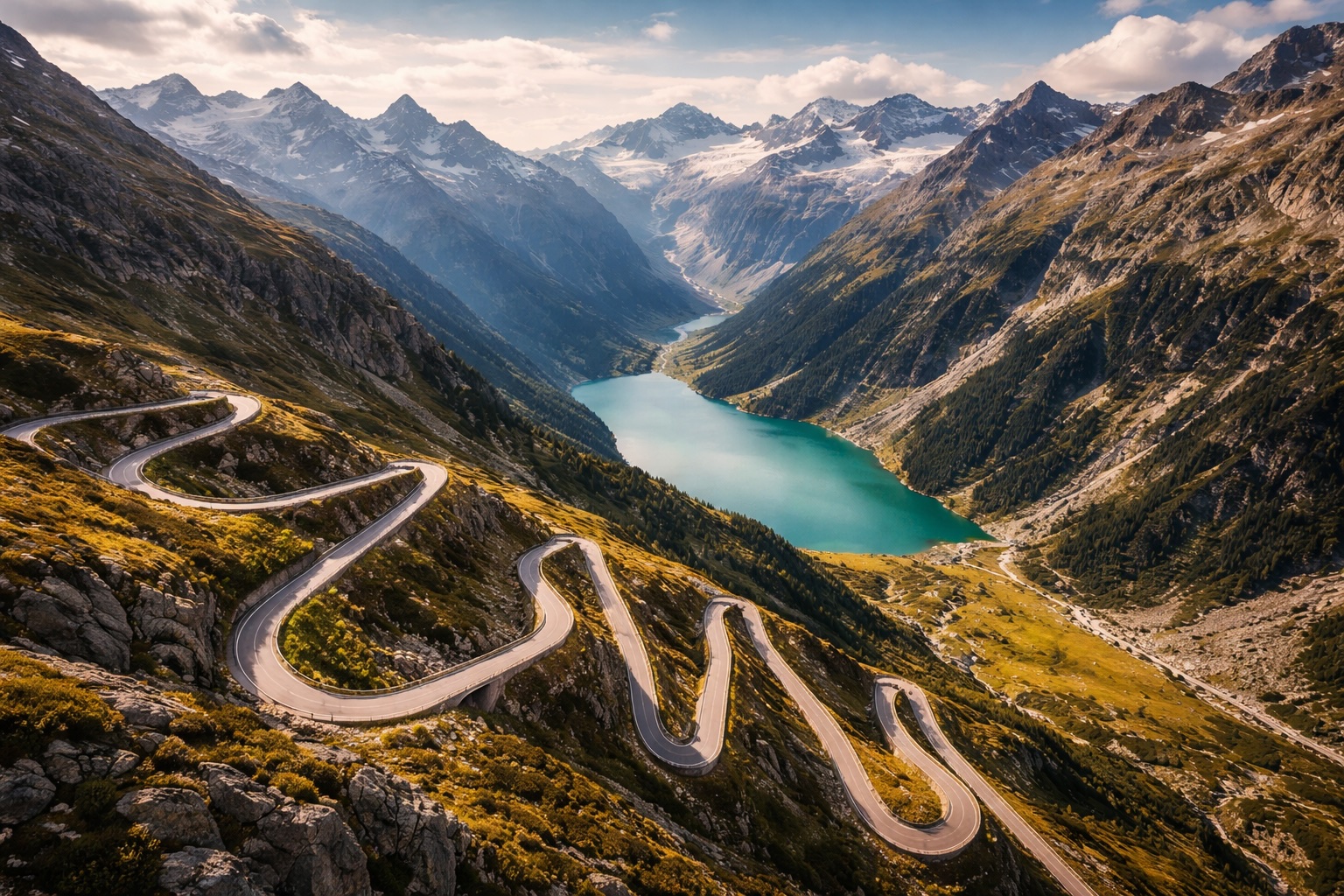
The Furka Pass: Switzerland’s Most Dramatic Mountain Drive
If you could only do one Swiss mountain drive in your life, the Furka Pass would make a strong case for itself.
Connecting the Urserental in Uri with the Goms valley in Valais, this high-altitude road climbs to 2,429 metres and earns every single one of them. From the summit, views stretch across glaciers and jagged ridgelines in four directions. James Bond famously drove an Aston Martin along this road — though honestly, a compact rental car handles the hairpin bends just as well, provided you take your time.
Stop near the Rhône Glacier viewpoint on the way up. The glacier has receded significantly over the decades, and what remains is both beautiful and sobering. The Furka Pass is typically open from late June through October, depending on snowfall. Outside those months, don’t count on it.
The Grimsel Pass: Ice, History, and Empty Roads
A short distance from the Furka, the Grimsel Pass offers something slightly different: a barren, almost lunar quality that surprises people expecting green-valley Switzerland.
At 2,164 metres, the road winds between dark granite walls and two striking reservoirs — Totensee and the Grimselsee — whose water sits in a deep, almost unnatural blue-green. On overcast days, the whole scene turns moody and cinematic. This is one of the best road trips Switzerland has to offer if you like routes that feel genuinely remote.
The pass also carries real history. French and Austrian forces clashed here in 1799, and a few quiet memorials still stand along the route. Driving through, you feel both the wild openness of the Alps and the weight of what these mountains have witnessed. That combination — raw beauty, quiet past — makes the Grimsel one of the most complete drives in the country.
The Bernina Pass: Where Switzerland Meets Italy
Head southeast to Graubünden for something completely different. The Bernina Pass connects St. Moritz with Tirano in Italy, crossing some of the most visually varied terrain in the entire Alps.
The drive climbs past Lago Bianco, a striking high-altitude reservoir sitting right on the European watershed — water on one side flows toward the Rhine, on the other toward the Po. From the 2,328-metre summit, the road sweeps downward in long, confident curves toward the palm trees and terracotta rooftops of the Italian side. You cross three climate zones in under two hours. It’s one of those drives where you genuinely feel the continent shift beneath you.
If you’re travelling in summer, keep an eye out for the Bernina Express train crossing the same route. It’s a UNESCO World Heritage railway, and spotting that iconic red train threading through the same pass you’re driving is one of those travel moments that sticks.
The Engadine Valley: High-Altitude and Quietly Spectacular
While most visitors focus on the passes, the Engadine Valley road deserves its own attention. Running through the Upper Engadine in southeastern Switzerland, this route connects the villages of Maloja, Sils Maria, Silvaplana, and St. Moritz along a chain of glacial lakes.
The light here is different — clearer, thinner, with a sharpness that explains why so many painters came to work in this valley. The road hugs the lakeshore for long stretches, then climbs through meadows above the treeline. In late summer, wildflowers cover the slopes in colours that feel almost excessive. The Maloja Pass at the western end adds a classic Alpine descent to complete the loop.
This route works beautifully as a morning drive before heading into St. Moritz for lunch. Traffic is lighter than the major passes, and the road quality is excellent throughout.
A Lake Geneva Loop: Gentler, but Just as Beautiful
Not every great scenic drive in Switzerland involves altitude. The Lake Geneva loop — circling the northern shore through Lausanne, Montreux, and Vevey before winding back through the Lavaux vineyard terraces — is one of the most underrated routes in the country.
The Lavaux terraces alone justify the detour. Carved into steep hillsides above the lake and dating back to the 11th century, they’re a UNESCO World Heritage site. In September and October during harvest season, the vines turn gold and amber and the whole hillside glows in the afternoon light. There’s a small cooperative near Chexbres where you can stop, buy a glass of local Chasselas, and sit on a stone wall looking out across the water to the Alps on the French side. No rush. Just wine and silence and a view that asks nothing of you.
This loop works perfectly as a one-day drive from Geneva or Lausanne and is accessible year-round — no snow closures, no vignette complications, no stress.
The Susten Pass: The One Most Tourists Miss
Ask Swiss driving enthusiasts which pass is underrated, and the Susten Pass comes up consistently. Connecting the Reuss valley in Uri with the Bernese Oberland’s Haslital, it carries significantly less traffic than the famous Gotthard route to the south.
The road is smoother, the views are wider, and the overall pace is more relaxed. Near the summit, two long road tunnels add an unexpected dramatic contrast — complete darkness for a few minutes, then suddenly you emerge into broad, bright alpine meadows. There’s also a viewpoint that faces directly toward the Steingletscher glacier, one of the most accessible glacier views from any public road in Switzerland.
For a half-day drive with minimal crowds, the Susten Pass is nearly impossible to beat. It pairs naturally with the Grimsel Pass to form a satisfying loop through some of the least-touristed mountain terrain in the country.
Practical Tips Before You Hit the Road
A few things worth knowing before you go:
- Swiss motorway vignette: Around CHF 40, valid for the calendar year, required on all motorways — buy it at the border or any petrol station.
- Pass openings: Most high passes open late May to early June and close by October. Always check current status at viasuisse.ch before heading up.
- Speed limits: 50 km/h in towns, 80 km/h on main roads, 120 km/h on motorways. Swiss speed cameras are reliable and fines are significant.
- Fuel: Fill up before entering remote alpine valleys. Some pass roads have no services for 30+ kilometres.
- Right of way: On narrow mountain roads, vehicles going uphill generally have priority. On single-track stretches, someone may need to reverse — Swiss drivers are usually patient about this.
- Alpine road conditions: Even in summer, temperatures at high altitude can drop sharply. Carry an extra layer, especially if you’re planning to stop at viewpoints.
Best Time for Each Route
| Route | Open Season | Best Month | Crowd Level |
|---|---|---|---|
| Furka Pass | Late June – Oct | September | Moderate |
| Grimsel Pass | Late May – Oct | August | Low–Moderate |
| Bernina Pass | Year-round* | July | Moderate |
| Susten Pass | June – Oct | September | Low |
| Engadine Valley | Year-round | August | Low–Moderate |
| Lake Geneva Loop | Year-round | October | Low |
*Bernina Pass can close briefly in heavy snow — always check alpine road conditions before departure.
FAQs
Do I need an international driving licence to drive in Switzerland?
Most EU/EEA and US licences are accepted for tourist stays under 12 months. If you’re travelling from outside those regions, carry an International Driving Permit alongside your national licence to avoid any issues at rental desks or checkpoints.
Is driving in Switzerland difficult for first-timers?
It’s genuinely manageable. Roads are well-signposted, lanes are clearly marked, and mountain pass routes have safety barriers in exposed sections. The main adjustment is getting comfortable with occasional narrow stretches on higher passes — take them slowly and you’ll be fine.
Can I drive mountain passes in a standard rental car?
Yes. In summer, most passes don’t require 4WD or specialist vehicles. Winter driving is a different matter — snow chains or winter tyres are essential on any Alpine route from November onwards, and some rental agreements require them.
How long does the Furka Pass take to drive?
The pass itself takes about 45 minutes to an hour without stops. With a break near the Rhône Glacier and a few photo stops, budget 2–3 hours to really enjoy it.
What’s the best scenic drive in Switzerland for nervous drivers?
The Lake Geneva loop is ideal — no mountain passes, no hairpin bends, smooth roads throughout. It’s beautiful, completely relaxed, and works perfectly for anyone who wants the scenery without the altitude.
Are Swiss mountain roads safe?
Very. Guardrails are well-maintained, road surfaces are consistently good, and Swiss road engineering is excellent. Keep to a sensible pace on the bends and you’ll feel at ease quickly.
Should I rent a car in Switzerland or bring my own?
Both work well. Rentals are available at all major airports and train stations. If you’re driving in from a neighbouring EU country, confirm your insurance covers Alpine driving conditions — some standard policies don’t include mountain passes by default.