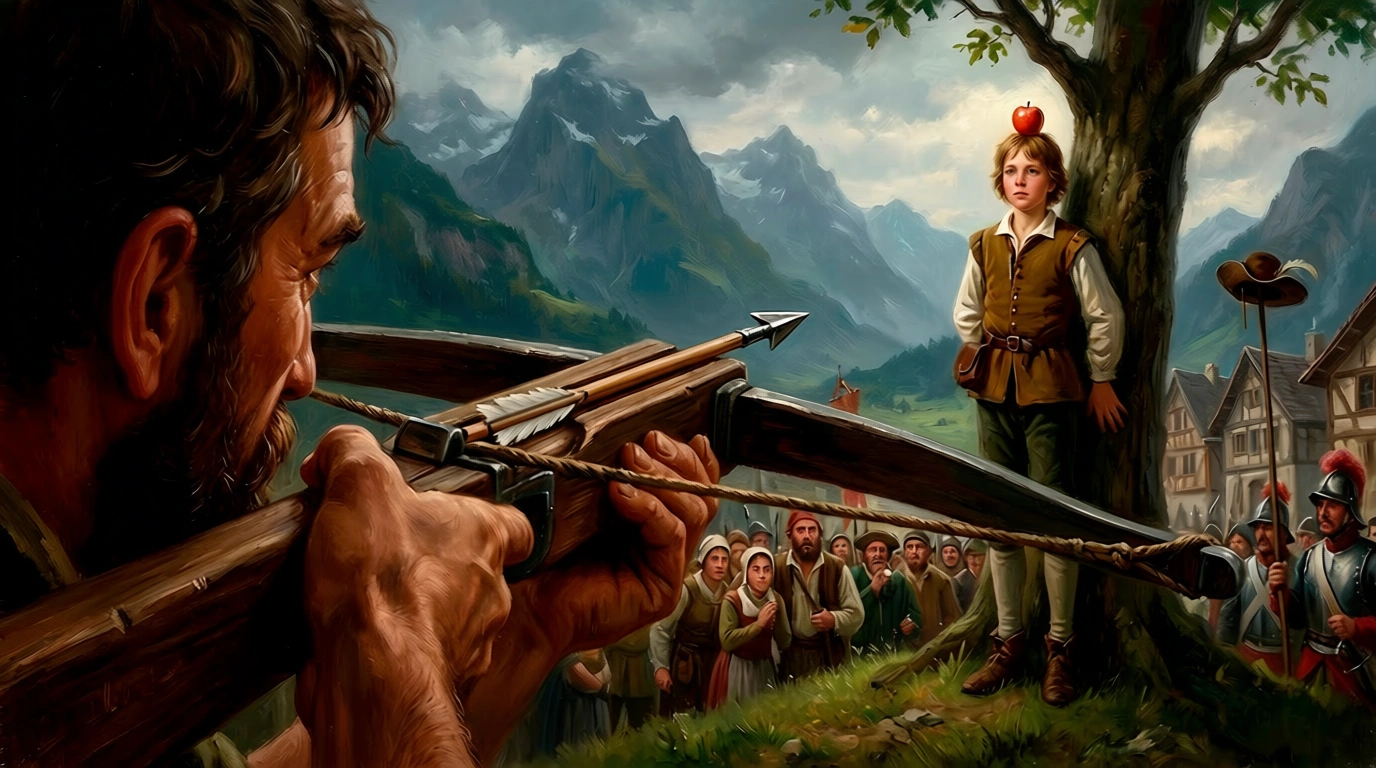
Every Swiss child grows up with the same image: a man in a mountain meadow, crossbow drawn, his son standing calm with an apple balanced on his head. One arrow. One shot. The apple splits cleanly in half. The boy is alive. The legend is born.
It’s 1307. Or maybe it’s not. The man’s name is William Tell. Or was it. Ask any Swiss person about their national hero, and they’ll tell you this story without hesitation. It’s woven into the fabric of Switzerland like the Alps themselves.
But here’s the problem: William Tell probably never existed.
The story of William Tell is one of history’s most successful myths—so successful that most people assume it must be true. Yet historians have spent centuries searching for evidence and found almost nothing. No records of a Tell. No documents mentioning a Gessler. The whole thing appeared in writing 150 years after it supposedly happened.
So how did a fabrication become a nation’s soul? And why does it matter if the man himself was never real?
The Story of William Tell: Myth vs. Reality — The legend dates to 1307, when Tell allegedly shot an apple from his son’s head to challenge Habsburg rule. However, the first written record appears in the White Book of Sarnen (1474)—over 150 years later. Historians found no contemporary records of “Tell” or the bailiff “Gessler” in Swiss archives. The apple-shot motif actually appears in older Scandinavian legends (particularly the Danish hero Toko, 10th century). Friedrich Schiller’s 1804 play Wilhelm Tell catapulted the legend into global consciousness, making it a symbol of liberty that inspired the French Revolution and American abolitionists. The verdict: Tell is almost certainly fictional, but culturally, he’s the truest Swiss who never lived.
The Historical Evidence (The Cold Hard Truth)
Let’s start with what we know for certain.
In 1474, a man named Hans Schriber—state secretary of the canton of Obwalden—sat down and began compiling important documents. He was creating a record book, now called the White Book of Sarnen, a collection of legal privileges, treaties, and historical accounts that would become the foundation of Swiss historical memory.
In this book, written 167 years after the supposed 1307 apple shot, Schriber mentions a man named Tell. Not much—just a passing reference to his “heroic deeds.” The account includes the apple shot, the crossbow, the second hidden arrow, and a connection to the Rütli Oath (the legendary founding moment of Switzerland). But notably, it doesn’t mention Tell actually assassinating Gessler. That detail got added later, by chroniclers who embellished the tale.
Now comes the awkward part. Historians have combed through the tax records, legal documents, and administrative files from Uri (the canton where Tell supposedly lived). They’ve found nothing. No “William Tell.” No “Thomas Tell.” No Tell family operating in that region in 1307. More significantly, they found no “Hermann Gessler” or “Albrecht Gessler”—the tyrannical bailiff who ordered the apple shot.
A bailiff definitely would have left a record. These officials collected taxes, issued decrees, made arrests. They had names in official documents. Yet Gessler vanishes from history entirely, as if he never existed.
Jean-François Bergier, a leading Swiss historian, investigated Tell’s origins in the 1990s and concluded: No historical evidence supports Tell’s existence as a real person. Other scholars found the same wall of silence.
“There is no historical evidence for them,” explains Schmidig Römer, a Tell guide at the chapel between Sisikon and Flüelen. “William Tell was mentioned for the first time in 1472 in the White Book of Sarnen, but in the archives there is no trace of anyone of that name.”
The legend, it seemed, had come from nowhere.
Then historians found where it actually came from.
The Viking Connection: The Smoking Gun
Sometime in the 10th century—around the 980s—a Viking leader named Palnatoki (sometimes spelled Toko) sat at a table with King Harald Bluetooth of Denmark. According to one account, Toko had drunk too much mead and made a boast: he was so skilled with a bow that he could shoot an apple off a stick from incredible distance.
King Harald heard this. And Harald, being a medieval monarch with a particular sense of humor, decided to test it.
But not with a stick. With a child.
Toko’s own son.
“Shoot the apple from your boy’s head,” the king commanded. “If you hit it, you live. If you miss, you both die.”
Toko took up his bow. He told his son to stand perfectly still. The boy looked away. Toko drew, aimed, and released the arrow. It split the apple cleanly. The boy was untouched.
When the king asked why Toko had carried two extra arrows hidden in his vest, Toko didn’t hesitate: “To kill you, sire, had I killed my son.”
King Harald found this answer perfectly reasonable. He laughed it off. But Toko was deadly serious. Years later, he did exactly that—he helped overthrow Harald and put the king’s son Sweyn Forkbeard on the throne.
The Toko legend comes from Saxo Grammaticus, a Danish historian who recorded it in his Gesta Danorum (Deeds of the Danes) in the late 12th century. That’s 130 years before the White Book of Sarnen mentioned Tell.
Historians now suspect Tell was borrowed wholesale from Toko. The details match too perfectly: the apple, the son, the second arrow, the defiant answer. It’s not coincidence. It’s cultural adoption.
But it gets stranger. The apple-shot motif shows up in multiple Germanic cultures. An English ballad from the 16th century tells of William of Cloudesley, who boasted he could shoot an apple from his seven-year-old son’s head. There’s also Egil in Icelandic legend, Hemming Wolf in Holstein, and others scattered across Northern Europe.
Some historians even suspect Persian origins. Around 1177, the Persian poet Farid du-Din Attar wrote about a master archer shooting an apple off his beloved servant’s head. The Vikings, who ranged far into Eastern trade routes, may have encountered this story and carried it back to Scandinavia. From there, it spread to Iceland, the Faroe Islands, and eventually down into Switzerland.
The theory goes like this: Maybe Danish pilgrims traveling to Rome stopped at an inn. Men from Uri were drinking there too. The Danes told the famous Toko story. The Uri men, listening to this powerful myth of defiance against tyranny, thought: This is our story. And they adapted it, replacing the Danish king with the Austrian bailiff, making it their own.
Why He Became the Ultimate Cultural Icon
Here’s what matters most: whether or not William Tell was real doesn’t change what he became.
In 1474, when Hans Schriber was writing down the Tell legend, Switzerland was in crisis. The country had recently formed the Confederacy (officially dating to 1291 with the Rütli Oath), and now it was fighting for survival. The Holy Roman Emperor still claimed authority over the Swiss cantons. Habsburg armies occupied parts of the region. Swiss independence was not guaranteed—it was contested, negotiated, fragile.
That’s when Tell appeared in the written record. He wasn’t born from ancient memory. He was born from immediate need.
Switzerland needed a symbol. It needed a story that said: We have always been free. We have always resisted foreign rule. This is not new. This is who we are.
Gessler’s hat on a pole—the moment Tell refuses to bow—encapsulated everything. It was defiance. It was the assertion that no foreign power could dictate conscience. It was the birth of Swiss independence personified in one crossbow shot.
Tell did something real people rarely do: he became instantly recognizable. Every Swiss child knew him. Plays were performed in villages. A bell dedicated to Tell hung in a chapel by 1581. Murals showed his face.
Then in 1507, Tell entered the printed word. A chronicler named Petermann Etterlin published an illustrated chronicle that featured the first ever picture of Tell shooting the apple. Now the legend had an image. It became visual, immortal, reproducible.
But Tell’s greatest transformation came in 1804.
Schiller’s Play: Tell Goes Global
A German playwright named Friedrich Schiller, living in Weimar and inspired by his wife’s knowledge of Switzerland, sat down to write a play about William Tell. Schiller was a historian as well as a dramatist—he knew the legend might be fiction, but he also knew it was perfect drama.
His play, Wilhelm Tell, premiered on March 17, 1804, at the Weimar Court Theater, directed by Johann Wolfgang von Goethe. It was published immediately in an edition of 7,000 copies.
The play transformed Tell from a Swiss provincial legend into a global symbol of freedom.
The timing was crucial. Europe was convulsing with revolutionary fervor. The French Revolution had just ended (1799), but its ideals remained alive. Schiller’s portrayal of Tell as a man who assassinates a tyrant to liberate his people spoke directly to the revolutionary moment. Here was a play about the justifiability of political violence, about resisting oppression, about ordinary people rising up against tyranny.
The play resonated across Europe. During the Napoleonic Wars, it kept German spirits alive. German-speaking intellectuals carried it with them when they emigrated. When these exiles landed in America in the 1800s, they brought Schiller’s Tell with them—and his revolutionary message influenced American abolitionists fighting slavery.
Victor Hugo read it. The French writer who would later pen Les Misérables—another story of ordinary people resisting injustice—admired Schiller’s Tell for its themes of liberty and heroism.
Even Hitler recognized Tell’s dangerous power. In 1941, after a young Swiss named Maurice Bavaud attempted to assassinate him (and was executed for it), Hitler banned public performances of Wilhelm Tell. The Nazis called Bavaud the “New William Tell.” Hitler himself reportedly said, with regret: “Of all people Schiller had to glorify this Swiss sniper.”
That single phrase reveals everything: Hitler understood that Tell represented something Hitler could not tolerate—the idea that ordinary people have a right to kill tyrants.
Schiller didn’t invent this idea. But he weaponized it through drama.
The Rütli Oath: Myth and Fact Collide
To understand why Tell matters to Switzerland, you need to understand the Rütli Oath.
In 1291—not 1307—three cantons (Uri, Schwyz, and Unterwalden) made a pact on a meadow called Rütli. This is documented. The pact still exists. It’s called the Bundesbrief (Federal Charter), and it’s Switzerland’s oldest historical document. It committed the three cantons to mutual defense against external threats, especially Habsburg aggression.
This is real history.
But here’s where myth and fact collide: the Tell legend got grafted onto the Rütli story. By the time the White Book was written in 1474, Tell was presented as one of the conspirators of the Rütli oath—the man whose crossbow defiance sparked the rebellion that led to the oath.
Except the oath came 16 years before Tell supposedly lived. The timeline doesn’t work. The story shouldn’t work. Yet it did, because narratively it makes perfect sense: the hero inspires the people, the people create the federation.
Modern Swiss education distinguishes between the two. The Rütli Oath (1291) is taught as historical fact. Tell (1307) is taught as legend—but a legend so culturally important that it functions as truth in the Swiss imagination.
Common Misconceptions About Tell
Myth #1: “If there’s no proof he was real, then the whole story is worthless.”
Not quite. Facts matter for history. But truth also matters for culture. Switzerland’s commitment to independence, resistance to tyranny, and willingness to defend freedom—that’s real. Tell is the perfect symbol for it, even if he’s fictional. Many nations have legendary founders (Arthur in Britain, Romulus in Rome). The legend’s power lies in what it represents, not in the biography of the man.
Myth #2: “So Switzerland was founded by nothing real?”
The Rütli Oath was real. The Confederacy was real. The resistance to Habsburg rule was real. Tell is the narrative lens through which Swiss people understand these real events. The events came first; the hero came second.
Myth #3: “Other countries don’t have fake legends too.”
Most do. But most don’t lean into them the way Switzerland does. The Swiss are relatively honest about the fact that Tell is a myth—they just don’t care. They’ve decided the myth is more true than the facts would be alone.
Frequently Asked Questions About William Tell
Sources & References
- Wikipedia: William Tell
https://en.wikipedia.org/wiki/William_Tell - Wikipedia: White Book of Sarnen
https://en.wikipedia.org/wiki/White_Book_of_Sarnen - Wikipedia: Wilhelm Tell (Schiller’s Play)
https://en.wikipedia.org/wiki/William_Tell_(play) - Wikipedia: Palnatoki
https://en.wikipedia.org/wiki/Palnatoki - Swiss National Museum Blog: “Tell’s Birth in the White Book of Sarnen”
https://blog.nationalmuseum.ch/en/2019/04/tells-birth-in-the-white-book-of-sarnen/ - Smithsonian Magazine: “In Search of William Tell”
https://www.smithsonianmag.com/history/in-search-of-william-tell-2198511/ - Wikipedia: Shooting an Apple Off One’s Child’s Head
https://en.wikipedia.org/wiki/Shooting_an_apple_off_one’s_child’s_head - Swiss Community: “Land of Myth and Glory: Why William Tell is So Important for Switzerland”
https://www.swisscommunity.org/en/news-media/swiss-revue/article/ein-einzig-land-von-mythen-warum-wilhelm-tell-und-der-ruetlisch - Tell-Film.com: History
https://tell-film.com/en/history/ - HistoryExtra: “William Tell: Was the Legendary Swiss Hero a Real Person?”
https://www.historyextra.com/period/medieval/william-tell-real-person-apple-true-story/